Did you know that for Australians over 65, falls remain a leading cause of injury-related hospitalizations, with the bathroom often being the highest-risk area in the home? It’s completely natural to feel a sense of hesitation or even fear when stepping onto wet tiles, especially when physical exhaustion makes standing for long periods a challenge. We understand that maintaining your personal hygiene is about more than just health; it’s about your dignity and the freedom to live life on your own terms.
By choosing the right shower chair, you can transform your bathroom into a secure sanctuary that preserves your independence. In this guide, we’ll help you discover how to select the perfect equipment to create a safer, more accessible space. We’ll explore the latest 2026 safety standards, explain how the new My Aged Care ‘Support at Home’ program impacts your choices, and provide practical advice on finding durable solutions that make every shower a stress-free experience. Our goal is to ensure you feel supported and informed as you enhance your home’s safety.
Key Takeaways
- Discover how specialized seating mitigates the high risk of slips on wet bathroom tiles and improves your daily stability and confidence.
- Learn to distinguish between stools, benches, and a shower chair to find the specific configuration that best supports your physical requirements.
- Identify key durability features, such as rust-proof aluminium frames and weight capacity ratings, to ensure your equipment remains safe for years to come.
- Navigate the latest 2026 NDIS and My Aged Care funding frameworks to access the bathroom aids you need while protecting your budget.
- Master simple maintenance routines and safety inspections to keep your assistive technology in peak condition for your continued independence.
Understanding the Role of Shower Chairs in Fall Prevention
We often view the bathroom as a place of relaxation, yet for many, it presents the most significant physical challenge within the home. A shower chair is a specialized piece of assistive technology designed to provide a stable, water-resistant seat for individuals who find standing difficult or unsafe. By moving the showering process from a standing position to a seated one, we can effectively remove the primary variables that lead to accidents. It’s not just a piece of furniture; it’s a tool for maintaining your lifestyle.
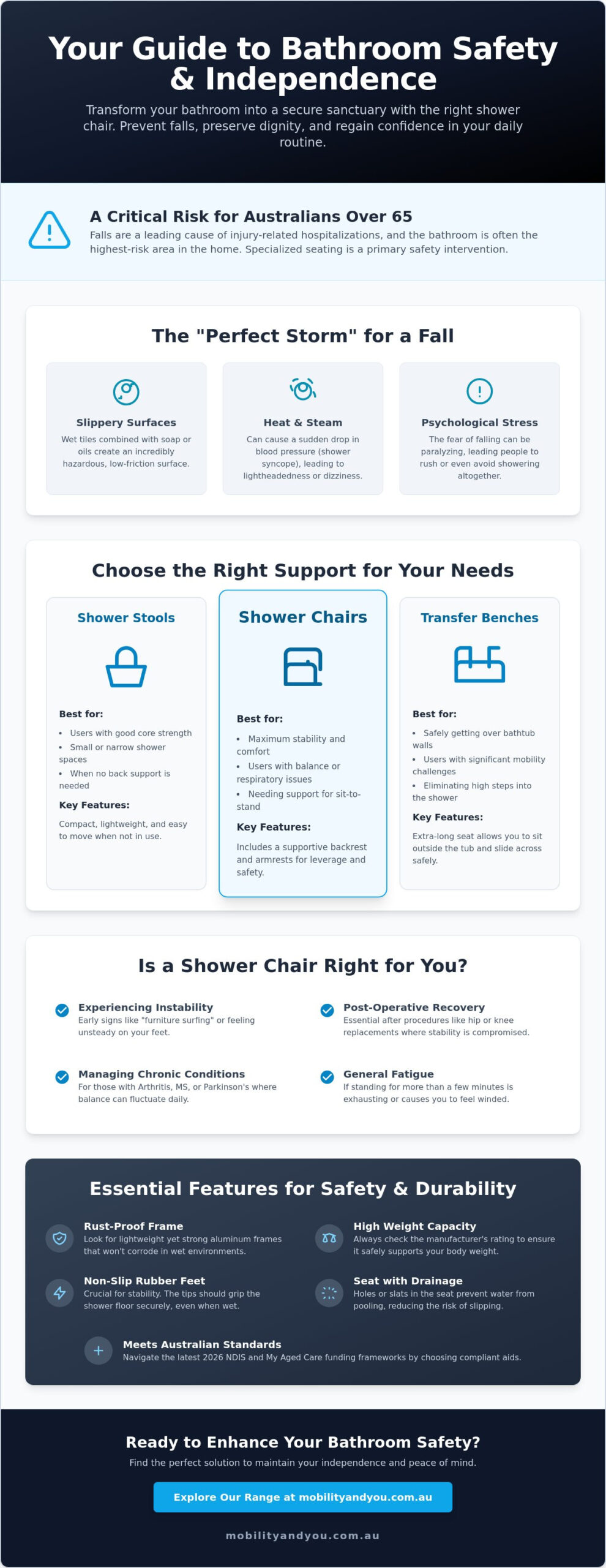
The mechanics of a bathroom fall are often a “perfect storm” of environmental factors. Wet tiles naturally lose their friction, and the addition of soap or bath oils creates a lubricated surface that’s incredibly difficult to navigate. Beyond the floor, the heat and steam of a shower can cause blood vessels to dilate. This often leads to a sudden drop in blood pressure or lightheadedness, known as shower syncope. When you’re seated, your center of gravity is lower and your body doesn’t have to work as hard to maintain balance, which significantly reduces the cognitive and physical load of your hygiene routine.
Who Should Consider Using a Shower Chair?
Recognizing the need for support early can prevent a minor slip from becoming a life-changing injury. We suggest looking for early signs of instability, such as “furniture surfing” or feeling winded after a few minutes of standing. This support is essential for those recovering from post-operative procedures like hip or knee replacements where stability is compromised. We also frequently work with individuals managing chronic conditions such as arthritis, Multiple Sclerosis, or Parkinson’s, where balance can fluctuate daily. In some instances, a person may require a transfer bench to safely bridge the gap over a bathtub wall. You can view our range of bathroom aids to see which options might suit your specific mobility level.
The Impact on Caregiver Safety and Wellbeing
Safety is a collective effort that involves the whole family. When a carer assists with showering, they often face immense physical strain while trying to steady someone on a slick surface. By using a chair, we facilitate “assisted independence.” This setup protects the carer from back injuries and reduces the risk of a “double fall” that could harm both people. A shower chair serves as a primary safety intervention in Australian homes by providing a stable, non-slip foundation that eliminates the need for precarious standing on slick bathroom surfaces.
Comparing Shower Chairs, Stools, and Transfer Benches
Shower Stools: Compact Support for Small Spaces
Stools are often the first choice for smaller apartments or ensuite bathrooms. They provide a compact footprint, making them ideal if your shower recess is narrow or has a corner design. We recommend stools for users who have good core strength and don’t require back support but find standing for ten minutes exhausting. Because these units are lightweight, they’re easy to move when other family members use the shower. To ensure complete stability, we suggest pairing these with non-slip mats to secure the floor area around the stool legs.
Shower Chairs: Maximum Stability and Comfort
A shower chair offers a higher level of security by including a backrest and, frequently, armrests. The backrest is a necessity for anyone with respiratory issues or balance disorders. It allows your body to fully relax without the risk of tipping backward during a dizzy spell. Armrests are equally vital; they provide the leverage needed for a safe sit-to-stand transition, which reduces the strain on your knees and hips. When browsing, you’ll see options with padded seats for skin protection or contoured plastic seats with drainage holes to prevent water pooling. If you live in a shared household, a folding shower chair can be stored easily, whereas a fixed-frame model provides the most robust support for daily use.
Transfer Benches: Bridging the Gap for Bath Users
For those who have a bathtub rather than a walk-in shower, a transfer bench is the primary solution. These benches bridge the gap over the bath rim, allowing you to sit down safely while still outside the tub and then slide across into the showering area. This design eliminates the dangerous “one-legged” balance act required to step over a high bath wall. It’s a game-changer for maintaining autonomy in older homes where a full bathroom renovation isn’t immediately possible. If you’re unsure which model fits your space, you can explore our full range of bathroom aids to compare dimensions and features.
Key Features to Evaluate Before You Buy
Finding the perfect shower chair involves looking beyond the surface to the technical specifications that guarantee long-term reliability. We believe that every detail, from the frame material to the grip of the feet, plays a critical role in your daily safety. By understanding these key features, you can make an informed choice that supports your physical needs without compromising on quality.
One of the most vital considerations is weight capacity. Standard models are typically rated for 100 to 120 kg, though some robust versions reach 150 kg. For those requiring extra support, bariatric or heavy-duty models are designed for users over 130 kg, with some rated to support up to 250 kg. Ensuring your equipment matches your body type prevents frame fatigue and provides the stable foundation you deserve. We also suggest looking for aluminium frames. Unlike steel, aluminium is naturally rust-resistant, which is essential in the high-moisture environment of a bathroom. It’s also lightweight, making it much easier for you or a carer to move the chair when cleaning.
Stability also depends on what’s touching the floor. High-quality rubber ferrules, or feet, should have a wide base and a suction-like grip to prevent the chair from “walking” on wet tiles. Additionally, the 2021 update to Australian Standard AS 1428.1 suggests a 30% luminance contrast for fixtures. This can be incredibly helpful if you have low vision and need to clearly distinguish the chair from your shower tiles. To ensure the best ergonomic fit, adjust the seat to your “popliteal” height. This is the distance from the floor to the crease at the back of your knee. When adjusted correctly, your feet should rest flat on the floor with your knees at a comfortable 90-degree angle, making it much easier to stand up safely.
Material Choice and Hygiene Maintenance
We prioritize hospital-grade plastics and treated metals because they stand up to daily use and rigorous cleaning. These materials are non-porous, which helps prevent the buildup of bacteria and mould in the damp shower environment. Drainage holes are a primary safety feature rather than just a design choice, as they prevent water from pooling on the seat and causing the user to slide or hydroplane. Choosing a model with smooth, accessible surfaces ensures that your bathroom aids remain hygienic with minimal effort.
Seat Ergonomics and User Comfort
The shape of the seat significantly impacts how long you can sit comfortably. Contoured seats help distribute your weight evenly, which is vital for pressure relief if you have limited mobility. For those who require assistance with personal hygiene, “U-shaped” or hygiene cut-outs allow for easier access without the need to stand up. If you have particularly sensitive or thin skin, we recommend looking for optional closed-cell foam padding. This provides a soft barrier that protects skin integrity while remaining water-resistant and easy to sanitize.
Navigating Funding and Acquisition in Australia
Securing the right equipment involves more than just a purchase. It’s about finding the most sustainable path for your budget through the Australian healthcare landscape. Whether you’re working within the National Disability Insurance Scheme (NDIS) or the My Aged Care system, understanding your entitlements is the first step toward a safer home. As of July 1, 2026, the NDIS categorizes most assistive technology like a standard shower chair as low-cost equipment if it’s priced under $1,500. This often means you can purchase these items directly using your core or capital budget without a lengthy approval process.
The landscape is shifting with the new NDIS planning framework introduced in July 2026. A critical change to remember is that unspent funds no longer roll over to your next plan. This makes it vital to address bathroom safety concerns promptly during your current plan cycle. For those using My Aged Care, the ‘Support at Home’ program, launching October 1, 2026, will fully fund personal care services as ‘clinical support.’ This change removes previous co-contribution requirements for showering assistance, making professional support more accessible than ever before. Many families also find it beneficial to consider a comprehensive approach to home safety that extends beyond the bathroom; a lift chair and adjustable bed package Brisbane residents can access through the same funding pathways offers a 24-hour support system that complements your bathroom aids.
Accessing NDIS and Government Support
Including your safety requirements in your NDIS plan review is essential for long-term support. We recommend speaking with an Occupational Therapist (OT) to provide a formal recommendation, especially for mid-cost items between $1,500 and $15,000. An OT’s assessment ensures the equipment meets the ‘reasonable and necessary’ criteria by documenting how a specific chair improves your daily function and safety. You can find more details on our NDIS information page regarding how we support participants and practitioners with these assessments.
The Benefits of Equipment Hire
Buying isn’t always the best first step. If you’re recovering from a temporary injury or a recent surgery, our equipment hire services offer a flexible, cost-effective alternative. Hiring allows you to test different models in your own bathroom before committing to a permanent purchase. This is particularly useful for those transitioning between care levels or waiting for a permanent home modification. For a step-by-step look at the process, read our guide on how to hire a shower chair to ensure you get the right fit for your home.
If you’re feeling overwhelmed by the paperwork, our team can help you find the right bathroom aids to suit your specific funding package.
Long-Term Care and Integration with Other Bathroom Aids
We’ve explored how to select and fund your shower chair, but its long-term effectiveness depends on how it integrates into your daily life. A single aid is rarely a complete solution; rather, it’s a vital component of a broader safety strategy within your home. We want to help you create a bathroom environment where every movement feels supported and every transition is predictable. This holistic approach ensures that your independence isn’t just maintained in the shower, but across every square inch of the room.
Correct positioning is a simple yet critical factor in your daily routine. We recommend placing your seat so that you have ample room to maneuver a walker or wheelchair close to the chair before transferring. For those who rely on a wheelie walker to move safely between rooms, ensuring there is sufficient clearance to park it beside the shower entry makes the entire transfer process far more predictable and secure. It’s also important to ensure the chair doesn’t block the natural drainage of the shower floor. Stagnant water can create a hidden slipping hazard when you eventually stand up to exit the recess. By thinking through these small details, we can prevent accidents before they have a chance to occur.
The Holistic Bathroom Safety Suite
Think of your bathroom as a sequence of movements that require different levels of support. A grab rail placed strategically near the shower entrance provides the initial stability needed to reach your seat safely. For many of our clients, safety in the shower is closely linked to safety near the toilet. Complementing your chair with an over toilet aid ensures that the transition between different areas of the bathroom remains consistent and secure. Similarly, raised toilet seats can significantly reduce the physical effort required for sit-to-stand movements throughout the day, preserving your energy for the activities you enjoy most. Extending this thinking beyond the bathroom, pairing your shower chair with a lift chair and adjustable bed package creates a seamless 24-hour support system that protects your mobility and independence from morning to night.
Maintenance for Safety and Longevity
Even the highest-quality equipment requires regular attention to remain reliable. We suggest a weekly cleaning protocol to prevent soap scum and mineral deposits from building up on the seat’s non-slip surfaces. Over time, these residues can make the plastic surprisingly slick, even if it has drainage holes. You should also perform a monthly check on the rubber ferrules. If the tread on the feet looks worn or the rubber feels brittle, it’s time for a replacement to maintain that essential high-grip suction on wet tiles.
Always check for any “wobble” by ensuring all four legs are clicked into the exact same height setting. A single notch difference can compromise the frame’s integrity and your balance. If you notice any hairline cracks in the plastic or if the frame feels less rigid than usual, it’s a clear indicator that an upgrade is necessary. For total peace of mind, you can always reach out for professional servicing and repairs to ensure your shower chair and other aids meet our rigorous safety standards. We’re here to support you through every stage of your mobility journey.
Taking the Next Step Toward Bathroom Safety
Your bathroom should be a place of comfort, not a source of anxiety. By choosing a high-quality shower chair and integrating it into a holistic safety plan, you’re investing in your long-term autonomy. We’ve seen how the right equipment, paired with the latest 2026 funding support through NDIS and My Aged Care, can remove the physical and mental barriers to maintaining personal hygiene. Small changes today can prevent significant injuries tomorrow, giving you and your family lasting peace of mind.
As a Registered NDIS Provider, our team is here to help you navigate these choices with compassionate, expert advice. We stock trusted quality brands including Aspire and Redgum to ensure your equipment is as durable as it is supportive. Whether you’re looking for a permanent solution or a short-term hire, we’re committed to your safety as a trusted regional partner. Explore our range of high-quality bathroom aids at Mobility and You today. We look forward to helping you reclaim your confidence and independence in the home.
Frequently Asked Questions
Is a shower chair better than a shower stool?
One isn’t necessarily better than the other; rather, they serve different mobility levels. A shower chair is often the superior choice for individuals who require back support or armrests to assist with balance and standing. Stools are ideal for those with strong core stability who simply need a place to rest in a confined space. We always recommend assessing your specific fatigue levels before choosing the right fit for your home.
Will a shower chair fit in my small shower recess?
Most standard chairs are designed to fit within a typical Australian shower footprint, but measuring your space is essential. If your recess is particularly narrow, a compact stool or a folding model might be a more practical solution. We suggest checking the width between the legs of the shower chair to ensure it sits flat on the floor without resting on the sloping edges of the shower tray.
What is the weight limit for a standard shower chair?
Standard models are generally rated for a capacity between 100 kg and 120 kg, though some reinforced versions support up to 150 kg. For users who require more robust support, bariatric models are specifically engineered for weights over 130 kg and can reach limits of 250 kg. Always verify the manufacturer’s rating on the frame to ensure the equipment provides a safe and stable foundation for your daily needs.
Can I use a regular kitchen chair in the shower?
We strongly advise against using household furniture in the shower as it poses a significant safety risk. Kitchen chairs aren’t water-resistant and can quickly rust or develop mould, compromising their structural integrity. More importantly, they lack the specialized non-slip rubber feet required to remain stable on wet tiles. Assistive equipment is purpose-built with non-corrosive materials to protect your safety and maintain hygiene in damp environments.
How do I know what height to set my shower chair at?
The most ergonomic height is determined by your “popliteal” measurement, which is the distance from the floor to the crease at the back of your knee. When you sit, your feet should rest flat on the floor with your knees bent at a 90-degree angle. This position provides the best leverage for standing up and reduces the strain on your joints. We can help you adjust your equipment to this specific height during a personalized consultation.
Are shower chairs covered by the NDIS or My Aged Care?
Funding is available through both schemes depending on your eligibility and plan goals. Under the NDIS, these are typically considered low-cost assistive technology if they’re under $1,500. For older Australians, the ‘Support at Home’ program starting October 1, 2026, will streamline access to bathroom aids by removing co-contribution requirements for personal care. We recommend discussing these requirements with your Occupational Therapist to ensure the equipment is included in your plan.
How often should I replace the rubber feet (ferrules) on my chair?
You should inspect the rubber feet on your chair every month to ensure they remain in peak condition. If you notice the tread has worn smooth, the rubber feels brittle, or the chair has started to slide, it’s time for a replacement. Maintaining these high-grip tips is vital for preventing the chair from moving on wet surfaces. We keep these components in stock to help you maintain your equipment’s safety and reliability.
Can I hire a shower chair for a few weeks after surgery?
Hiring is an excellent, cost-effective option for short-term recovery periods following procedures like hip or knee replacements. It allows you to access professional-grade equipment without the commitment of a permanent purchase while your mobility is temporarily limited. We offer flexible hire terms to ensure you have the support you need for as long as your rehabilitation requires. This is a practical way to maintain your independence during your recovery journey.