What if the most significant improvement to your daily safety isn’t a complex home renovation, but a simple adjustment to your bathroom’s geometry? For many Australians, the standard height of a toilet can suddenly feel like a barrier to privacy and dignity. It’s a common struggle to feel steady while sitting down or standing up, and that uncertainty often leads to a genuine fear of falling in the one place where you should feel most at ease. Choosing a raised toilet seat is a practical, clinical step toward reclaiming your confidence and maintaining your personal agency at home.
We believe that every person deserves to feel secure in their own space. In this guide, we’ll help you find the ideal solution to enhance your bathroom safety and ensure a stable seating surface that fits your specific toilet shape. You’ll learn exactly how to determine whether a 5cm, 10cm, or 15cm height is right for your physical requirements. We’ll also touch on how Australian funding pathways, such as the NDIS and My Aged Care, can help make these vital home modifications more accessible. For families looking to navigate these services, Aged Care Made Easy is an excellent resource to find and connect with local aged care providers, ensuring you have the support needed to live life on your own terms.
Key Takeaways
- Learn how to accurately measure your toilet bowl and determine whether a 5cm, 10cm, or 15cm height best supports your unique physical requirements.
- Discover why we view a raised toilet seat as a vital clinical tool that reduces joint strain and restores your confidence in the bathroom.
- Compare the functional benefits of bolt-on, clip-on, and padded models to find the most secure and comfortable fit for your home.
- Explore the pathways for financial support, such as VAT relief and local council grants, that help make high-quality bathroom aids more accessible.
- Decide between short-term equipment hire for post-injury recovery and purchasing a permanent solution for long-term independence and hygiene.
Understanding the Benefits of a Raised Toilet Seat for Safety and Independence
A raised toilet seat is far more than a simple bathroom accessory; it’s a vital category of assistive technology devices designed to bridge the gap between physical limitation and personal freedom. For many of us, the standard height of a household toilet is surprisingly low. This creates a significant “drop” distance that requires intense muscle control and joint flexibility to manage safely. By increasing the height of the seating surface, we effectively reduce the physical demand on your body, making the transition from standing to sitting controlled and secure.
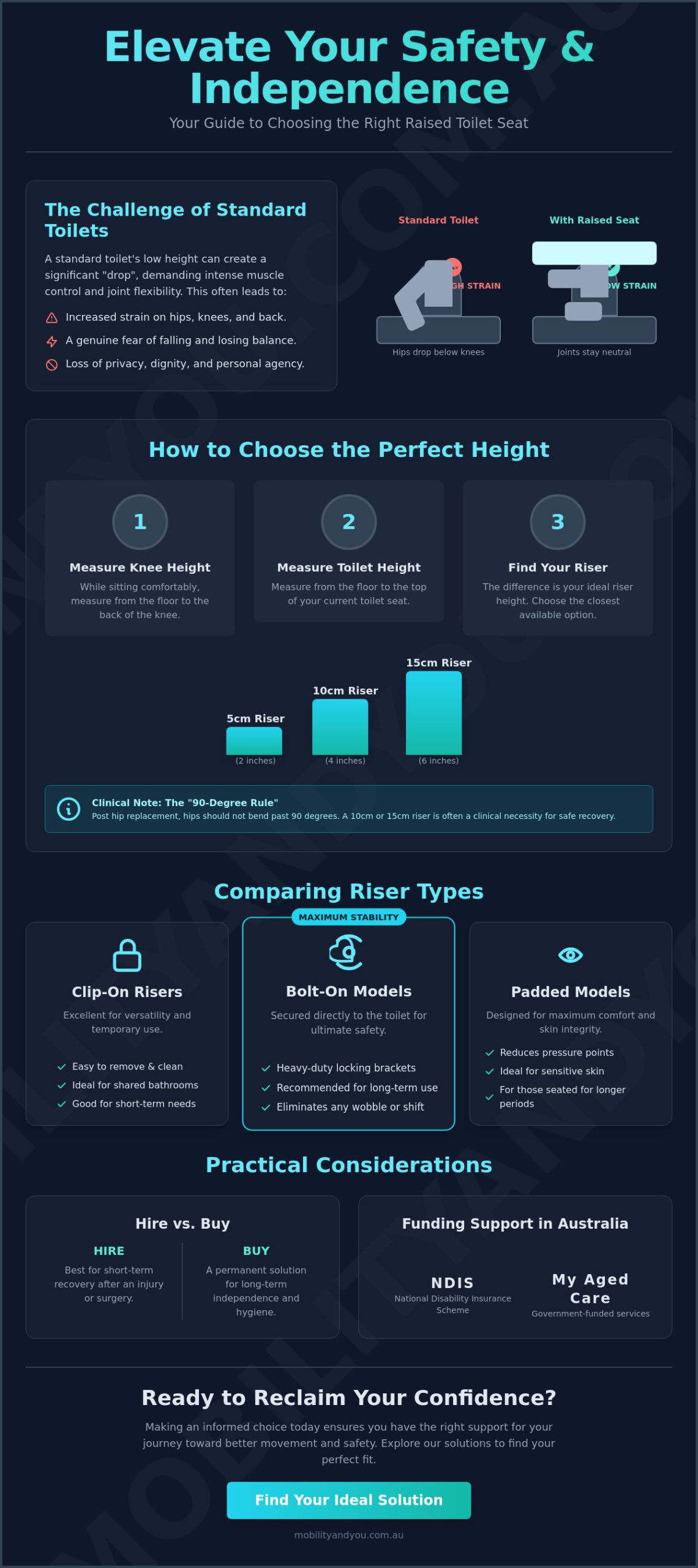
The biomechanical benefits are clear. When you sit on a low surface, your hips often drop below your knees, placing immense strain on the lower back, hip sockets, and knee ligaments. A riser keeps your joints in a more neutral position. This is especially crucial for preventing bathroom-related falls, which are a leading cause of injury at home. A stable, elevated surface provides a predictable point of contact, giving you the confidence to move without the fear of losing your balance or collapsing onto the seat. We see this as a proactive step in preserving your long-term mobility, much like how wellness tools from elitechairs.com.au can help manage daily muscle fatigue and joint stiffness.
Restoring Dignity Through Better Accessibility
Maintaining privacy in the bathroom is essential for your mental well-being and self-esteem. It’s a deeply personal space, and the ability to use it without assistance is a key part of maintaining your autonomy. We’ve found that modern, ergonomic designs have moved away from the cold, clinical looks of the past. Today’s options are discreet and blend seamlessly into your home environment. By installing a raised toilet seat, you can often delay the need for more intensive daily assistance, allowing you to stay in the home you love while keeping your personal care routines private.
Common Use Cases: From Post-Surgery to Chronic Conditions
Specific physical requirements often dictate the type of support you need. For example, patients recovering from a Total Hip Replacement (THR) are typically advised to follow the “90-degree rule,” where the hip should never bend more than a right angle. In these cases, a 10cm or 15cm riser isn’t just a comfort choice; it’s a clinical necessity for a safe recovery. Those managing chronic, degenerative conditions like Parkinson’s or severe osteoarthritis also find that the extra height compensates for reduced muscle power and balance issues.
Whether your challenge is a temporary recovery or a permanent change in mobility, the right aid makes a world of difference. If you’re unsure which height or style suits your specific diagnosis, we invite you to explore our resources for further guidance on selecting equipment that aligns with professional occupational therapy standards. Making an informed choice today ensures you have the right support for your journey toward better movement and safety.
Comparing the Different Types of Toilet Seat Risers
We understand that choosing a raised toilet seat isn’t just about adding height; it’s about finding a configuration that matches your physical strength and your bathroom’s layout. There are several types of elevated toilet seats available, each serving a unique purpose. Whether you need a permanent fixture for long-term safety or a temporary aid for post-operative recovery, the choice usually falls into three categories: bolt-on models, clip-on risers, and over-toilet frames.
Basic plastic risers are durable and easy to sanitize, making them a standard choice for many households. However, if you have sensitive skin or spend longer periods seated, a soft-padded comfort model might be better. These padded versions reduce pressure points, which is a critical consideration for maintaining skin integrity. We often see that a small change in material can lead to a significant increase in daily comfort and willingness to use the aid.
Basic Clip-On vs. Fixed Bolt-On Models
Clip-on risers are excellent for their versatility. They’re best for easy removal and cleaning, which is helpful if you share a bathroom with others or only need the aid temporarily. On the other hand, bolt-on models offer the maximum stability. They’re secured directly to the porcelain using heavy-duty locking brackets. We often recommend these for users with significant balance impairment because they won’t shift or wobble, even during a heavy transfer. When choosing these, look for security features like anti-slip pads to ensure the seat remains locked in place.
Raised Seats with Integrated Arms
Sometimes, height alone isn’t enough to ensure safety. If you struggle with the strength to push up from a seated position, a model with built-in handles provides essential leverage. These integrated arms act like a stable support system right where you need it most. When selecting these, it’s vital to consider weight capacity. Bariatric-rated toilet seat raisers are designed with reinforced materials to support higher weight limits safely. You should also check if you need width-adjustable arms. Fixed-width models might feel restrictive, while adjustable versions allow you to customize the space to your body type.
For those who still enjoy traveling or visiting family, portable models are a practical option. They’re lightweight and easy to pack. However, they rarely offer the same weight capacity or locking security as a residential installation. If your home setup is permanent, a fixed raised toilet seat is usually the safer, more robust choice. If you’re ready to see these different styles in person, you can browse our full range of bathroom aids to find the perfect fit for your home.
How to Measure and Choose the Right Fit for Your Home
Selecting the correct raised toilet seat is a precise process that balances your physical dimensions with the specific geometry of your bathroom fixtures. We’ve seen many families choose a model based on height alone, only to find it doesn’t quite suit the user’s body or the toilet bowl’s shape. To get this right, we start with the “90-degree rule.” This clinical standard ensures your hips remain slightly higher than your knees when seated. If your knees sit higher than your hips, you’re still placing excessive strain on your joints, which defeats the purpose of the aid. When you’ve been assessed as needing a raised toilet seat, achieving this specific alignment is our top priority for your safety.
Most high-quality risers are available in three standard increments: 5cm (2-inch), 10cm (4-inch), or 15cm (6-inch). Choosing between these isn’t a matter of “the higher the better.” A seat that’s too high can be just as dangerous as one that’s too low. If your feet can’t rest flat on the floor, you lose the stability needed to stand up safely, and the pressure on the underside of your thighs can restrict circulation. We also emphasize checking the weight capacity of every product. It’s vital to match the manufacturer’s rating to your specific requirements to ensure the structure remains stable under daily use.
Compatibility with Modern Toilet Designs
Modern bathroom aesthetics have introduced a variety of shapes, including D-shaped, square, or rimless toilet suites. These designs often require specialized mounting hardware. Before you buy, identify if your current toilet has top-fix hinges, where the screws go in from the top, or bottom-fix hinges that you bolt from underneath. A secure, wiggle-free fit depends entirely on this compatibility. We also recommend measuring the internal bowl diameter. If the riser’s underside doesn’t sit snugly within the rim, it may shift during a transfer, which creates a significant fall risk. Pairing your raised seat with a quality non slip mat on the bathroom floor adds another critical layer of protection against slips and falls during transfers. If you’re unsure about your toilet type, our resources page offers further guidance on identifying home fixtures.
Calculating Your Ideal Elevation
To find your ideal height, measure the distance from the back of your knee to the floor while wearing your usual indoor footwear. Subtract the height of your current toilet seat from this number to find the required rise. While this calculation provides a great starting point, every person’s range of motion is different. We always suggest consulting with an Occupational Therapist (OT) for precise measurements. They can evaluate your balance and strength in real-time, ensuring the height we provide supports your independence without introducing new risks. This professional oversight is a key step in creating a truly accessible and dignified home environment. For a comprehensive approach to bathroom safety, pairing your raised toilet seat with a well-chosen shower chair can further reduce your risk of falls across all wet areas of the bathroom.
Practical Considerations: Hire vs. Buy and Funding Options
We believe that choosing between acquiring a permanent fixture or opting for a temporary solution is a decision that should prioritize your specific recovery timeline and financial comfort. If you’re managing a temporary change in mobility, such as the standard six-week recovery period following a total hip replacement, equipment hire is often the most practical and cost-effective path. It allows you to access high-quality bathroom aids without the full upfront investment of a permanent purchase. This flexibility ensures you have the support you need exactly when you need it, without cluttering your home once your strength returns.
When you rent from a trusted regional partner, you receive the peace of mind that comes with clinical-grade sanitization. Every raised toilet seat in our hire fleet undergoes a rigorous cleaning process to meet strict hygiene standards, ensuring it’s safe for immediate use. Renting is also an excellent solution for accommodating visitors who may have specific accessibility needs during their stay. While hire fees are manageable for short durations, we typically suggest that if your need extends beyond three months, purchasing a seat outright becomes the more economical choice over time.
The Hire Option for Short-Term Recovery
Renting is ideal for those “in-between” moments in life. Whether you’re hosting a relative with limited mobility or recovering from a minor injury, hire services provide professional-grade equipment with minimal commitment. We ensure every item is checked for structural integrity and bracket wear before it reaches your door. This approach is particularly helpful for families who want to test a specific height or model before committing to a permanent installation.
Navigating Funding and Professional Advice
Accessing the right support shouldn’t be a hurdle. If you have an NDIS plan, you can often use your funding for assistive technology like a raised toilet seat under the “Consumables” or “Core Supports” budget categories. Similarly, those using My Aged Care packages can work with their providers to include these aids in their home modification plans. Our team works closely with Occupational Therapists to ensure the equipment we provide matches the clinical prescription exactly. You can find more resources and guides on our website to help you prepare for a home safety assessment.
Maintaining your equipment is just as important as the initial selection. We recommend checking the mounting brackets for any signs of loosening or wear every few months to ensure the seat remains wiggle-free. Use non-abrasive, hospital-grade disinfectants to keep the surface clean without damaging the integrity of the plastic. If you’re ready to discuss your specific needs or need help navigating your funding options, please contact our compassionate team for personalized assistance.
Finding Your Ideal Toileting Solution with Mobility and You
We believe that every interaction regarding your personal care should be handled with the utmost respect and sensitivity. Selecting a raised toilet seat is a clinical decision, but it’s also a deeply personal one that affects your daily comfort and confidence. Our team takes pride in being more than just a retailer; we’re a supportive community partner dedicated to helping you find the exact fit for your lifestyle. We curate our range from the highest quality Australian and international brands to ensure that every product we offer meets rigorous safety standards and provides long-term reliability. This hands-on approach ensures you don’t have to tackle these choices alone.
Our commitment to your independence doesn’t end once you’ve made a selection. We offer ongoing servicing and maintenance to ensure your equipment remains in peak condition. Whether it’s checking for wear in the mounting brackets or ensuring the structural integrity of a frame, we’re here to provide the technical expertise that keeps your home environment safe and secure. We understand that even the most robust aids require regular checks to maintain their safety. By choosing a local partner, you gain access to face-to-face service and a team that values your long-term well-being over a simple transaction.
Expert Guidance for Every Household
We offer personalized consultations to match equipment to your specific bathroom layout. Every home is different, and we take the time to understand the nuances of your space and your physical requirements. Our long history as a trusted partner for families and healthcare professionals allows us to provide solutions that prioritize your dignity and agency above all else. We’ve spent years building relationships within our regional healthcare landscape, ensuring that our advice is both clinically sound and deeply compassionate. We prioritize the goal of movement and autonomy in every recommendation we make.
Next Steps for a Safer Bathroom
If you’re ready to explore the options we’ve discussed, you can browse our full range of bathroom aids online. We also encourage you to visit our resources page for more detailed information on home safety assessments and equipment selection. This central hub provides further clarity on how different assistive technologies can work together to create a truly accessible home. We’re here to support your journey toward better movement and safety. Contact our team today to discuss your mobility needs and let us help you reclaim your independence. We look forward to meeting you and helping you find the perfect raised toilet seat for your home.
Empowering Your Home Safety Journey
Restoring your independence starts with making informed choices about the equipment that supports your daily life. We’ve explored how the right raised toilet seat protects your joints and prevents falls by adhering to clinical standards like the 90-degree rule. Whether you need a temporary solution through our flexible hire options or a permanent fixture for long-term health, the goal is always to provide a secure and stable environment that respects your dignity. Complementing your raised seat with a well-chosen non slip mat on wet bathroom surfaces is another straightforward measure that significantly reduces your risk of a fall. For those who also find standing in the shower a challenge, exploring the right shower chair for safety and independence is a natural next step in creating a fully accessible bathroom.
As an NDIS Registered Provider, we prioritize expert, OT-friendly advice to ensure every aid we provide is a perfect match for your physical requirements and home layout. We’re here to bridge the gap between technical expertise and compassionate, community-focused care. You don’t have to navigate these health challenges alone; our team is ready to support your journey toward better movement and safety.
Take the next step in creating a safer, more accessible home today. Browse Our Range of Raised Toilet Seats & Bathroom Aids to find the ideal solution for your needs. We believe in your ability to maintain your autonomy, and we’re honored to be your partner in achieving that freedom.
Frequently Asked Questions
Will a raised toilet seat fit my D-shaped or square toilet bowl?
Most standard models are designed for round or elongated porcelain, so they may not sit flush on modern D-shaped or square bowls. If your bathroom features these contemporary shapes, you’ll need to look for a raised toilet seat with wide, adjustable fixing brackets. These specialized designs ensure the seat remains stable and doesn’t slide during use. We recommend checking the specific dimensions of your toilet rim before purchase to ensure a secure, wiggle-free fit.
How do I know what height raised toilet seat I need after hip surgery?
To maintain the required safety standards after hip surgery, you must ensure your hips remain higher than your knees while seated. For most people of average height, a 10cm riser is the clinical standard. However, taller individuals often require a 15cm model to avoid over-flexing the hip joint. We suggest consulting your hospital’s occupational therapist to confirm the exact height that supports your specific recovery protocol and protects your new joint.
Can I still use my existing toilet lid with a riser attached?
This depends entirely on the mounting style of the riser you choose. Many basic clip-on models require you to remove your existing seat and lid entirely to provide a flat surface for the aid. In contrast, some bolt-on models are designed to sit underneath your current seat, while others come with an integrated lid of their own. If maintaining the aesthetic look of your bathroom is important, we can help you find a model that includes a matching cover.
Are raised toilet seats safe for people who weigh over 120kg?
Yes, but it’s essential to select a bariatric-rated model specifically designed for higher weight capacities. Standard plastic risers often have a safe working load limit of 100kg to 120kg. For users exceeding this, we provide reinforced models with heavy-duty brackets that can safely support up to 200kg or more. Always check the manufacturer’s specifications to ensure the equipment provides the structural integrity needed for your peace of mind and long-term safety.
Do I need a professional to install my raised toilet seat?
Most clip-on and basic bolt-on models are designed for simple home installation without the need for a plumber. However, if you’re dealing with complex top-fix hinges or have limited hand strength, asking a family member or a professional for help is a wise safety precaution. Ensuring the brackets are tightened correctly is the most important step. If you’re unsure, our team can provide guidance on the installation process to ensure your new aid is completely secure.
How do I clean and maintain a toilet seat raiser for hygiene?
You should clean your seat raiser regularly using warm, soapy water or a non-abrasive household disinfectant. Avoid using harsh chemicals or scouring pads, as these can create small scratches where bacteria can grow. Every few weeks, it’s a good habit to check the mounting brackets or clips to ensure they haven’t loosened with use. Keeping the attachment points tight is vital for preventing the seat from shifting, which helps maintain your safety and hygiene.
Is a raised toilet seat covered by NDIS or My Aged Care funding?
A raised toilet seat is generally eligible for funding through both NDIS and My Aged Care packages. To access this support, the equipment usually needs to be recommended by an Occupational Therapist as a necessary aid for your daily living. If you’re self-managing your NDIS plan, you can often purchase these as low-cost assistive technology. We’re happy to work with your plan manager or provider to ensure the paperwork is handled correctly for your claim.
What is the difference between a raised toilet seat and an over-toilet aid?
The primary difference lies in the level of support and the way the aid is positioned. A raised seat attaches directly to the porcelain bowl, making it a more discreet and space-saving option. An over-toilet aid is a free-standing frame with its own legs and armrests that sits over the toilet. Frames are often better for those who need significant help with balance or extra leverage to stand up, as they provide much wider, more stable handgrips.