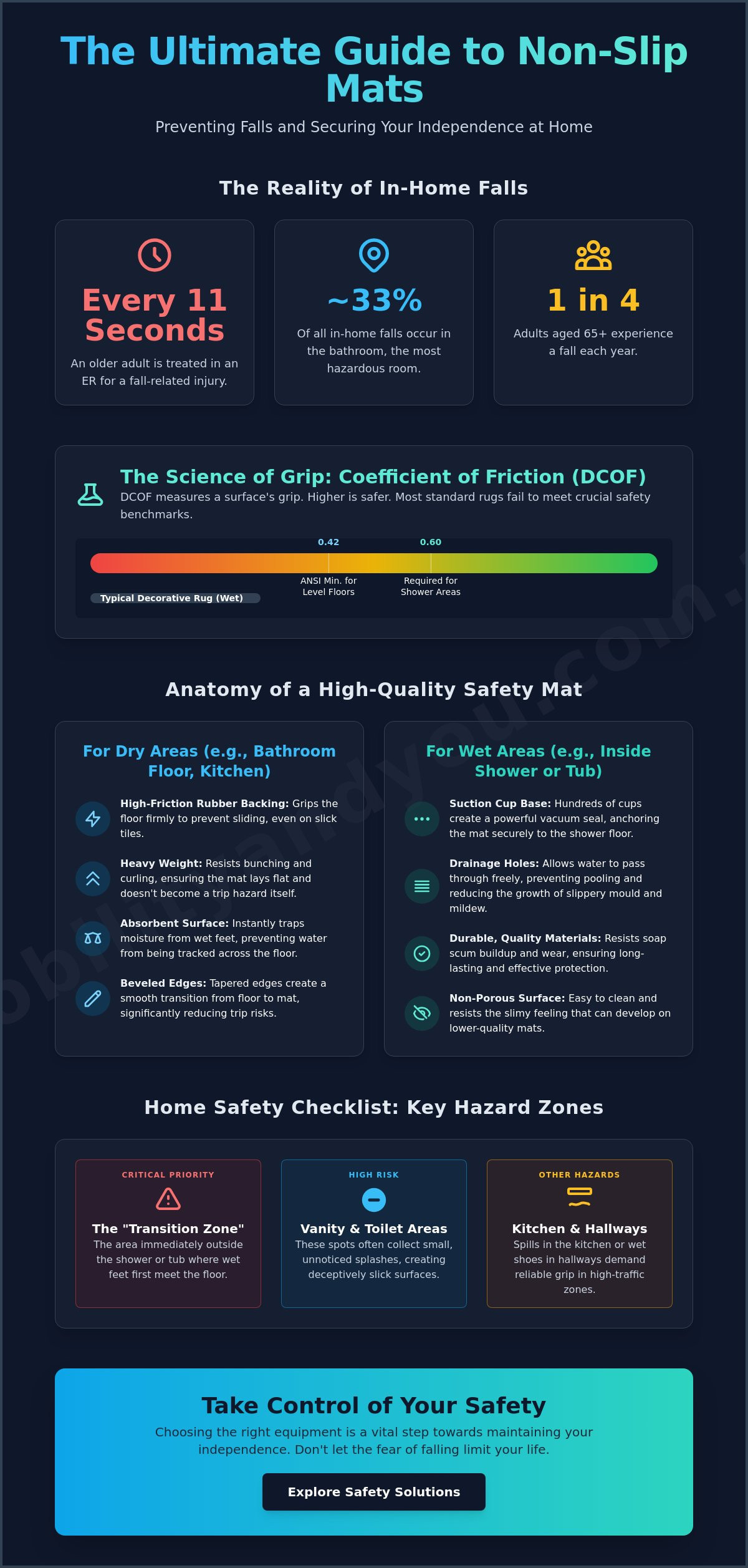
Did you know that every 11 seconds, an older adult is treated in the emergency room for a fall? With the bathroom accounting for nearly a third of all in-home falls, we understand why you might feel hesitant on wet tiles or slick surfaces. You deserve to feel completely confident and secure in your own home. Choosing a high-quality non slip mat is a simple yet vital step toward maintaining your independence and preventing life-altering injuries.
We agree that finding the right solution can feel overwhelming when there are so many materials to consider. You might even worry about a mat bunching up and becoming a trip hazard itself. This article will help you identify hidden risks in your home and select the best equipment to secure your space. We’ll walk you through our essential safety checklist, covering everything from technical friction standards to the best materials for long-term durability and ease of maintenance.
Key Takeaways
- Learn how the Coefficient of Friction acts as a technical benchmark for choosing surfaces that truly support your stability and peace of mind.
- Identify the specific “transition zones” in your home where a professional-grade non slip mat provides the essential grip needed for safe movement.
- Discover why beveled edges and high-quality materials are necessary to ensure your safety aids don’t accidentally become trip hazards themselves.
- Master a straightforward maintenance routine to keep your equipment effective and ensure it continues to protect your independence.
Understanding the Role of Non-Slip Mats in Fall Prevention
We often think of mats as simple decorative touches for our homes. However, there’s a significant difference between a standard decorative rug and a specialized non slip mat. While a regular rug might look beautiful, it often lacks the structural integrity to stay anchored on smooth surfaces. A true safety mat is engineered with a specific purpose: to create a reliable bond between your feet and the floor, even when moisture is present. By choosing equipment designed for stability, you’re taking a proactive step toward protecting your dignity and your freedom of movement.
This reliability comes down to the “Coefficient of Friction,” a technical term we use to measure how much grip a surface provides. In 2026, safety standards like ANSI A326.3 require a Dynamic Coefficient of Friction (DCOF) of 0.42 or higher for level interior floors. For shower areas, this requirement is even stricter, jumping to 0.60. Most standard mats fail to meet these benchmarks, especially on the polished ceramic or porcelain tiles common in Australian homes. When water hits these tiles, they become incredibly slick. Without a professional-grade backing, a standard rug can easily slide out from under you, turning a simple task into a dangerous situation.
The High Cost of Slips and Falls
Falling isn’t just a physical event. It’s an experience that can deeply shake your confidence and limit your desire to move freely. Research shows that more than one out of four people aged 65 and older fall each year, and the bathroom remains the most dangerous room in the house. This is why we advocate for preventative home modification. Floor mats also provide safe surfaces by acting as a stable platform during those tricky transition moments, such as stepping out of a bath or reaching for a towel. By addressing these hazards early, you protect your long-term mobility and maintain your independence in the home you love.
How Non-Slip Technology Works
Effective mats use different technologies depending on where they’re placed. In wet areas like showers, high-quality mats utilize hundreds of small suction cups. These cups create a vacuum seal against the floor, ensuring the mat doesn’t shift under your weight. For dry areas like the kitchen or hallway, we look for heavy, high-friction rubber backings. Weight is a crucial factor here; a heavier mat is less likely to bunch up or catch your toe. You can explore our range of bathroom aids to see how these professional designs prioritize your stability. It’s about finding a solution that stays exactly where you put it, every single time.
The Bathroom Safety Checklist: Where and Why You Need Grip
When we look at bathroom safety, we focus heavily on the “Transition Zone.” This is the critical area where you move from a wet environment, like your shower or tub, onto the dry floor. It’s here that a high-quality non slip mat becomes your most important ally. Without it, wet feet on a hard tile floor create a high risk of a slide. We recommend placing a mat exactly where your feet first land to provide immediate stability. Beyond the shower, check the areas in front of your vanity and toilet. These spots often collect small splashes that make the floor surprisingly slick.
Assessing the internal surface of your bathtub or shower is equally vital. Even if your floor feels textured, soap scum and oils can quickly neutralize that grip. Using a comprehensive home safety checklist helps identify these hidden hazards before an accident occurs. We believe that securing these zones isn’t just about safety; it’s about giving you the confidence to use your bathroom without fear or hesitation.
In-Shower vs. Out-of-Shower Mats
The equipment you use inside the shower serves a different purpose than what sits outside. In-shower mats must feature drainage holes to prevent water from pooling, which reduces the risk of mould growth and keeps the surface from becoming slimy. You should ensure the suction cups are compatible with your specific shower base, as some textured acrylic floors don’t allow for a proper seal. Conversely, mats for the dry floor should be highly absorbent. These mats trap moisture instantly, preventing you from tracking water onto the rest of the bathroom tiles.
Coordinating with Other Safety Equipment
A safe bathroom requires all your aids to work in harmony. If you use an over toilet aid, ensure the mat is positioned so it doesn’t interfere with the legs of the frame. The same rule applies when using a shower chair; the mat should be large enough to provide grip for your feet without causing the chair to wobble. If you’re currently choosing a raised toilet seat, consider how your foot placement will change once you’re seated higher. A well-placed mat ensures your feet stay firmly planted as you stand up. You can explore our full range of bathroom aids to find the perfect combination for your specific layout.
Beyond the Bathroom: Identifying Slip Hazards Throughout the Home
Entrance ways are a primary concern, especially during the rainy months. When you step inside, moisture from your shoes can turn a tiled foyer into a skating rink. A heavy-duty mat that traps water and dirt before it hits your main flooring is essential. Following a Home Fall Prevention Checklist helps you see your living space through a safety-first lens. It encourages us to look at the transition points we often take for granted, such as moving from a carpeted hallway onto a polished timber floor.
Kitchen and Laundry Hazards
The kitchen is the heart of the home, but it’s also a high-risk zone for spills. When you’re working at the sink or loading the dishwasher, small splashes are inevitable. In these areas, we recommend mats made from grease-resistant materials. Unlike standard mats, these won’t degrade when exposed to cooking oils or detergents. If you enjoy spending time preparing meals, look for mats with anti-fatigue properties. These provide a cushioned surface that reduces strain on your legs and back. Just be sure to check the thickness; the mat must be thin enough to allow your cupboard doors and dishwasher to swing over it without catching.
Bedroom and Living Area Stability
Nighttime movements present their own set of risks. When you rise from your bed in the dark, your balance may not be at its peak. Placing a low-profile non slip mat right at your bedside ensures your feet find a firm, secure grip the moment they touch the floor. This is particularly important if you use our adjustable beds or lift chairs, as the transition from a seated or reclined position to standing requires maximum stability. For your existing decorative rugs, we suggest using high-quality non-slip underlays. This simple addition prevents rugs from “creeping” or bunching up, which are common causes of trips. Always evaluate the height of any floor covering to ensure it doesn’t catch on the edge of your slippers or walking aids.
Key Features to Look for in a High-Quality Safety Mat
Choosing the right non slip mat requires looking past the surface design to the engineering underneath. We recommend prioritizing materials like nitrile rubber, which is considered the gold standard in 2026 for its flexibility and grease-proof properties. It’s essential that your mat meets the Dynamic Coefficient of Friction (DCOF) standard of at least 0.42 for general areas and 0.60 for shower floors. High-quality materials ensure the mat maintains this grip over time, unlike cheap foam alternatives that tend to degrade and become brittle after just a few months of use.
Size is another critical factor we often see overlooked. A mat must be large enough to cover the entire “strike zone” of your step. If a mat is too small, you might find yourself stepping half-on and half-off, which creates an uneven surface and increases the risk of a stumble. In wet environments, look for integrated drainage holes. These allow water to pass through the mat rather than sitting on top, which prevents the dangerous “hydroplaning” effect where your foot slides on a thin film of water. For those who find standing in the shower difficult, pairing a quality non slip mat with a shower chair designed for safety and independence creates a comprehensive solution for bathroom security.
Avoiding the Trip Hazard Irony
It’s a common mistake to assume that a thicker, more cushioned mat is always better. In reality, research indicates that mats exceeding 1/4 inch in thickness can become a trip hazard, especially for those who have a shuffling gait or use walkers. To prevent “toe-catch,” we look for mats with beveled or ultra-low profile edges. These tapered edges provide a smooth transition for both feet and wheels. We also prioritize “curl-resistant” corners. If the edges of a mat begin to lift, it’s no longer a safety tool; it’s a hazard that needs immediate replacement.
Material Safety and Standards
Because these mats often come into direct contact with your skin, we insist on BPA-free and phthalate-free compositions. In damp environments like bathrooms or laundries, an antimicrobial treatment is a must-have feature. This prevents the growth of bacteria and unpleasant odours that can thrive in moisture-trapping materials. A high-quality mat should also “breathe” to protect your underlying floor from moisture damage or discolouration. If you’re unsure which specifications are right for your home, you can contact our team for expert advice on selecting the safest equipment for your needs.
Maintenance and Professional Guidance for Home Safety
Purchasing a high-quality non slip mat is a vital investment in your home safety, but its effectiveness depends on consistent care. Over time, everyday substances like soap scum, body oils, and hair conditioners can build up on the surface. This creates a thin, slippery film that significantly reduces the mat’s grip. We recommend establishing a regular cleaning routine to ensure your safety equipment remains reliable. A quick weekly inspection, or “grip check,” is a simple way to confirm that suction cups are still pliable and rubber backings remain firmly anchored to the floor.
Knowing when to replace your equipment is just as important as knowing how to clean it. We suggest looking for visible signs of wear such as fraying edges, cracking in the material, or a noticeable loss of “tackiness” on the underside. If the corners begin to curl or the mat shifts easily when stepped on, it has reached the end of its functional life. Replacing a worn mat immediately prevents it from becoming the very trip hazard you were trying to avoid. Your safety is worth far more than the cost of a replacement.
Cleaning Tips for Longevity
The best cleaning method often depends on the material of your mat. Many modern synthetic mats are machine washable, which makes maintenance much easier for busy families. However, natural rubber often requires a gentle hand-scrub with mild soap to preserve its structural integrity. You should avoid using harsh chemicals or bleach; these substances can break down the rubber compounds and cause the mat to lose its slip-resistant properties. After cleaning, always dry your mats thoroughly. Moisture trapped underneath a mat can lead to mould growth and may cause the mat to slide on the very floor it is meant to secure.
Funding and Professional Support
We understand that finding the right path for home modifications can be complex. If you are living with a permanent disability, you may be able to access NDIS funding to help cover the cost of essential safety aids. For seniors looking to stay in their own homes longer, My Aged Care resources provide excellent pathways for home assessments and equipment support. We often recommend consulting an Occupational Therapist (OT) for a professional home assessment. An OT can provide tailored advice on the best placement for your mats and other bathroom aids. If you need more information, please don’t hesitate to reach out to a specialist provider like our team for personalized guidance on securing your home.
Take the Next Step Toward a Safer Home
Since 2016, we’ve served as specialists in daily living aids. We supply leading brand mobility equipment nationally and offer expert advice to both families and OT practitioners. Our team is here to ensure you feel understood and supported through every stage of your journey. We invite you to browse our range of high-quality non-slip mats and daily living aids to find the perfect fit for your home. You’ve worked hard for your independence, and we’re honored to help you protect it.
Frequently Asked Questions
What is the best material for a non-slip bathroom mat?
Nitrile rubber is widely considered the best material for a non slip mat in the bathroom due to its exceptional grip and resistance to oils and chemicals. High-grade PVC is another reliable option that offers longevity in damp environments. These materials maintain their structural integrity much better than standard foam, ensuring your safety aid doesn’t become brittle or lose its “tackiness” over time.
Can I use a non-slip mat on top of carpet?
We don’t recommend placing a standard non-slip mat on top of carpet, as the two surfaces will often shift against each other. This movement causes the mat to bunch up or “creep,” creating a significant trip hazard rather than preventing one. If you need to secure a rug on carpet, you should look for a specialized “carpet-to-carpet” underlay designed specifically for that purpose.
How often should I replace my safety mats?
You should replace your safety mats as soon as you notice signs of degradation like fraying, cracking, or curling edges. For most high-quality mats in daily use, this typically occurs every 12 to 24 months. Regularly performing a “grip check” will help you determine if the backing is still providing the necessary friction to keep you secure on smooth surfaces.
Are non-slip mats covered by the NDIS or My Aged Care?
Yes, many non-slip mats and daily living aids are eligible for funding through the NDIS or My Aged Care programs. These items often fall under the “Low Cost Assistive Technology” or home modification categories. We recommend speaking with your Occupational Therapist to ensure the specific mat you choose meets your clinical requirements and is correctly documented for your funding plan.
How do I stop my mat from sliding on floor tiles?
The most effective way to stop a mat from sliding is to ensure both the floor tiles and the mat’s backing are completely free of dust and soap residue. Choosing a mat with a heavy rubber backing provides the weight needed to stay anchored. For particularly stubborn areas, adding a high-friction underlay can provide an extra layer of security between the non slip mat and the tile.
Are suction cup mats safe for all types of showers?
Suction cup mats are not safe for all showers, particularly those with heavily textured or porous floor tiles. The cups require a smooth, non-porous surface to create a vacuum seal. If your shower floor has a stone-like texture or small mosaic tiles with lots of grout lines, the suction cups won’t be able to grip effectively, which could lead to the mat sliding.
What is the difference between an anti-fatigue mat and a non-slip mat?
An anti-fatigue mat is designed to provide cushioning and reduce strain on your joints during long periods of standing, while a non-slip mat focuses primarily on providing grip. While some products offer both features, they serve different physical needs. If your primary concern is preventing a fall on a wet surface, prioritizing the slip-resistance rating is your most important step.
Can a non-slip mat actually cause me to trip?
A non-slip mat can actually become a trip hazard if it is too thick or has edges that don’t lay flat. To avoid this “trip hazard irony,” we suggest choosing a mat with a profile under 1/4 inch and beveled edges. These features allow for a smooth transition, which is especially important if you use a walker or have a shuffling gait.