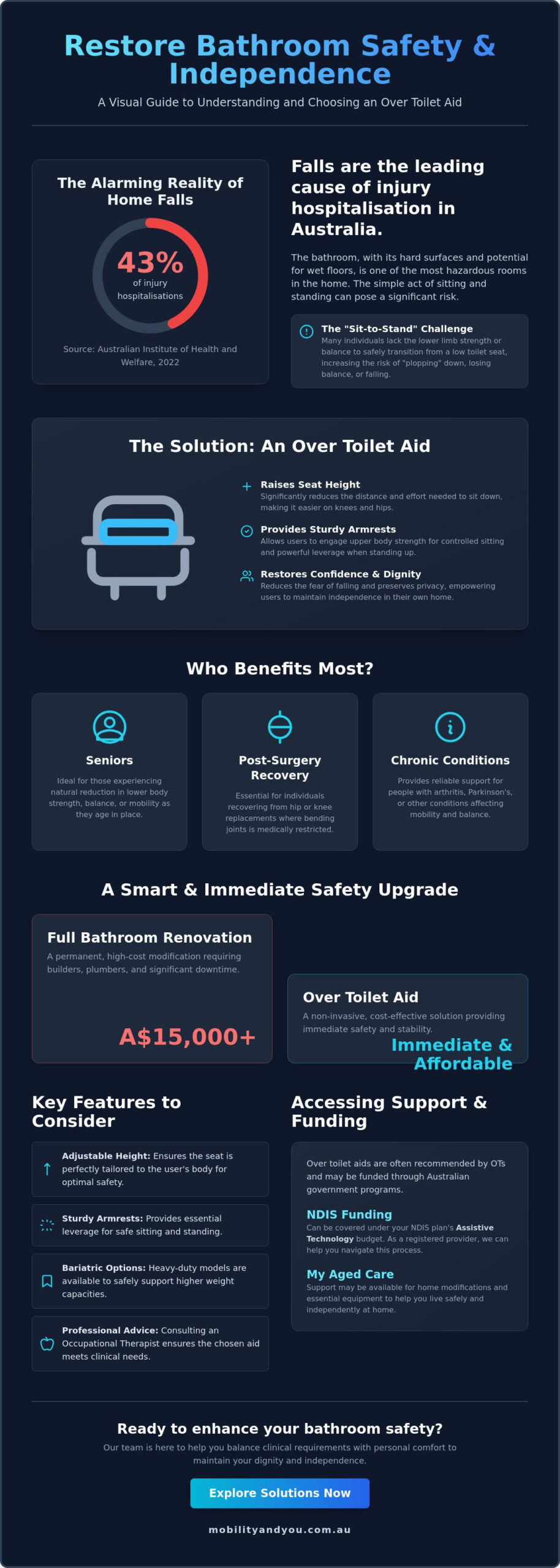
According to the Australian Institute of Health and Welfare, falls accounted for 43% of injury-related hospitalisations in 2022, with the bathroom remaining one of the most hazardous rooms in the home. We understand that for many of our neighbours, the simple act of sitting down or standing up from a low toilet seat can become a source of anxiety. It’s a challenge that shouldn’t stand in the way of your comfort or your home life. That’s why an over toilet aid is more than just a piece of equipment; it’s a practical solution designed to restore your confidence and physical stability.
You deserve to feel safe and private in your own home without the constant fear of a slip or fall. In this guide, we’ll show you how to choose a support system that matches your specific physical needs while protecting your long-term independence. We’ll also simplify the NDIS funding process and explain which features, from adjustable heights to bariatric specifications, are essential for your safety. Our team is here to ensure you find a reliable solution that makes daily life easier and more dignified.
Key Takeaways
- Learn how an over toilet aid can restore your independence by reducing the physical effort required to sit and stand safely in the bathroom.
- Understand the essential features to look for, such as adjustable height and armrest configurations, to ensure your equipment is perfectly tailored to your body.
- Master the measurement and installation process to create a secure, clutter-free environment that minimizes the risk of slips or falls.
- Navigate the Australian funding landscape with our guide to NDIS Assistive Technology budgets and My Aged Care support for your home modifications.
- Discover how our team helps you balance clinical requirements with personal comfort to maintain your dignity while using essential mobility tools.
Understanding Over Toilet Aids: Safety, Dignity, and Independence
We understand that maintaining independence in the bathroom is a top priority for our clients and their families. An over toilet aid is a specialized, height-adjustable frame designed to fit directly over your existing toilet suite. Its primary function is to raise the seat height, which significantly reduces the distance you need to lower yourself when sitting down. This simple adjustment makes a world of difference for those who find standard toilets too low or difficult to navigate without assistance.
Like toilet seat risers, these aids provide a raised platform, but they offer the added stability of a full frame equipped with sturdy armrests. For many Australian families, these frames represent a cost-effective and non-invasive alternative to permanent plumbing modifications. While a full bathroom renovation can easily cost upwards of A$15,000, a high-quality frame provides immediate safety without the need for a builder or plumber. Our team views these tools as essential components of a proactive home safety plan, ensuring the bathroom remains a space of comfort rather than a source of anxiety.
For those who require more comprehensive structural changes, HomeSafe Living Solutions specializes in professional ageing-in-place home modifications and accessibility remodels designed to enhance residential safety.
Who Benefits Most from an Over Toilet Aid?
Our team often works with seniors who are experiencing a natural reduction in lower body strength or balance. These frames are also vital for individuals recovering from significant procedures, such as hip or knee replacement surgeries, where bending the joint beyond a certain angle is medically restricted. People living with chronic conditions like arthritis or Parkinson’s disease find that the extra support helps manage daily fluctuations in mobility. The ‘sit-to-stand’ challenge occurs when a person lacks the lower limb strength or balance required to transition safely between a seated and standing position.
If you’re navigating the NDIS or My Aged Care systems, you’ll find that these aids are frequently recommended by Occupational Therapists to support “ageing in place.” We’re proud to be an NDIS registered provider, helping Australians access the equipment they need to stay in their own homes longer. You can browse our full range of bathroom equipment in our online shop to find a model that suits your specific requirements.
The Connection Between Bathroom Aids and Falls Prevention
Safety in the bathroom is a serious concern, as the Australian Institute of Health and Welfare reports that falls are the leading cause of injury hospitalization in Australia, with 43% of these incidents occurring within the home. The armrests on an over toilet aid provide vital leverage, allowing users to use their upper body strength to control their descent and assist in pushing back up to a standing position. This prevents the “plopping” effect, which often leads to loss of balance or impact injuries.
Beyond the physical benefits, there’s a significant psychological advantage to feeling secure in a private environment. Knowing that a stable frame is there to support you reduces the fear of falling, which can otherwise lead to a decline in activity levels. Using these aids also helps preserve energy. By reducing the physical strain of toileting, users keep their strength for other daily activities, improving their overall quality of life and sense of empowerment. We’re here to help you find the right fit for your home, ensuring every trip to the bathroom is safe and stress-free. If you’re also concerned about shower safety, our guide on how to hire a shower chair for bathroom safety and recovery covers everything you need to know about selecting the right seating solution for wet areas.
Different Types of Over Toilet Aids for Every Need
We understand that every home and every person has unique requirements. Finding the right over toilet aid isn’t just about picking a product; it’s about ensuring your daily routine remains safe and dignified. Our team often sees how the right selection transforms a bathroom from a place of anxiety into a space of independence. We highly recommend consulting an Occupational Therapist (OT) before making a final choice. These professionals assess your specific reach, strength, and balance to ensure the equipment provides optimal support for your physical needs.
- Frames must match the specific height of the user to prevent falls.
- Layouts vary, so measuring the distance between the toilet and the wall is essential.
- Clinical advice helps determine if a permanent or removable solution is best.
Standard Over Toilet Frames vs. Toilet Surrounds
Standard frames feature an integrated seat and a splash guard. These are ideal if you need to increase the toilet’s height to reduce the strain on your hips or knees. In contrast, a toilet surround provides sturdy armrests while you continue to use your existing toilet seat. If you live in a multi-user household, a lightweight surround is often easier to move aside when it’s not required. Stability remains a priority; we ensure our frames feature non-slip rubber feet to grip tiled Australian bathroom floors securely.
Bariatric and Heavy-Duty Options
Safety is paramount when standard equipment doesn’t provide enough support. Bariatric aids are engineered with reinforced steel or heavy-duty aluminium to handle higher Safe Working Loads (SWL), which often exceed 200kg. These models offer extra-wide seating to prevent skin pinching and ensure comfort. Choosing a reinforced over toilet aid helps maintain skin integrity by providing ample space, which is a critical consideration for long-term health. Our bariatric range focuses on durability, using materials that resist corrosion in high-moisture environments.
Folding and Portable Aids
For those who enjoy travelling or have limited space, folding aids offer a practical solution. These designs allow the frame to collapse into a compact shape for storage or transport in a car boot. While portable, these units still maintain high structural integrity through secure locking mechanisms. There’s often a slight trade-off in maximum weight capacity compared to fixed frames, so checking the specifications is vital for your safety. If you’re unsure which model suits your lifestyle, you can contact our local team for personalized advice. We take pride in being an NDIS registered provider, helping you find the right equipment to support your freedom at home.
Key Features to Look for in a Quality Aid
Selecting the right equipment involves more than just finding a seat that fits over your existing plumbing. We understand that every user has unique physical requirements, so we look for specific engineering details that promote safety and longevity. A high-quality over toilet aid should offer customisable settings to suit your body’s mechanics, ensuring you can sit and stand without unnecessary exertion or risk of a fall.
- Height adjustability: Most professional-grade frames allow for 25mm incremental adjustments. This helps position the seat at an optimal level, usually where the hips stay slightly higher than the knees to protect the joints and reduce strain on the lower back.
- Armrest design: While fixed arms provide a sturdy grip for most users, drop-down arms are a better choice for side transfers from a wheelchair. Our team often recommends these for clients who need clear lateral access.
- Seat ergonomics: Look for contoured designs that distribute weight evenly. A built-in splash guard is also essential to keep the surrounding area dry and maintain a high standard of hygiene.
Durability and Rust Resistance
Bathrooms are high-humidity environments where low-quality steel frames can rust within 12 months. We prefer powder-coated aluminium for our clients because it’s lightweight, often weighing under 4kg, and naturally resistant to corrosion. To keep your over toilet aid in peak condition, wipe the frame with a soft cloth once a week to remove moisture and soap residue. This simple step ensures your investment remains a reliable part of your home for many years.
Safety Feet and Stability
Stability starts at the floor level. A quality frame features a wide base footprint to prevent tipping during heavy leans or transfers. The legs must be fitted with non-slip rubber ferrules, which provide vital suction on wet or tiled surfaces common in Australian bathrooms. It’s vital to check these rubber tips every month for signs of thinning or cracking to ensure the frame doesn’t slide unexpectedly. If you’re an NDIS participant, these maintenance checks are a key part of managing your assistive technology effectively.
Hygiene and Cleaning Considerations
Maintaining a sterile environment is crucial for skin health and general wellbeing. Quality aids use high-density, moulded plastic seats that don’t have porous surfaces where bacteria can hide. These seats are easy to sanitise with standard household cleaners or mild detergents. Many models also feature removable components, allowing for deep cleaning and better infection control in shared living spaces. Choosing a model with a detachable splash guard makes the cleaning process much faster and more thorough. You can explore our range of easy-to-clean options at our online shop or visit our showroom for a demonstration.
How to Measure and Install Your Over Toilet Aid
Finding the right fit is the most critical step in ensuring your bathroom remains a safe, private space. An over toilet aid that hasn’t been measured correctly can lead to instability or unnecessary strain on your joints. Our team recommends starting with a clear workspace. Remove any loose bath mats or decorative items from around the base of the toilet. These items often interfere with the frame’s legs and create trip hazards. Check that your bathroom floor is level. Even a 2mm slope can prevent the four legs from making uniform contact, which compromises the frame’s weight-bearing capacity.
If you’re recovering from a surgery like a hip replacement, you might only require this support for a short period of 6 to 12 weeks. In these cases, learn more about our equipment hire options to find a cost-effective, temporary solution that doesn’t require a permanent purchase. Many clients in this situation also choose to hire a shower chair alongside their toilet aid to ensure complete bathroom safety during their recovery period. We’ve helped hundreds of local families navigate these short-term needs with flexible rental terms and professional advice.
Step-by-Step Measurement Guide
To determine the ideal seat height, have the user sit in a sturdy chair with their feet flat on the ground. Measure from the floor to the crease at the back of their knee or mid-thigh. This height allows for a safe “sit-to-stand” motion without overexerting the hip joints. Next, check the width of your toilet bowl. Most standard Australian bowls are roughly 360mm wide, but some modern designs vary. Measure the distance to the nearest side wall or vanity as well. You’ll need at least 55cm of clear width for the frame to sit comfortably without hitting cabinetry or obstructing the door.
Installation and Safety Checks
Once your equipment arrives, adjust the pin-clip legs to the pre-measured height. Ensure every leg is set to the exact same hole setting; a single mismatched leg creates a dangerous wobble. After setting it down, perform the “rock test” by applying firm downward pressure on each side of the frame. If it shifts or rattles, the floor may be uneven or a pin isn’t fully engaged. Finally, position the splash guard so it sits directly over the centre of the bowl. This prevents spills and maintains hygiene, keeping your bathroom clean and easy to manage. If you’re unsure about the fit, contact our local team for expert guidance on selecting the right model for your home.
Accessing Support: NDIS, Funding, and Expert Advice
Securing the right equipment shouldn’t be a financial burden or a source of stress. In Australia, several government initiatives exist to help you maintain your independence at home without high out-of-pocket costs. If you’re a participant in the National Disability Insurance Scheme (NDIS), your Assistive Technology budget is designed specifically for tools like an over toilet aid. Most standard models fall under the “low-cost AT” category. The NDIS defines this as items costing less than A$1,500, which often simplifies the procurement process and allows you to access essential support faster.
For high-risk users or those with complex physical needs, we always recommend consulting with an Occupational Therapist (OT). An OT provides a professional assessment to ensure the equipment height, weight capacity, and frame style align with your specific mobility goals. They help prevent falls by verifying that the equipment is used correctly within your unique bathroom layout. Discover how we support NDIS participants through our dedicated service team and streamlined ordering process.
Navigating the NDIS and Aged Care Systems
The Commonwealth Home Support Programme (CHSP) and Home Care Packages (HCP) are vital resources for older Australians. These programs prioritize safety modifications that allow you to age in place with dignity. Our team is deeply familiar with the administrative requirements of these funding bodies. We regularly assist clients and their case managers by providing detailed quotes and technical specifications for their chosen over toilet aid. Choosing an NDIS registered provider like Mobility and You, or partnering with a high-quality care service such as Im with you, ensures you’re working with a team that adheres to rigorous national quality and safety standards, giving you and your family total peace of mind.
The Mobility and You Difference
We’re a family-owned business with a local heart. We understand that choosing mobility equipment is a personal and sometimes sensitive journey. Our commitment to your independence goes beyond a simple transaction. We offer personalized fittings and product trials because we know that a solution that works in a showroom must also work in your specific bathroom. This hands-on approach reduces the risk of purchasing unsuitable equipment and gives you the confidence to use your home safely. We prioritize your comfort and long-term well-being in every interaction. Contact our compassionate team today to find the perfect solution for your needs.
Take the Next Step Toward Bathroom Safety
Maintaining your independence at home starts with making informed choices about your safety. You now understand how a high-quality over toilet aid provides the essential stability and height needed to prevent falls and reduce strain on your joints. By selecting a model that matches your specific measurements and weight requirements, you’re investing in long-term confidence and privacy. Our team has spent over 10 years helping families across Australia find these practical solutions, ensuring every piece of equipment meets rigorous safety standards.
As an NDIS Registered Provider and specialists in bathroom safety, we pride ourselves on offering more than just products. We provide the expert advice you need to navigate funding pathways and find the right daily living aids for your unique situation. Our family-owned approach means you’ll receive personalized support from people who truly care about your quality of life. We’re here to help you transform your bathroom into a secure environment that supports your mobility goals every day.
Browse our range of high-quality Over Toilet Aids
We look forward to helping you rediscover comfort and freedom in your own home.
Frequently Asked Questions
What is the difference between an over toilet aid and a raised toilet seat?
An over toilet aid is a free-standing metal frame that sits over your existing toilet to provide both a higher seating position and sturdy armrests for support. A raised toilet seat is a plastic component that attaches directly to the toilet bowl without any external legs or side handles. While the raised seat is more discreet, our team often recommends the over toilet aid for clients who need the extra stability of armrests to stand up safely.
Can an over toilet aid be used in a small or narrow bathroom?
Yes, you can find compact models designed specifically for tight spaces in older Australian homes. Standard frames usually measure between 500mm and 550mm in width, but narrow versions are available that fit into gaps as small as 480mm. It’s vital to measure the distance between your toilet and the vanity or shower screen before you buy to ensure the frame doesn’t block your movement.
Do I need an Occupational Therapist to buy an over toilet aid?
You don’t need a referral or an Occupational Therapist (OT) to purchase equipment privately from our showroom. However, we strongly suggest a professional assessment to ensure the seat height is calibrated to your specific hip and knee requirements. If you’re seeking government funding through a home care package, an OT assessment is a mandatory step in the application process to ensure the equipment meets safety standards.
Is an over toilet aid covered by the NDIS or My Aged Care?
Yes, these safety aids are typically covered under NDIS Assistive Technology budgets or My Aged Care Home Care Packages (HCP). As a registered provider, we regularly process these claims for our clients to reduce their out-of-pocket expenses. You should speak with your Plan Manager or Aged Care Coordinator to confirm that your current funding includes provisions for bathroom mobility equipment before making your purchase.
What is the weight capacity of a standard over toilet aid?
A standard over toilet aid usually supports a maximum user weight between 100kg and 160kg depending on the specific model. For those who require more substantial support, bariatric versions are reinforced to accommodate weights up to 250kg or higher. Always check the manufacturer’s label on the frame or ask our staff to verify the weight rating so you can feel completely secure when using the device.
How do I clean and maintain my bathroom aid safely?
You should clean the plastic seat and metal frame weekly using warm soapy water and a soft, non-abrasive cloth. Don’t use harsh bleach or scouring pads as these can damage the powder-coated finish and lead to rust in the humid bathroom environment. We recommend checking the rubber feet every month to ensure they aren’t worn down, as intact suction tips are essential for preventing the frame from sliding on wet tiles.
Can I hire an over toilet aid for short-term recovery?
Yes, hiring is an excellent option if you only need the equipment for a 6-week or 12-week recovery period following a hip or knee surgery. We offer flexible weekly rental rates for clean, sanitised frames to help you maintain your independence without the cost of a permanent purchase. This service is particularly popular for patients transitioning from hospital back to their own homes who expect a full return to their usual mobility.
What should I do if the aid feels wobbly on my tiles?
If the frame feels unstable, first check that the height-adjustment pins on all four legs are clicked securely into the same position. Many Australian bathroom floors have a slight slope for water drainage, which can make a level frame feel uneven. You can fix this by adjusting one leg by a single notch to compensate for the floor’s fall. If the wobble persists, check that the rubber feet are clean and free from soap scum buildup. If you’re also evaluating whether a raised toilet seat might better suit your bathroom layout, our complete buyer’s guide can help you compare your options and determine the right height adjustment for your needs.