What if a simple 15cm oversight in your bedroom layout could compromise your daily independence or prevent a vital mobility hoist from fitting beside your mattress? We’ve met many clients who feel frustrated when a “standard” purchase doesn’t meet their specific physical needs, leading to unnecessary returns and added stress. Getting the single bed dimensions australia right is the first step toward a safe, comfortable, and supportive sleeping environment.
We believe that every Australian deserves a home that supports their dignity, which is why our team has created this comprehensive 2026 guide. We’ll help you understand the nuances between Long Singles and King Singles with precise data in cm and mm. You’ll learn exactly which variants provide the necessary legroom for taller individuals and how to ensure your bed choice remains compatible with NDIS registered mobility equipment and pressure care solutions.
Key Takeaways
- Understand the specific single bed dimensions australia uses (92cm x 188cm) and why these standards differ from UK and US sizes when selecting your equipment.
- Compare the benefits of Long Single and King Single variants to determine which size best supports long-term comfort and future-proofs your bedroom layout.
- Gain clinical insights into how bed dimensions impact the safety of transfers and the installation of critical mobility aids like grab rails and pressure-care mattresses.
- Master the practical steps of room planning, from accounting for skirting boards to ensuring enough “swing space” for easy access and caregiver support.
- Learn how our team and Occupational Therapists can help you navigate NDIS requirements to find a bed that truly empowers your independence and lifestyle.
Standard Single Bed Dimensions in Australia: The Essentials
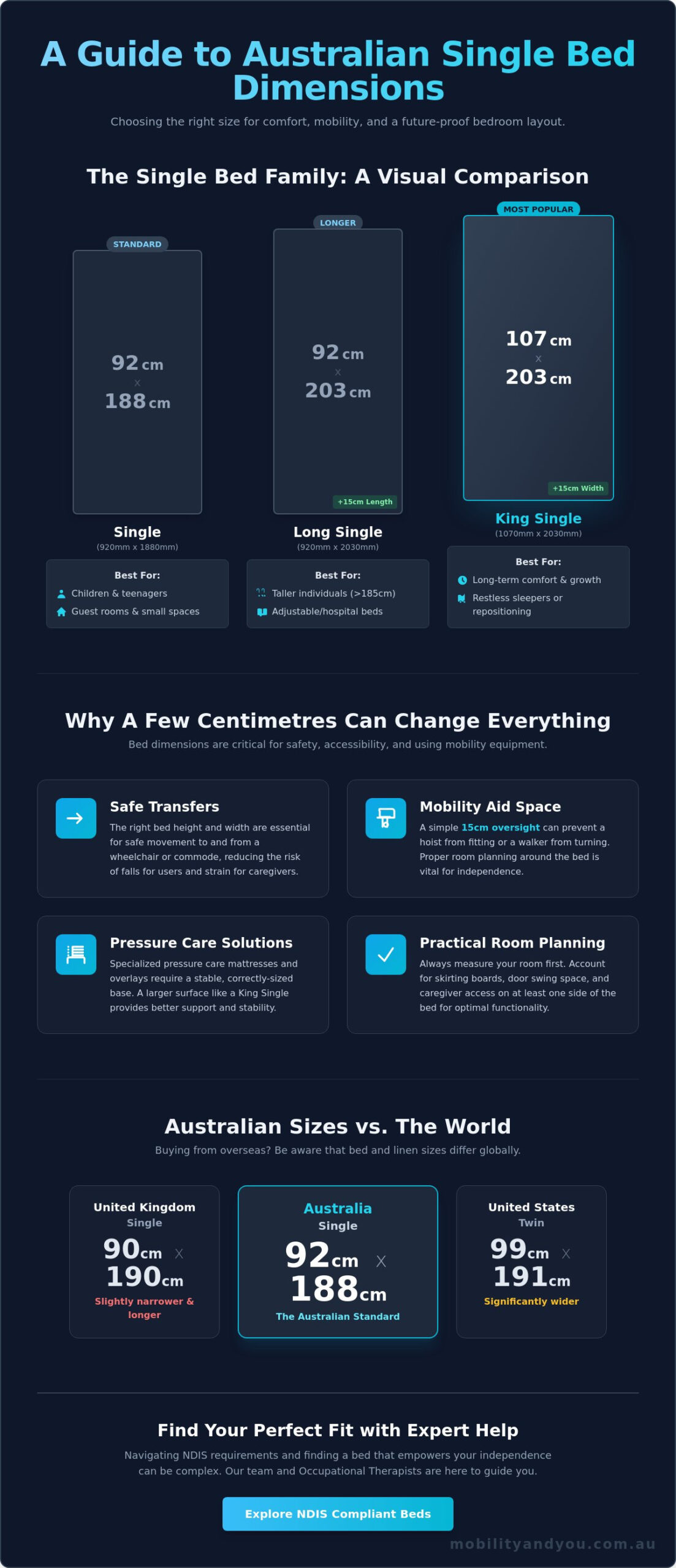
Choosing the right bed starts with accurate measurements. In our years of supporting local families as a family-owned business and NDIS registered provider, we’ve seen how the right fit impacts both comfort and room accessibility. The standard single bed dimensions australia are officially 92cm x 188cm, or 920mm x 1880mm in technical specifications. This size provides a reliable foundation for children moving from a cot or for caregivers looking to maximize floor space in a smaller bedroom or guest house.
While it might seem straightforward, these measurements are unique to our region. If you’re looking at international furniture, you’ll find that Standard Bed Sizes vary globally. An Australian single is distinct from the American ‘Twin’ (99cm x 191cm) and the UK ‘Single’ (90cm x 190cm). This 2cm to 7cm difference can cause significant issues when trying to fit sheets or mattress protectors purchased overseas. For those with very tight space constraints, we also see the ‘Small Single’, measuring 76cm x 188cm. This narrow profile is frequently used for trundle beds that slide under a standard frame or for compact caravans.
Metric vs. Imperial: Understanding the Measurements
Our team and most healthcare professionals typically use millimetres for precision. This ensures that frames fit perfectly with pressure care equipment or specialized safety rails without leaving dangerous gaps. For those who prefer imperial units, a standard single translates to approximately 3’0″ x 6’2″. It’s the most space-efficient adult-length bed available, providing enough height for most teenagers while keeping the footprint minimal. Using metric measurements is the safest way to ensure your bedding and frame are compatible, especially when ordering medical-grade equipment.
Who is the Standard Single Best For?
This size is the primary choice for toddlers transitioning into their first bed. It’s also the standard for bunk beds and guest rooms where every centimetre of floor space counts, such as in studio apartments or shared aged care rooms. We often recommend this size for:
- Children and teenagers who don’t require extra width.
- Guest rooms designed for solo sleepers.
- Rooms where floor space is needed for mobility aids like walkers or hoists.
However, we always consider the user’s long-term comfort. A standard single might not be suitable for taller adults or patients who require complex pressure care equipment that needs more surface area. If a sleeper is over 185cm tall, they may find their feet reaching the edge. In these cases, we often discuss ‘Long Single’ or ‘King Single’ options to ensure their independence and mobility aren’t compromised by a cramped sleeping surface.
Comparing the Single Bed Family: Single vs. Long Single vs. King Single
We see many families and healthcare providers moving away from the traditional 188cm length that defined Australian bedrooms for decades. The standard single bed dimensions Australia residents grew up with are often too restrictive for modern comfort and support requirements. According to the Australian Bed Size Guide, the market now prioritizes length and versatility. This shift has led to the rise of the Long Single and King Single as the preferred choices for both residential homes and clinical settings.
Choosing between these three variants depends on your available floor space and the specific physical needs of the sleeper. While they all fall under the “single” umbrella, the differences in width and length significantly impact sleep quality and room accessibility.
King Single: The Choice for Growth and Comfort
The King Single measures 107cm x 203cm, making it the fastest-growing bed size in the country as of 2024. It offers a 15cm width advantage over a standard single, which provides much-needed room for restless sleepers or individuals who require space for repositioning during the night. This extra width creates a more stable sleeping surface for adults without the footprint of a double bed.
Its 203cm length is a vital feature for teenagers and taller Australian adults. It ensures that taller users don’t find their feet hanging off the edge, a common issue with the 188cm standard single. While King Single bedding and linens are widely available in most retail stores, it’s important to remember that these mattresses require specific, larger frames. If you’re transitioning from a standard single, your existing furniture won’t accommodate this wider profile.
The Long Single: A Specialist Mobility Solution
A Long Single maintains the 92cm width of a standard single but extends the total length to 203cm. You’ll often hear this referred to as a “Single XL” in retail environments, but the dimensions remain identical. This variant serves a specific role in modern bedding, particularly for couples with differing health needs. Two Long Singles placed side-by-side create a “Split King” bed, allowing partners to maintain their proximity while using independent mattress tensions or bases.
Our team frequently recommends the Long Single because it maintains a narrow profile, which is excellent for smaller rooms or when carers need access to both sides of the bed. It provides the extra legroom required for tall individuals without encroaching on valuable floor space. Crucially, Long Singles are the standard for adjustable beds, as they perfectly match the dimensions of specialized pressure care mattresses. If you’re looking to improve your sleep setup, you can contact our local team for a personalized consultation on which frame size best supports your independence.
Why Bed Dimensions Matter for Mobility and Home Care
When we help families choose the right setup, we focus on more than just floor space. The single bed dimensions australia standard of 92cm x 188cm plays a critical role in daily “transfers.” If a bed is too wide, a person using a wheelchair might struggle to bridge the gap safely during a slide-board transfer. Conversely, if a mattress is too narrow, there isn’t enough room for side rails or grab rails to be mounted securely. When you are looking at hospital beds for sale, we always check that the mattress width leaves enough space for these safety accessories to lock into place without pinching the user.
Pressure care is another vital factor. Larger surface areas, such as those found in a King Single (107cm wide), provide more room for repositioning. This extra 15cm of width allows a carer to turn a patient more easily, which helps prevent skin breakdown and pressure sores. Our team often recommends these slightly wider dimensions for clients who spend 12 or more hours in bed each day, as the added space promotes better air circulation and comfort.
Width and Safety: Navigating the Room
Navigating a bedroom requires a clear, unobstructed path. We recommend leaving at least 90cm of clearance around at least one side of the bed to accommodate a walker or wheelchair. In smaller Australian heritage homes or high-traffic care environments, the 92cm width of a Standard Single is often safer than a larger bed because it preserves this essential floor space. Bed height is just as important as width. Matching the mattress top to the user’s knee height ensures their feet touch the floor safely during egress. By following the Mobility and Home Care Bed Standards, we prioritize adjustable height frames that prevent falls during these critical transitions.
Adjustable Bases and Dimension Compatibility
Specialized mobility mattresses must match the frame dimensions exactly to function. If a mattress is even 3cm too long, it can bunch up when the head or foot section is raised, creating a “shear” effect on the skin. The 203cm length of a King Single or Long Single is excellent for foot elevation, providing enough room to support the heels without them hanging off the edge. This length is a standard requirement for taller users to prevent their feet from pressing against the footboard. For those recovering from surgery, we offer equipment hire so you can test which single bed dimensions australia suit your home layout and physical needs before making a permanent choice. If you want to understand how motorised positioning can further support your recovery, our electric adjustable bed guide explains how custom head and foot elevation reduces physical strain and makes transfers safer.
Practical Planning: Measuring Your Room and Choosing Bedding
Selecting the right single bed dimensions australia wide is only the first part of the process. You also need to ensure the furniture fits comfortably within your living environment without restricting your movement or compromising safety. Our team recommends a systematic approach to measurement to avoid the stress of a bed that blocks a walkway or prevents a door from opening.
- Step 1: Measure the total room dimensions. Use a steel tape measure for accuracy. Always measure from the skirting boards rather than the bare walls. Skirting boards often add 15mm to 20mm of thickness on each side, which can prevent a bed frame from sitting flush against the wall.
- Step 2: Account for swing space. A standard bedroom door or wardrobe door requires at least 900mm of clearance to open fully. If you’re placing a bed near a closet, ensure there’s enough room for you or a carer to stand comfortably while the door is open.
- Step 3: Map out mobility aids. If you use an over-bed table, a walker, or a hoist, you’ll need a minimum of 800mm of clear floor space beside the bed. Planning for these items now ensures your single bed dimensions australia choice doesn’t lead to a cramped, unsafe environment.
- Step 4: Check the total footprint. Remember that the mattress size is not the bed size. A timber or upholstered frame can add 10cm to 15cm to the overall length and width of the setup.
Common Room Layouts for Single Beds
The “Corner Placement” works well for standard singles in smaller rooms because it maximizes floor space for other activities. However, for those receiving home care, the “Island Placement” is often essential. This layout provides 750mm to 900mm of access on both sides of the mattress, allowing carers to assist with transfers or medical needs safely. If you plan to include a lift chair next to the bed, ensure you leave at least 1.2 meters of width to allow the chair to recline and lift without hitting the bed frame.
Finding the Right Bedding for Australian Sizes
Standardized sizing can be confusing. A common mistake we see is trying to use King Single sheets on a Standard Single mattress. They won’t fit properly; the excess fabric creates bunches that can lead to skin irritation or pressure sores. If you choose a Long Single, you’ll likely need to visit specialized linen stores, as these 203cm long sheets are less common in general department stores. Always check the “pocket depth” of your fitted sheets. Modern mobility mattresses are often 25cm to 35cm thick. If you add a pressure-relieving topper, you’ll need a “Mega” or “Extra Deep” pocket of 40cm to 50cm to prevent the corners from popping off. Once you’ve confirmed your dimensions, pairing your mattress with an electric adjustable bed base can significantly improve your ability to get in and out of bed independently, particularly if you manage chronic back pain or joint stiffness.
If you’re unsure how a specific frame will fit in your home, contact our local team for expert advice on spatial planning and equipment compatibility.
Finding Your Perfect Fit with Mobility and You
Choosing the right bed involves more than just measuring a floor plan. Our team looks at your daily routine and physical requirements to ensure your sleep setup enhances your quality of life. While standard single bed dimensions australia usually measure 92cm by 188cm, these measurements are only a starting point for those with specific health challenges. We analyze how you transfer in and out of bed, your reach range, and whether you require space for medical accessories. Our range is diverse, featuring everything from standard adjustable bases to bariatric-width solutions designed for users who need extra room for pressure care or repositioning.
We invite you to visit our showroom to experience these sizes in person. Feeling the 15cm difference between a standard Single and a King Single width can change your entire perspective on comfort. It’s often the difference between feeling restricted and having the freedom to move safely throughout the night. We take pride in being a family-owned business that prioritizes your dignity above all else.
When transitioning to a new home that better suits your mobility needs, Interstate Canberra Removalist can provide the specialist care required to transport your specialized bedding and furniture safely.
NDIS and Funding for Specialized Bedding
Navigating equipment dimensions can be overwhelming, but you don’t have to do it alone. As NDIS registered providers, we work closely with participants to secure the right Assistive Technology. Occupational Therapists (OTs) play a vital role here, often recommending specific single bed dimensions australia to accommodate equipment like floor hoists or slide sheets. An OT might suggest a longer frame for a taller participant to prevent pressure sores on the heels, or a wider base to assist with manual rolling.
We strongly advocate for “Trialing” a bed before you commit to a purchase. This allows you to test the height and width in a real-world setting, ensuring the bed integrates with your existing mobility aids. We also offer customization options. If you have unique height requirements for safe wheelchair transfers, we can adjust our solutions to meet those exact millimetres. This precision ensures your funding is spent on a solution that works from day one.
Expert Support for Your Independence
We’re your trusted local partner, and we’ve built our reputation on reliability and expert knowledge. Our goal is to ensure the bed you choose supports your long-term independence and mobility. We don’t just sell products; we provide the foundation for a better night’s rest. Our team understands the Australian healthcare landscape and the specific regulations governing medical furniture. We help you balance the clinical need for a certain bed size with the practical reality of your home’s layout.
Our commitment to your well-being extends far beyond the initial delivery. We focus on building lasting relationships with our clients and their families. Every recommendation we make is backed by years of experience in the mobility industry. If you’re ready to find a bed that truly fits your life, Contact our team for a personalized bed consultation. We’ll help you navigate the options and find the perfect match for your home.
Take the Next Step Toward Comfort and Independence
Choosing the right foundation for your rest is a vital step in maintaining your independence at home. It’s clear that understanding single bed dimensions australia is essential for more than just aesthetics; it’s about ensuring your room accommodates the specialized support you need for pressure care and daily mobility. Whether you require the 203cm length of a Long Single or the extra 15cm width of a King Single, getting these measurements right ensures your home remains a safe and functional space.
As a family-owned, NDIS Registered Provider, we’re dedicated to helping you find a solution that respects your dignity and fits your lifestyle. Our team specializes in mobility-aligned bedding and pressure care, providing the clinical expertise you can trust. We offer personalized sizing consultations to help you navigate the selection process with ease. You don’t have to worry about the technical details alone because our local experts are here to guide you every step of the way.
Explore our range of Australian-standard adjustable beds
We’re excited to help you achieve the comfort and freedom you deserve in your own home.
Frequently Asked Questions
What is the most common single bed size in Australia?
The most common single bed size in Australia is 92cm wide by 188cm long, often referred to as a Standard Single. This size is the baseline for children’s bedrooms and guest accommodations across the country in 2026. Because it’s the industry standard, you’ll find the most extensive range of linen and specialized pressure-care mattresses designed specifically for these dimensions.
Will a King Single bed fit in a small bedroom?
A King Single bed fits in a small bedroom if the floor plan is at least 2.7 meters by 3.0 meters. While the mattress itself is 107cm wide and 203cm long, you need to account for the bed frame’s external footprint and walking paths. We recommend leaving at least 60cm of space on one side to ensure you can move freely without feeling restricted.
What is the difference between a Long Single and a King Single?
The main difference between these two sizes is the width, as both share a common length of 203cm. A Long Single is 92cm wide, while a King Single provides an extra 15cm of sleeping surface with a width of 107cm. Our team often suggests Long Singles for NDIS participants who need extra legroom but have limited space for wider medical equipment or hoist access.
Do standard single sheets fit a King Single mattress?
Standard single sheets won’t fit a King Single mattress because the King Single is 15cm longer and 15cm wider than a standard single. If you try to stretch standard sheets over the larger frame, the corners will likely pop off or the fabric might tear. You’ll need to purchase specific King Single Manchester to properly cover the 107cm by 203cm surface area.
Are Australian single bed sizes the same as in the UK or USA?
Australian single bed sizes are not the same as those found in the UK or USA markets. A standard Australian single is 92cm x 188cm, whereas a UK single is 90cm x 190cm and a USA Twin is roughly 99cm x 191cm. It’s vital to check the specific single bed dimensions Australia retailers use to ensure your imported bed frames or linens are actually compatible.
How much extra space do I need around a single bed for a walker?
You should maintain a minimum clearance of 90cm around the side of the bed to use a walker or mobility aid safely. For those using larger bariatric equipment or requiring a carer’s assistance, a 100cm to 120cm gap is much safer and more comfortable. This extra space prevents accidents and ensures your transition from sitting to standing remains stable and dignified.
Can I use two single beds to make a King bed?
Two standard single beds won’t create a standard Australian King bed because they’re 15cm too short. To create a King size footprint of 183cm x 203cm, you must use two Long Single beds pushed together. This is a common configuration for couples who use split adjustable bases, allowing each person to customize their head and foot elevation independently.
Is a King Single bed long enough for a tall adult?
A King Single bed is 203cm long, which provides ample space for adults up to 190cm tall to sleep comfortably. This extra length is a significant upgrade from the 188cm found on standard singles, ensuring your feet don’t hang over the edge of the mattress. It’s a highly recommended option for taller individuals who want to maximize their comfort while living in smaller apartments or aged care suites.