Imagine heading out for a morning stroll in your local park, only to feel a surge of anxiety as the path begins to slope. You shouldn’t have to worry about your equipment rolling away or struggle with stiff levers that aggravate your arthritis. We believe that choosing a seat walker with brakes and basket should be about more than just mobility. It’s about reclaiming your confidence to visit the shops or meet friends for coffee without hesitation.
We understand that the right equipment is the difference between staying home and enjoying your community. That’s why we’ve put together this expert 2026 buying guide to ensure you find a solution that balances security, storage, and comfort. We’ll walk you through the latest ergonomic braking systems designed for ease of use, explain how NDIS support can assist with your purchase, and help you select a walker that feels like a reliable partner in your daily adventures. Whether you need a bariatric model with higher weight capacity or a lightweight frame for easy transport, our goal is to help you move with dignity and ease.
Key Takeaways
- Understand the critical safety difference between standard walking frames and rollators with built-in rest stations for longer outings.
- Learn to evaluate braking systems, focusing on easy-to-use “park” functions and internal cables that prevent snagging on furniture.
- Find the ideal seat walker with brakes and basket by balancing storage capacity with proper weight distribution for effortless steering.
- Follow our 2026 checklist to measure your doorways and car boot, ensuring your new aid fits seamlessly into your daily environment.
- Discover why professional assembly and NDIS-supported quality are non-negotiable for maintaining your independence and long-term safety.
Understanding the Seat Walker: More Than Just a Walking Frame
Choosing the right mobility aid often marks a significant turning point in maintaining your daily routines. While many people start their journey with a basic Walker (mobility), transitioning to a seat walker with brakes and basket offers a level of freedom that a standard frame simply cannot match. A seat walker, often called a rollator, features wheels on all legs. This design allows for a smooth, continuous gait rather than the lift-and-place movement required by traditional models.
The inclusion of a padded seat provides a built-in rest station that fundamentally changes how you approach the world. Instead of scanning for the nearest park bench, you carry your own place to rest. This psychological safety net reduces the fear of fatigue, encouraging longer outings and more frequent social engagements. When combined with a sturdy storage area, a seat walker with brakes and basket becomes an essential tool for autonomy. It allows you to carry your handbag, a light jacket, or even a few groceries without needing to rely on a companion to hold your belongings.
In 2026, standard models have evolved to be more user-friendly than ever. You’ll find lightweight frames made from advanced aluminum or carbon fiber, which makes lifting the device into a car boot much easier. Modern designs also feature ergonomic grips with contoured surfaces. these distribute pressure across your palm to prevent hand strain and improve control during longer walks.
Who Benefits Most from a Seat Walker?
These aids are ideal for individuals who have the strength to walk but require a steadying hand for balance. We often see people with respiratory or cardiovascular challenges find immense relief in knowing they can pause and sit whenever they feel short of breath. For caregivers, these walkers offer peace of mind. They know their loved ones have a secure, braked platform to sit on if they become unsteady while out in the community. If you aren’t sure which model fits your lifestyle, you might consider our equipment hire options to test a few styles before committing to a purchase.
Indoor vs. Outdoor Seat Walkers
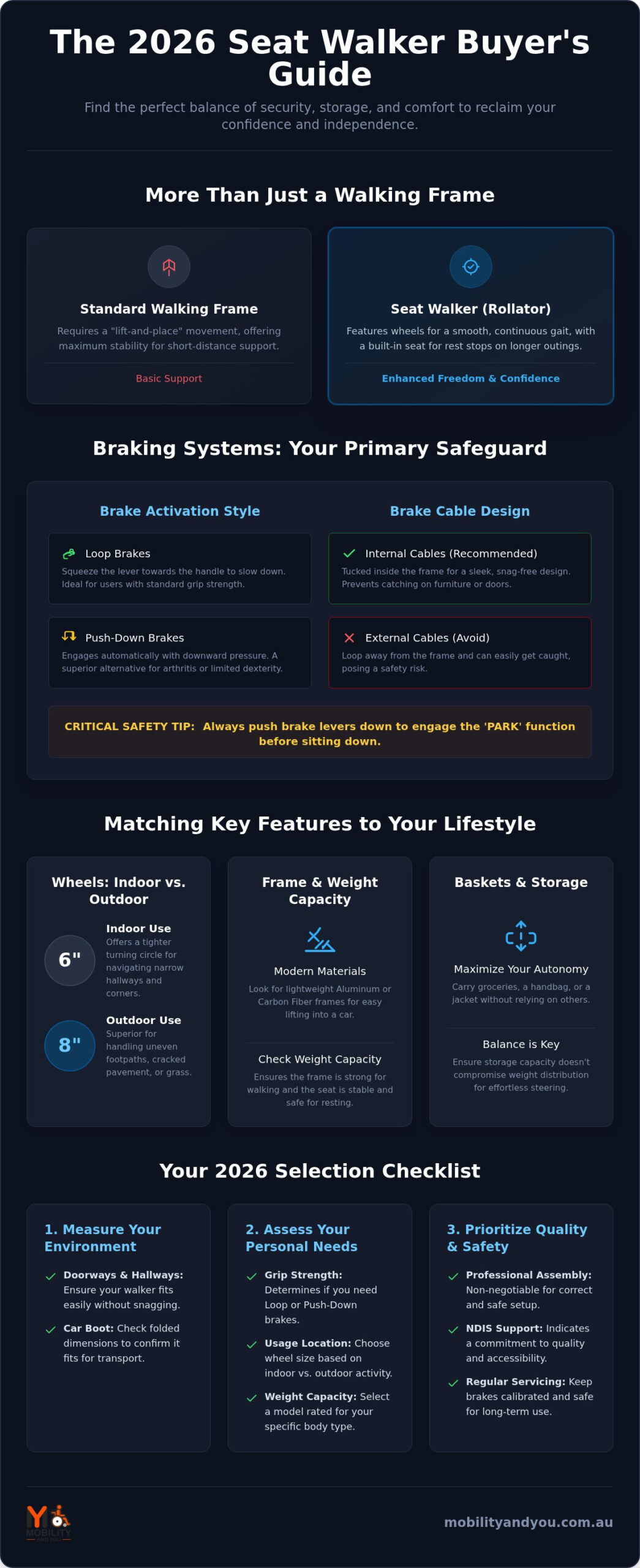
Selecting the right model depends heavily on where you plan to use it. For indoor use, smaller 6-inch wheels offer a tighter turning circle; this makes it easier to navigate narrow hallways or kitchen corners. However, if you enjoy walking on Australian footpaths or through local parks, 8-inch wheels are far superior for handling cracked pavement or uneven grass. It’s also vital to check weight capacity ratings. These aren’t just about the frame’s strength while walking. They ensure the seat is safe and stable for your specific body type when you’re taking that well-earned break. You can explore our full range of walkers and rollators to find the specifications that match your needs.
Evaluating Brake Systems: Safety Tailored to Your Strength
Security is the most vital feature of any mobility aid. When you’re using a seat walker with brakes and basket, the braking system acts as your primary safeguard against falls and unintended movement. It’s not just about stopping while you walk. It’s about ensuring the device remains perfectly still when you need to sit down. Most modern walkers feature a “park” or “lock” function. You engage this by pushing the brake levers downward until they click into place. We always recommend testing this function before you attempt to sit; a walker that rolls while you’re transitioning to the seat can lead to a serious injury.
You’ll also need to consider the cable design. Older or budget models often have external cables that loop away from the frame. These can easily snag on door handles, furniture, or the corners of your car boot when you’re loading the equipment. We suggest looking for models with internal brake cables. These are tucked neatly inside the frame, which provides a sleeker look and a much safer, snag-free experience. If you notice your brakes feel “spongy” or don’t engage immediately, it’s time for professional servicing to ensure your tension is correctly calibrated.
Loop Brakes vs. Push-Down Brakes
Most people are familiar with loop brakes. These require you to squeeze the lever toward the handle to slow down. They’re excellent for users with standard grip strength. However, if you live with severe arthritis or limited hand dexterity, loop brakes can be painful or difficult to manage. In these cases, push-down or compression brakes are a superior alternative. These systems engage the brakes automatically when you apply downward pressure on the handles. They’re incredibly intuitive for those who find squeezing a lever challenging, though they’re often best suited for flat, indoor surfaces where sudden stops on steep hills are less frequent.
Ergonomic Handle Design
The handles are your primary point of contact with your walker. Ergonomic designs now feature wider, contoured surfaces that distribute your weight across the entire palm. This prevents the “pins and needles” sensation that often comes from leaning on thin, round grips. Finding the right height is equally important. Stand tall and let your arms hang naturally; the handles should align with your wrist crease. Correct handle height ensures your hands are positioned to apply maximum pressure to the levers without straining your wrists. If you’re unsure which braking style feels most secure, you can explore our range of walkers to find a fit that matches your physical strength.
Baskets and Storage: Maximising Utility and Balance
A mobility aid is more than a tool for walking. It’s a way to carry your life with you. When you choose a seat walker with brakes and basket, you’re gaining the ability to shop independently or carry your own supplies to a picnic. Over the years, storage options have evolved significantly. We’ve moved away from the heavy, rattling wire baskets of the past toward modern nylon and vinyl bags. These newer materials are lighter, quieter, and often more durable in our harsh Australian sun.
However, storage isn’t just about how much you can carry. It’s about how that weight affects your safety. A common mistake is focusing only on the size of the basket without considering balance. If you place heavy items in a front-mounted basket, it shifts the center of gravity forward. This can make steering feel sluggish and, in some cases, increase the risk of the walker tipping when you encounter a kerb or a steep ramp. We often suggest exploring different configurations in our online shop to see which setup feels most stable for your walking style.
Front-Hanging Baskets vs. Under-Seat Bags
Front-hanging baskets offer the most convenient access. You don’t have to stand up or reach under the seat to grab your phone or purse. The trade-off is privacy. Items in a front basket are visible to everyone. Under-seat bags solve this by keeping your valuables tucked away and out of sight. Because these bags sit directly beneath the user’s center of mass, they provide much better balance and don’t interfere with the walker’s turning radius. When selecting a bag, look for vinyl or heavy-duty mesh. These materials resist tearing and are much easier to wipe clean if you’re out in the elements.
Carrying Capacity and Safety Limits
Most standard walker baskets are designed for a maximum weight limit of approximately 5kg. It’s tempting to overload them with heavy groceries, but doing so compromises the frame’s integrity and your stability. Overfilling can lead to tipping, especially when navigating the uneven surfaces of local parks. If you primarily use your walker indoors, you might consider a tray attachment instead. These provide a flat surface for transporting meals or tea from the kitchen to the lounge without the spills that come from placing loose items in a deep bag. For those who need to transport their aid frequently, look for removable storage. This allows the frame to fold more compactly, making it much simpler to fit into a car boot or storage cupboard.
Selection Checklist: Finding Your Perfect 2026 Model
Selecting the right seat walker with brakes and basket involves more than just a quick glance at a brochure. It requires a thoughtful assessment of your daily environment and your physical requirements. We want you to feel completely confident in your choice, so we’ve developed a practical checklist to guide your decision making process. This ensures your new aid doesn’t just sit in a corner, but becomes a vital part of your independent lifestyle.
Your first step should always be to grab a tape measure. Check the width of your narrowest interior doorway and the dimensions of your car boot. Many people find a walker they love, only to discover it’s two centimetres too wide for their bathroom door. Next, think about where you’ll spend most of your time. If you’re primarily visiting shopping centres, a compact frame with a tight turning circle is best. For those who enjoy local parks, larger wheels are necessary to handle grass and cracked footpaths. You also need to assess your grip strength. If squeezing standard levers is painful, you’ll want to prioritize the push-down braking systems we discussed earlier. Finally, check the seat height. Your feet should rest flat on the ground when you’re seated; this ensures you have the leverage needed to stand up safely. Don’t forget to explore your funding options through the NDIS or My Aged Care, as these schemes often cover the cost of high-quality mobility aids.
Portability and Folding Mechanisms
How you transport your walker is just as important as how you walk with it. Side-to-side folding models are increasingly popular in 2026 because they often stay upright when closed. This makes them much easier to store in a narrow hallway or behind a dining chair. Front-to-back folding models can be more compact but often require you to lay them flat. Always check the total weight of the frame. If you’re lifting it into a vehicle independently, every kilogram matters. Look for models with a secure locking mechanism that prevents the walker from springing open while you’re handling it.
Comfort Features for the Seat
Since the seat is your “rest station,” comfort is paramount. Padded seats offer much better support for longer breaks than basic plastic versions. You should also look at the backrest design. Flexible fabric straps are often more comfortable as they contour to your back, whereas curved metal bars provide a more rigid sense of security. Ensure the width between the handles provides enough space for you to sit without feeling pinched. If you’re still undecided, we invite you to contact our local team for a personalized recommendation tailored to your specific needs.
Why Quality and Support Matter for Your Mobility
Just as you choose high-quality equipment for safety, selecting the right support services is equally important; Liv.Care Singapore offers personalized care solutions that help families ensure their loved ones are safe and well-supported.
Professional assembly is another non-negotiable factor for your peace of mind. A walker that isn’t correctly adjusted can lead to poor posture or, worse, a mechanical failure during use. Our team ensures that every bolt is tightened and every brake cable is perfectly tensioned before you take your first step. By choosing a local Australian partner, you gain access to a support network that understands our unique healthcare landscape. If you ever need advice or a quick adjustment, you can contact us for a personalized fitting that prioritizes your specific physical needs.
The “Hire Before You Buy” Advantage
We know that choosing the right mobility aid is a big decision. This is why we offer a comprehensive equipment hire service. It allows you to “test drive” a walker in your own home environment. You can see how it fits through your narrowest hallway or how easily it folds into your car boot. This is especially helpful for those recovering from surgery who may only need an aid for a few months. If you decide the model is a perfect fit, we often allow you to apply a portion of your hire costs toward a final purchase. It’s a risk-free way to ensure you’re making the right choice for your long-term independence.
Ongoing Maintenance and Peace of Mind
Your journey doesn’t end when you take your walker home. To keep your seat walker with brakes and basket in top condition, we recommend annual maintenance checks. Our expert servicing department handles everything from wheel alignments to brake cable replacements. Having a local source for spare parts like baskets, seats, and rubber ferrules means you’ll never be left stranded by a minor break. We’re deeply committed to your safety and autonomy. Our heritage as a community-focused provider means we value these long-term relationships far more than a simple transaction. We’re here to support your movement every step of the way.
Step Confidently Into Your Next Adventure
Selecting the right mobility aid is a vital step toward reclaiming your independence and social freedom. By focusing on ergonomic braking systems that match your hand strength and choosing storage solutions that maintain your center of gravity, you’re setting yourself up for long term success. We’ve seen how a high quality seat walker with brakes and basket can transform a simple trip to the local supermarket into an enjoyable, stress-free outing. Remember that your safety depends on professional assembly and regular maintenance, which ensures every component remains as reliable as the day you first used it.
As an Australian owned and operated NDIS registered provider, we’re dedicated to helping you find a solution that fits your unique lifestyle. Our specialist repair and service centre is always available to keep your equipment in peak condition. Browse our range of high-quality seat walkers and rollators today and rediscover the joy of moving with total confidence. Your community is waiting for you to explore it; we’re honored to help you reach your destination safely and comfortably.
Frequently Asked Questions
What is the difference between a rollator and a seat walker?
There is no functional difference between these two terms; they describe the same type of mobility aid. “Rollator” is the technical term used by healthcare professionals and manufacturers, while “seat walker” is the more common name we use in Australia. Both refer to a walking frame equipped with wheels on all legs, a built-in seat, and a hand operated braking system.
Can I adjust the brake tension on my seat walker myself?
While many models have a small barrel adjuster on the brake cable for minor tightening, we strongly recommend professional servicing for any significant adjustments. Your safety depends on the brakes engaging evenly on both wheels. Our specialist team ensures the tension is perfectly calibrated so you don’t experience “spongy” brakes or unintended rolling when you try to sit down.
How much weight can a standard seat walker basket hold?
Most standard baskets and under-seat bags are designed to carry a maximum of 5kg. It’s vital to stay within this limit to maintain the device’s center of gravity. Overloading your seat walker with brakes and basket can make steering difficult and increases the risk of the frame tipping forward when you encounter a kerb or a small bump in the footpath.
Are seat walkers covered by NDIS funding in Australia?
Yes, seat walkers are typically covered under NDIS funding as Level 1 or 2 Assistive Technology. Because we are a registered NDIS provider, we can work with you and your Occupational Therapist to ensure the model you choose aligns with your plan’s goals. We also offer hire options if you need to provide evidence that a specific walker meets your physical requirements.
Which brake type is best for someone with arthritis?
Push-down or compression brakes are usually the best option for individuals with severe arthritis or limited grip strength. These brakes engage automatically when you lean your weight onto the handles, which removes the need to squeeze a traditional loop lever. This design reduces hand pain and ensures you can stop safely even on days when your dexterity is limited.
How do I know if a seat walker will fit in my car boot?
You should measure the width, depth, and height of your boot space before comparing it to the “folded dimensions” provided in the product specifications. Many 2026 models now feature side-folding mechanisms that allow the walker to stand upright while folded. This design often takes up less room and is much easier to lift into a vehicle than older front-to-back folding styles.
Is it safe to use a seat walker as a transport chair?
No, you should never allow someone to push you while you are sitting on a standard seat walker. These frames are designed for stationary resting only and lack the footrests and reinforced axles required for safe transport. Using a walker as a wheelchair can lead to the frame buckling or the user tipping over if the wheels hit a small stone or threshold.
How often should I have my seat walker serviced?
We recommend having your walker professionally serviced at least once every twelve months. Regular maintenance includes checking the brake cables for fraying, ensuring the wheels are aligned, and inspecting the seat hinges for wear. Keeping your seat walker with brakes and basket in top condition ensures it remains a reliable and secure partner for your daily outings and social activities.