The standard crutches you were issued at the hospital might actually be the biggest hurdle between you and your long-term independence. While traditional underarm models are the common choice for short-term fixes, they often lead to painful nerve pressure and a hunched posture that can hinder your overall recovery. We believe your mobility aid should feel like a natural extension of your body, not a source of new aches and frustrations.
We understand the daily challenges of navigating life with limited movement, from the fear of instability to the simple difficulty of performing daily tasks. You deserve to move with confidence and dignity. In this guide, we’ll discover why forearm crutches are often the preferred choice for long-term support and how they promote a healthier, more upright gait. We’ll also break down the essential 2026 updates regarding Medicare Part B coverage and hire options to ensure you have a clear path to the equipment you need. Our goal is to help you find a solution that restores your autonomy and provides the pain-free mobility you deserve.
Key Takeaways
- Learn how superior weight distribution across the arms protects sensitive nerves and promotes a more upright, dignified posture during recovery.
- Compare gait efficiencies to understand why forearm crutches offer greater agility and long-term comfort for active individuals.
- Identify critical features like dual-adjustability and lightweight materials that ensure your mobility aid feels like a natural extension of your body.
- Follow our professional fitting guide to achieve the perfect floor-to-grip height and cuff placement for maximum stability and safety.
- Explore how personalized equipment selection and expert local support can help you regain your independence and confidence in daily life.
What Are Forearm Crutches and How Do They Work?
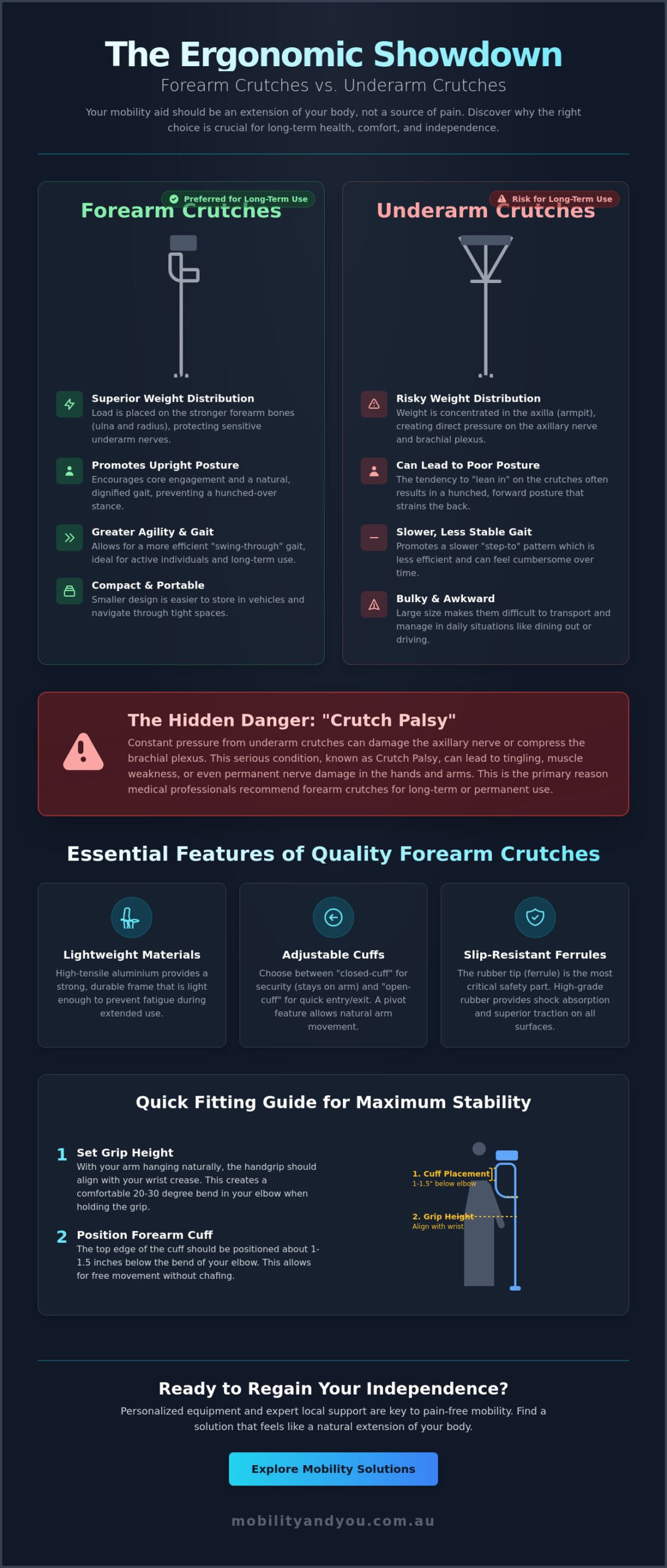
Forearm crutches, also known as Lofstrand or Canadian crutches, represent a significant advancement in ergonomic mobility design. Unlike traditional underarm models that can cause discomfort through nerve compression, these devices use a specialized cuff that encircles the arm. This design shifts the primary weight-bearing load away from the armpits and onto the stronger structures of the forearm. To understand the fundamental history and mechanical variations of these aids, one might ask What is a crutch?. At its core, the forearm model transfers your weight through the ulna and radius bones, providing a more stable and controlled movement pattern.
The choice between “open-cuff” and “closed-cuff” designs is a vital safety consideration. Closed-cuff models feature a full ring that stays attached to your arm even when you let go of the handle. This is incredibly helpful for daily tasks like reaching for your keys or opening a door. Open-cuff designs are easier to exit quickly, which some users prefer for specific safety reasons. We often help our clients navigate these choices based on their grip strength and daily environment. You can view our full range of options in our online shop to see these designs in detail.
The Anatomy of a Forearm Crutch
A high-quality crutch is built on a foundation of high-tensile aluminium. This material is essential because it provides a strong, durable frame while remaining light enough to prevent fatigue during long walks. The pivot cuff is another ingenious feature; it allows the cuff to tilt with your arm’s movement, maintaining a secure fit regardless of your arm angle. Finally, never overlook the ferrule. This rubber tip is the most critical safety component for slip resistance. It must be made of high-grade rubber to absorb shock and maintain traction on slippery surfaces like hospital tiles or wet pavements.
Who Benefits Most from Forearm Models?
While forearm crutches are the gold standard for individuals with permanent mobility challenges or conditions like cerebral palsy, they’re not just for long-term use. Many people recovering from leg injuries choose them for mid-term rehabilitation because they promote a more upright posture. Athletes also tend to prefer these models for active recovery. The design allows for a more efficient gait and greater agility, helping you move through the world with a sense of autonomy and confidence rather than feeling weighed down by your equipment.
Forearm vs Underarm Crutches: The Ergonomic Showdown
Choosing between these two mobility aids isn’t just about preference. It’s about how your body handles weight. Underarm crutches are the standard choice for many because they’re intuitive. You lean in, and they support you. However, this reliance on the axilla (armpit) creates a mechanical disadvantage. By contrast, forearm crutches require you to bear weight through your hands and arms. It’s a simple shift. But it changes everything. This design demands more core stability and upper body engagement, yet it rewards the user with a more efficient “swing-through” gait rather than the slower “step-to” pattern common with underarm models.
| Feature | Forearm Crutches | Underarm Crutches |
|---|---|---|
| Portability | Compact and easy to store | Bulky and hard to transport |
| Long-term Comfort | High; protects sensitive nerves | Low; risks axillary pressure |
| Learning Curve | Requires practice for balance | Intuitive and quick to learn |
The Risk of Underarm Pressure
Many users don’t realize that leaning on underarm pads can lead to “Crutch Palsy.” This condition occurs when constant pressure damages the axillary nerve or compresses the brachial plexus. It often starts as a simple tingle in the fingers. If ignored, it can progress to muscle weakness or permanent numbness. Because forearm crutches remove all contact with the armpit, they eliminate this risk entirely. They also reduce the strain on your shoulder joints. Underarm models often force the shoulders into an unnatural, shrugged position, which can lead to rotator cuff wear over time. Understanding these ergonomic differences is crucial for anyone facing a recovery period longer than a few weeks.
Posture and Independence
Dignity in movement starts with how you stand. Underarm crutches often cause users to slouch or look at the ground to maintain balance. Forearm models encourage a naturally upright spine. This improves your line of sight and helps you engage with the world around you. They’re also far more practical in tight spaces like small cafes or busy hallways. If you use a model with a closed cuff, you can even let go of the handle to open a door without the crutch falling to the floor. If you’re navigating a temporary injury and want to test these benefits yourself, our team can help you explore equipment hire options to find the best fit for your lifestyle.
Essential Features to Look for in Quality Forearm Crutches
Selecting the right mobility aid is a deeply personal decision that impacts your daily comfort and long-term health. When we evaluate forearm crutches, we look beyond the basic frame to the specific engineering that supports your independence. The material of the shaft is your first consideration. Lightweight aluminium is the most common choice, offering a robust Safe Working Load (SWL) while remaining easy to lift. For those seeking the absolute minimum weight to reduce shoulder fatigue, premium carbon fibre options provide exceptional strength without the bulk. You can explore these material options in our online shop to find a weight that feels right for you.
We believe that a perfect fit is non-negotiable for safe movement. This is why dual-adjustability is a vital feature. A quality crutch must allow you to adjust both the distance from the cuff to the grip and from the grip to the floor. This ensures the aid matches your unique proportions perfectly. Additionally, look for built-in shock absorption. Modern designs often include spring-loaded mechanisms or specialized tips that dampen the impact on your wrists and elbows with every step. This small detail can make a massive difference in preventing repetitive strain injuries over months of use. For those with lower-leg injuries who find crutches too physically demanding, it may also be worth exploring a knee scooter hire as an alternative recovery mobility solution that removes weight-bearing strain from the upper body entirely.
Handle Design and Grip Comfort
The interface between your hand and the crutch determines how long you can remain active before fatigue sets in. Standard grips are functional for short distances, but anatomical grips are designed to mirror the natural contours of your palm. These contoured shapes distribute pressure across a larger surface area, significantly reducing hot spots and cramping. We often recommend soft-touch rubber or gel inserts for our clients who rely on their aids for several hours a day. The angle of the handle is equally important; a slight downward tilt ensures your wrist remains in a neutral alignment, which prevents the median nerve compression often associated with long-term use.
Cuff Styles and Safety
The cuff is what keeps the crutch secured to your arm, and its design impacts both safety and convenience. Full-circle cuffs wrap entirely around the forearm, ensuring the crutch stays attached even if you release your grip to use your hands. V-shaped openings offer a “slip-away” design that some users find easier for quick entries and exits. We find that hinged cuffs offer the best range of motion, as they pivot with your arm as you move. When checking the adjustment mechanisms, prioritize secure push-button systems or screw-locks. These ensure the height settings remain fixed under pressure, providing the reliability you need to move with total confidence. If you have questions about which features suit your specific needs, we invite you to contact our team for personalized guidance.
How to Correctly Fit and Walk with Forearm Crutches
A mobility aid only works as well as it fits. When we assist our clients, we emphasize that forearm crutches are precision tools. If they aren’t adjusted to your specific body measurements, they can cause more harm than good. To ensure your safety and comfort, we follow a rigorous four-step fitting process that turns your equipment into a natural extension of your movement. We want you to feel secure from the very first step.
- Step 1: Floor-to-Grip Height: Stand as upright as possible with your arms hanging naturally at your sides. The handle should align exactly with your wrist crease. This ensures your weight is supported without straining your wrist joints.
- Step 2: Cuff Position: Adjust the cuff so it sits approximately 2 inches below the bend of your elbow. This placement provides essential stability while allowing your arm to pivot freely for daily tasks.
- Step 3: The Elbow Bend: Once you grip the handles, check your elbow angle. You should have a slight bend of 15 to 30 degrees. This provides the mechanical leverage needed to propel yourself forward safely.
- Step 4: The Shoe Test: Always perform your final adjustments while wearing your standard walking shoes. A flat slipper versus a supportive sneaker can change your height enough to throw off your alignment.
Mastering the Gait
Learning to walk with new equipment takes patience. For those with partial weight-bearing requirements, we recommend the Two-Point Gait. This pattern mimics natural walking by moving the crutch and the opposite leg forward at the same time. It’s the most fluid way to maintain a steady rhythm. If you’re recovering from a surgery where one leg cannot touch the ground, the Three-Point Gait is your best option. Move both crutches forward first, then swing your unaffected leg through. Navigating the uneven Australian footpaths or steep stairs requires extra care. When going up, lead with your “good” leg; when going down, lead with the crutches and your injured leg. This simple rule keeps your center of gravity stable and prevents falls.
Common Fitting Mistakes to Avoid
One of the most frequent errors we see is setting the height too high. This forces you to shrug your shoulders, which quickly leads to tension headaches and neck pain. Similarly, a cuff that is too tight can restrict circulation, while a cuff positioned too high on the arm limits your range of motion. These subtle errors can undermine your recovery and lead to secondary injuries that are entirely preventable. If you feel any tingling or persistent discomfort, it’s a sign that your settings need adjustment. We invite you to Contact our team for a professional fitting to ensure your equipment is perfectly calibrated for your body. You can also browse our resources page for more practical tips on maintaining your independence during recovery.
Finding Your Perfect Mobility Solution with Mobility and You
At Mobility and You, we’re dedicated to more than just providing equipment. We’re committed to restoring your dignity and independence through tailored solutions that fit your life. Our team understands that choosing forearm crutches is a step toward greater autonomy, and we’re here to ensure that step is taken with confidence. As a trusted regional partner, we pride ourselves on building long-term relationships with our community. We don’t just hand over a product; we offer the technical expertise and compassionate support you need to navigate your recovery journey.
We work closely with the National Disability Insurance Scheme (NDIS) and My Aged Care providers to ensure our clients receive the high-quality equipment they deserve. Navigating government schemes can feel overwhelming, but our experienced staff is here to simplify the process. Beyond the initial selection, we provide comprehensive equipment servicing and maintenance. Regular check-ups on your ferrules and adjustment locks ensure your mobility aid remains a reliable extension of your body for years to come.
Hire vs. Purchase: Which is Right for You?
Deciding whether to buy or rent can be difficult when your recovery timeline is uncertain. For those facing a brief rehabilitation of a few weeks, equipment hire is often the most practical and cost-effective choice. It allows you to access premium technology without a long-term commitment. However, if you’re managing a permanent condition or a multi-month recovery, purchasing your own pair offers better long-term value. Our hire-to-buy options provide a flexible middle ground. You can start by renting to ensure the fit is perfect before deciding to make the equipment your own. If your injury is specifically below the knee and crutches feel too strenuous, you may also want to consider our knee scooter hire guide for lower-leg injury recovery as a hands-free alternative that keeps you mobile and independent.
Support for Occupational Therapists and Healthcare Pros
We value our collaborative relationships with healthcare professionals across the country. Our team works hand-in-hand with Occupational Therapists to ensure every clinical requirement is met with precision. Whether you’re an OT looking for specific technical specifications or a participant seeking to maximize your funding, you can access our NDIS resources for streamlined assistance. We invite you to explore our full range of mobility aids and walking sticks to find the solution that best supports your goals for movement and freedom. If you prefer a face-to-face conversation, our doors are always open for personalized, in-person engagement.
Take the Next Step Toward Confident Movement
Choosing the right mobility aid is a proactive decision for your long-term health and well-being. By opting for forearm crutches, you’re prioritizing nerve safety and a naturally upright posture that preserves your dignity. We’ve explored how high-quality materials and a precision fit can transform your recovery from a daily struggle into a manageable, smooth transition. Whether you’re navigating a short-term injury or managing a permanent condition, sourcing reliable equipment from a family-owned specialist like Care2MoveMobility makes a profound difference in your daily autonomy and confidence.
As an NDIS Registered Provider with over 10 years of providing compassionate, professional advice, we’re here to support you every step of the way. Our commitment to your independence includes expert equipment servicing and repairs to keep your aids in peak condition. We invite you to Browse our range of forearm crutches and mobility aids today. You don’t have to navigate these complex health challenges alone. We’re ready to help you rediscover the freedom and quality of life you deserve. Your journey toward pain-free mobility starts with a single, supported step.
Frequently Asked Questions
Is it harder to learn to use forearm crutches than underarm crutches?
Learning to use forearm models typically takes more practice than underarm crutches because they require greater upper body coordination and active balance. While underarm models are intuitive for immediate use, the forearm design rewards patient practice with a more natural gait and increased agility over time. Most users find that once they master the balance, the increased maneuverability is well worth the initial learning curve.
Can I use forearm crutches if I have weak wrists or arthritis?
You can use these aids with wrist challenges, provided you select models with anatomical or padded grips. These specialized handles distribute weight across the palm to reduce pressure on specific joints. If wrist stability is a significant concern, we recommend consulting with an Occupational Therapist to ensure the cuff height is perfectly calibrated to support your forearm rather than straining the joint.
What is the weight limit for standard forearm crutches in Australia?
Standard models in Australia typically support a Safe Working Load (SWL) between 120kg and 160kg. For users requiring higher weight capacities, bariatric versions are available that can support up to 325kg. It is essential to check the manufacturer’s specific rating on the shaft or product manual to ensure the equipment safely meets your individual requirements for long-term use.
Are forearm crutches covered by NDIS or My Aged Care funding?
Yes, forearm crutches are generally covered under NDIS and My Aged Care funding when they are deemed a necessary piece of Assistive Technology for your mobility goals. Participants can typically use their core or capital supports budget to secure this equipment. We suggest discussing your specific mobility requirements with your plan coordinator to ensure the chosen model aligns with your approved funding categories.
How do I know if my crutch ferrules need replacing?
You should replace your ferrules when the tread pattern becomes smooth or if you notice the rubber wearing unevenly. A worn ferrule significantly reduces slip resistance and shock absorption, which increases the risk of falls on slick surfaces. We suggest a weekly visual check; if the internal metal washer is visible through the rubber, the tip is no longer safe and requires immediate replacement.
Can I use just one forearm crutch, or do I always need a pair?
You can use a single crutch if you only require partial support or are transitioning away from full assistance during your recovery. When using one, always place it on the side opposite your injured leg to mimic a natural walking pattern and balance your center of gravity. However, a pair remains essential for non-weight-bearing recovery to ensure total stability and safe movement.
What is the best way to walk up stairs with forearm crutches?
The safest method for stairs is the “up with the good, down with the bad” rule. When ascending, lead with your stronger leg followed by the crutches and the injured leg. When descending, place the crutches on the lower step first, then step down with the injured leg, followed by your stronger leg. This sequence ensures your center of gravity remains supported by the equipment at all times.
Are there collapsible forearm crutches available for travel?
Yes, collapsible and telescopic forearm crutches are available specifically for travel and easy storage in vehicles or overhead compartments. These designs feature a folding hinge or a push-button shaft that allows the crutch to be reduced to a compact size. They maintain the same safety standards and weight capacities as standard frames while offering the flexibility needed for an active, mobile lifestyle. For those heading on a cruise, using a secure facility like East Coast Parking ensures your vehicle is safe while you enjoy your trip with your portable mobility aids.