Will a long single adjustable bed fit the person, the room and the mattress you have in mind? A base that moves comfortably still needs a mattress designed to flex with it. If you’re comparing a long single adjustable bed for sale, assess the complete setup rather than choosing features by appearance alone.
The right choice depends on the sleeper’s height and preferences, the room’s dimensions, mattress compatibility and which adjustments will be useful in daily life. Consider the positions the person prefers for reading, resting or getting comfortable, and whether they can operate the controls easily.
This guide covers what to measure for Australian long single sizing, how to assess mattress and base compatibility, and how to compare adjustment functions with everyday needs. Use the checklists to organise your requirements and make a more informed comparison.
Key Takeaways
- Measure the sleeper, room and access route to see whether a long single setup will fit and be practical to use.
- Compare the mattress and base as a complete setup. The mattress needs to flex with the base and match its supported area.
- Choose adjustment functions for their everyday usefulness, not simply because they are included.
- Gather measurements, mattress details and user preferences before comparing options.
- Keep the person who will use the bed at the centre of the decision, with comfort and independence as priorities.
What to check before buying a long single adjustable bed
A long single adjustable bed pairs a long single mattress with a base that changes position. An Australian long single is wider like a single bed but longer than a standard single, so it may suit someone who needs more length without the wider footprint of a double. Exact dimensions can vary, so compare the stated measurements rather than relying on the size name alone.
The mattress measurement is only one part of the fit. The base may have a larger overall footprint, and a frame or accessories can require additional space. An adjustable bed can be positioned for different resting and sitting activities, but the full setup needs to fit the person and the bedroom.
How do you know if a long single is the right size?
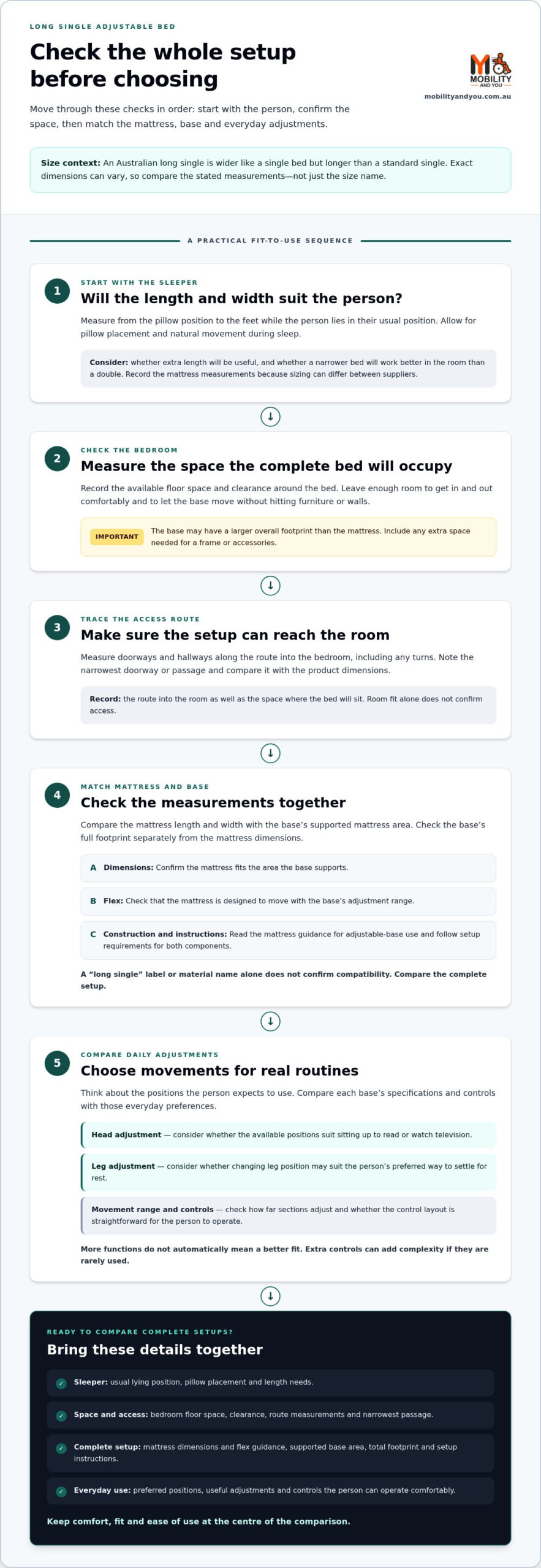
Measure the sleeper lying comfortably in their usual position, including pillow placement and room for natural movement during sleep. Consider whether the extra length will be useful and whether a narrower bed will work better in the room than a double. Record the mattress dimensions and compare them with the stated Australian sizing, since measurements can differ between suppliers.
What should you measure in the bedroom?
Measure the floor space where the bed will sit. Then check doorways, hallways and turns along the route into the room. Leave enough clearance to get in and out comfortably and to allow the base to move without hitting furniture or walls.
Before comparing a long single adjustable bed for sale, write down these measurements and compare them with the product specifications. Check the mattress dimensions and the base’s total footprint, including any space needed for a frame or accessories. This helps identify a setup that fits the room without making everyday access awkward.
- Sleeper: Measure from the pillow position to the feet while lying in a usual position.
- Room: Record the available floor space and clearance around the bed.
- Access: Measure the narrowest doorway or passage on the route into the room.
- Base: Compare the full base footprint, not just the mattress dimensions.
Taking these measurements first gives you a practical basis for comparing options and planning a comfortable, accessible setup.
How an adjustable base and mattress work together
An adjustable base and mattress need to work as one setup. As the base changes position, the mattress must flex with it and remain supported. Compatibility depends on the mattress construction and the base’s requirements, so a size label or material name alone does not tell you whether two components are suitable together.
When comparing a long single adjustable bed for sale, look beyond whether the mattress is labelled “long single”. Compare its actual dimensions with the base specifications, then consider whether it is designed to move with the base. A mattress that does not flex as intended may not sit or feel right when the base changes position.
Which mattress details matter on an adjustable bed?
Check the mattress construction and its instructions for use with an adjustable base. Different designs can respond differently to bending, so don’t assume a particular material is automatically suitable. Compare the mattress length and width with the base’s mattress-supporting area, and follow the setup instructions for both components.
Which adjustable movements may matter in daily use?
Head and leg adjustments can change the person’s position for everyday activities. Raising the head may make reading or watching television more comfortable, while changing the leg position offers another way to settle in for rest. Think about the person’s routines and the positions they are likely to use. Choose functions for practical use, not as a promise of a medical or health outcome.
Use this checklist to compare mattress and base compatibility:
- Dimensions: Compare the mattress measurements with the base’s supported mattress area.
- Movement: Check that the mattress is designed to flex with the base’s adjustment range.
- Construction: Read the mattress information for guidance on adjustable-base use.
- Instructions: Review the setup requirements for both the base and mattress, including any placement or support guidance.
Compare the mattress and base together instead of choosing one first and assuming it will suit the other. This keeps fit, comfort and ease of use in view throughout the decision.
Browse adjustable bed options and use these checks to compare complete setups.
Which long single adjustable bed features are worth comparing?
The most useful features are those that match the person’s routines and preferences. More functions do not automatically make a bed a better fit. Extra controls can add complexity if they are rarely used. Start with the essentials: a suitable fit, straightforward operation and adjustments the person expects to use. Then consider whether optional conveniences have a practical benefit.
How can you compare adjustment functions?
Start with familiar activities, such as sitting up to read or changing position before resting. Compare the available movements and controls with those routines, using the product specifications to understand what each base can do. “Movement range” describes how far a section of the bed can adjust. Check each model’s specifications rather than assuming the range or control layout is the same across beds.
| Feature to compare | Everyday situation to consider | What to assess |
|---|---|---|
| Head adjustment | Sitting up to read or watch television | Whether the available positions suit the person’s preferred posture |
| Leg adjustment | Changing position while resting | How this movement works alongside head adjustment, as described in the specifications |
| Controls | Making adjustments without relying on someone else | Whether buttons and labels are clear and manageable for the user |
| Optional convenience features | Making the bedroom routine easier | Whether an added feature has a practical purpose for this person |
When comparing a long single adjustable bed for sale, separate essential functions from optional extras. Prioritise fit, ease of use and adjustments that support regular activities. Consider conveniences only once those needs are clear.
What should families and caregivers consider?
Include the person who will use the bed in the decision wherever possible. Their comfort, preferences and independence matter alongside practical considerations for family members or caregivers. If the user will operate the controls, consider whether the layout is clear and manageable for them. Others can help compare specifications while keeping the user’s choices central.
If a particular position is being considered for a clinical or rehabilitation reason, discuss that need with the appropriate health professional rather than treating a product feature as a clinical recommendation. This helps keep the decision grounded in the person’s circumstances and focused on useful everyday functions.
How to prepare for a long single adjustable-bed purchase
Prepare a short list of needs and measurements before comparing options. Keep the room dimensions, mattress details and user preferences together so you can assess each setup consistently. Family members or caregivers can help gather information, while the user’s preferences guide the decision.
What information should you gather before comparing beds?
Start a comparison sheet or notes page. Record preferred positions, daily routines, room measurements, access constraints and details of any existing mattress. Separate essential requirements from features that would simply be nice to have. This makes it easier to assess a long single adjustable bed for sale without letting optional extras distract from fit and everyday use.
How can you plan for delivery and everyday setup?
Think beyond where the bed will sit. Consider the route into the room, nearby furniture, access to power connections and whether the person can reach and understand the controls from their usual position. Read the equipment’s setup and care instructions so you know what the everyday arrangement involves.
Use this sequence to organise your comparison:
- Identify needs: Note the user’s preferred resting positions, daily routines and priorities. Invite family or caregivers to contribute, but let the user’s choices guide the discussion.
- Measure: Record the room space, access route and necessary clearances, then keep the measurements together.
- Compare compatibility: Note the existing mattress details, if applicable, and compare mattress and base specifications as a complete setup.
- Review functions: Separate essential adjustments from features that are desirable but not needed for regular use.
- Plan setup: Consider the bed’s position, power access, control placement and the setup and care instructions.
Keep a short list of questions beside your notes. For example, distinguish the measurements for the mattress from those for the base, and note how the controls operate. This gives the user and anyone helping with the comparison a shared set of practical details.
If you’re considering NDIS funding, read the NDIS equipment information and consider how eligibility applies to your circumstances. Once your needs and measurements are organised, browse adjustable bed options to continue your comparison.
Find an adjustable bed that supports comfort and independence
A suitable adjustable bed brings several decisions together: a size that fits the person and room, a mattress and base that work as a complete setup, functions that support familiar routines, and a practical layout for everyday use. The longest feature list is not necessarily the best fit. Focus on what helps the person feel comfortable and maintain as much independence as possible.
When is an adjustable bed a practical choice?
An adjustable bed may suit someone who wants to change position for activities such as reading, resting or settling in for the night. Its practicality depends on the person’s preferences, the available space and mattress-base compatibility. An adjustable bed is generally intended for home use and positioning, while a hospital bed is designed for a healthcare setting and may have different functions.
Consider how the bed will fit into the person’s routine. Can they operate the controls comfortably? Do the available adjustments match positions they actually prefer? A thoughtful match can support comfort and choice without assuming that a particular bed or position will provide a health outcome.
Where can shoppers explore adjustable-bed options?
Mobility and You offers adjustable beds as part of its wider range of mobility and daily-living equipment. The team helps customers find equipment suited to their needs, so bed selection can be considered alongside practical needs and independence. If you’re comparing a long single adjustable bed for sale, use your notes on fit, mattress compatibility, useful functions and setup to guide your choice.
Explore adjustable beds and equipment, then compare the options against the user’s preferences and everyday needs.
A clear comparison can help the user, family and caregivers feel more confident about the choice while keeping the user’s comfort and independence at the centre.
Explore adjustable bed options when you’re ready to take the next step.
Choose a setup that supports your everyday comfort
Choosing a long single adjustable bed involves more than selecting a size. Check that the bed suits the person and room, that the mattress and base are compatible, and that the adjustments and controls make sense for daily use. Careful comparison helps you focus on practical needs rather than features that may go unused.
If you’re considering a long single adjustable bed for sale, keep the user’s preferences at the centre of the decision. Record key measurements, mattress details and the functions that matter most, then use them to compare options.
Adjustable beds are part of Mobility and You’s wider mobility and daily-living equipment range. The team helps customers find equipment suited to their needs, with comfort and independence in mind.
When you’re ready to take the next step, explore adjustable bed options. Use your measurements and priorities to choose a setup that fits the person’s everyday needs.
Frequently Asked Questions
What is a long single adjustable bed?
A long single adjustable bed pairs a long single mattress with a base that changes position, such as raising the head or leg section. In Australian sizing, a long single is generally longer than a standard single while remaining narrower than a double, but exact dimensions can vary. Compare the mattress and base specifications rather than relying on the size label alone.
How do I choose the right size long single adjustable bed?
Measure the person lying comfortably in their usual sleeping position, including pillow placement, then compare the measurement with the mattress dimensions. Check the room’s available floor space and leave clearance around the base for access and movement. A long single may suit someone who wants more length than a standard single without the width of a double. Compare the stated Australian measurements, as sizing can vary.
Can you use any mattress on an adjustable bed?
No, not every mattress is suitable for an adjustable base. The mattress needs to flex with the base and match the dimensions of its supported area. Suitability depends on the mattress construction and the base’s requirements, so a material or size label alone does not guarantee compatibility. Review the instructions and specifications for both components before putting them together, especially if you’re keeping an existing mattress.
What features should I look for in an adjustable bed?
Prioritise features that fit the user’s daily routines. Head adjustment may be useful for sitting up to read, while leg adjustment provides another way to change position for resting. Consider whether the controls are clear and manageable for the person using the bed. Optional conveniences are worth comparing when they serve a practical purpose, but more functions do not necessarily mean a better fit.
Is a long single adjustable bed the same as a hospital bed?
No. A long single adjustable bed is a size-specific home bed setup with a base that changes the mattress position. A hospital bed is designed for a healthcare setting and may have different functions and support features. The terms are not interchangeable, and an adjustable home bed should not be assumed to provide hospital-bed functionality. If a clinical requirement is involved, seek guidance from the appropriate health professional.
How do I measure a bedroom for an adjustable bed?
Measure the space where the bed will sit, including room for getting in and out and for the base to move. Also measure doorways, hallways and turns along the route into the bedroom. Compare these measurements with the base’s overall footprint, not just the mattress dimensions. Include any frame or accessory allowances and consider power access and nearby furniture when planning the layout.
Can an adjustable bed support independence at home?
An adjustable bed may support a person’s independence by letting them change position with the bed’s controls, if those controls are comfortable and manageable for them. Its usefulness depends on the person’s preferences, routines, room layout and the complete bed setup. Mobility and You offers adjustable beds as part of its equipment range, and its team helps customers find equipment suited to their needs. The user’s choices should guide the decision.