Medicare coverage isn’t the only consideration when planning bathroom safety in Australia. To understand how to make a bathroom safer for seniors, start with practical changes that support steadier movement, such as suitable bathroom aids, accessible storage and bright, even lighting.
It’s understandable to want a clear answer about whether Medicare will pay for equipment. Funding depends on the support pathway and the person’s circumstances, so consider coverage separately from safety changes that may make daily routines easier. This guide covers useful options, including raised toilet seats, shower seating and grab rails, as well as ways to reduce clutter and improve visibility. It also explains what to consider when choosing equipment and how bathroom aids can support comfort, confidence and independence at home.
Key Takeaways
- Consider a raised toilet seat if standing up or sitting down takes extra effort, and make sure the user’s feet can rest comfortably on the floor.
- Explore shower seating and lower-threshold access to make bathing easier, while reducing slippery surfaces and obstacles.
- Place grab rails where they support the person’s movements, and ensure they’re securely fixed rather than relying on towel rails or holders.
- Keep daily toiletries and towels within easy reach, and use bright, even lighting to make bathroom hazards easier to see.
- Learn what to consider about Medicare coverage and when bathroom aids may help support safer, more independent routines.
1. Raised toilet seats
A raised toilet seat can make sitting down and standing up easier by reducing how far a person needs to bend. These seats add 5–10 cm of height to a standard toilet seat. That difference may help someone whose knees, hips or balance make a low seat difficult to use. While equipment assists with daily transfers, addressing underlying joint discomfort and stiffness with healthcare professionals—such as a chiropractor Russell Ontario or a local physical therapist—can also support functional movement. The right height is personal, so focus on comfortable movement rather than choosing the tallest option.
Check the user’s position before choosing a seat height. When seated, both feet should touch the floor; if they don’t, the seat may be too high. They should also feel stable when sitting down and standing up. A seat that feels awkward or affects their balance may not suit their needs, even if it provides the desired height.
Raised seats come with different features. Some have adjustable height, cushioning or handrails, while others are easy to remove. Choose features that address the person’s main difficulty: extra height can reduce bending, while handrails provide a place to hold during transfers. Follow the product’s installation instructions and check that the seat is stable before use. Most raised toilet seats can be installed in minutes without tools.
Toilet safety rails and grab bars are related, but they aren’t automatically interchangeable. Some raised toilet seats include handrails. Fixed grab bars can provide another handhold near the toilet, with placement based on the person’s reach and how they move between sitting and standing. A towel rail or toilet paper holder isn’t designed to support someone’s weight. Position each support where the user can reach it without twisting.
Storage matters during toilet use, too. Keep toilet paper, toiletries and other daily essentials within easy reach, rather than on a high shelf or across the room. This reduces the need to bend, stretch or twist while seated or standing. For example, move frequently used supplies to an accessible shelf beside the toilet, and keep the area around the seat clear for transfers.
A motorised toilet incline lift is another option for someone who needs powered assistance. A button raises and lowers the seat to help guide the movement between sitting and standing. Consider whether the person can reach and operate the button from their usual position. Compare this option with a raised seat’s simpler increase in height and handrails, then focus on the support that best matches their movement needs.
2. Walk-in tubs, stand-up showers and transfer benches
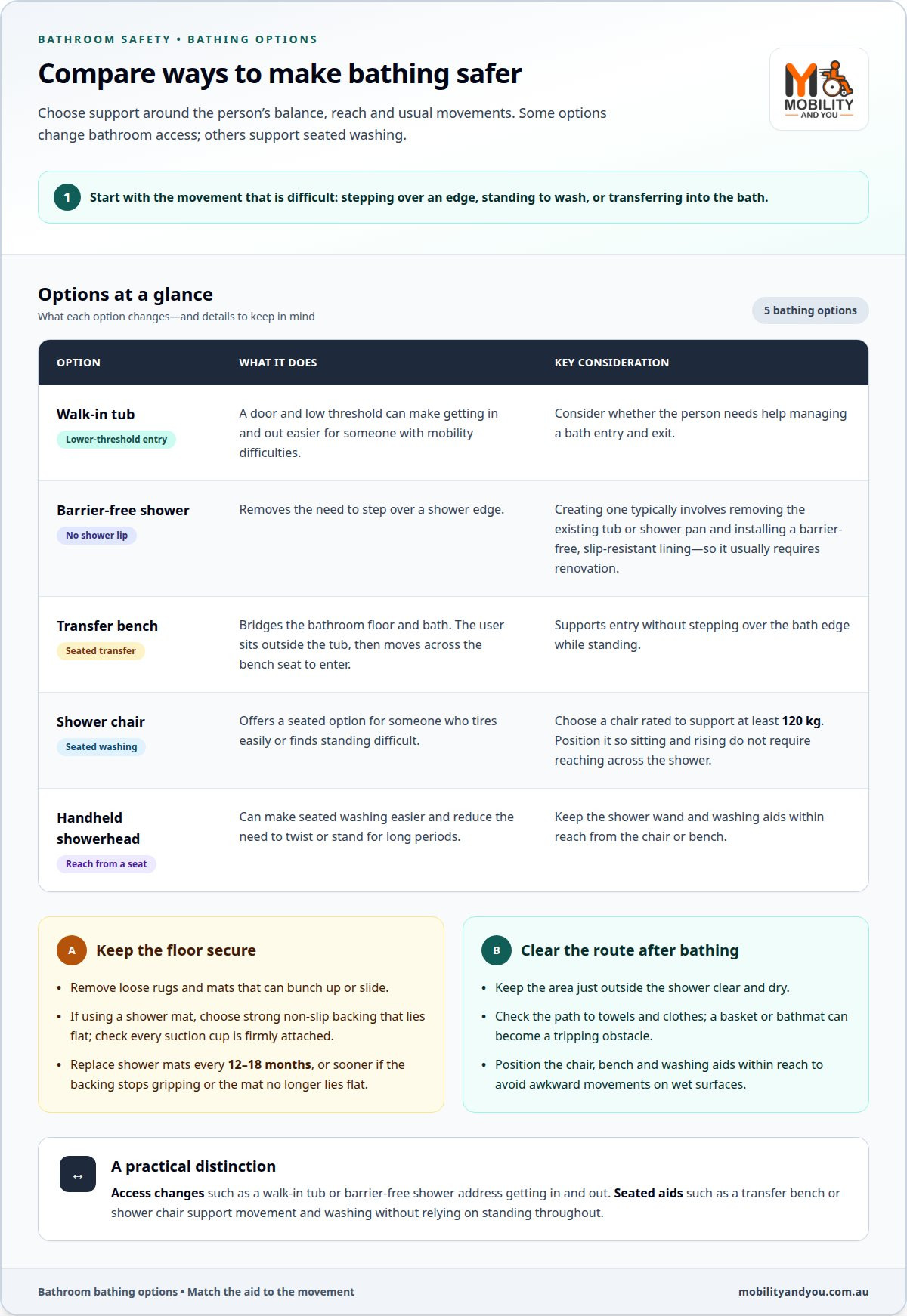
Getting into a bath or shower can involve stepping over a slippery edge, turning and balancing at the same time. A walk-in tub has a door and low threshold, which can make entry and exit easier for someone with mobility difficulties. A barrier-free shower removes the need to step over a shower lip. Creating one typically involves removing the existing tub or shower pan and installing a barrier-free, slip-resistant lining, so it usually requires renovation.
A transfer bench can bridge the gap between the bathroom floor and the bath. The user sits on the bench outside the tub, then moves across its seat to enter, rather than stepping over the edge while standing. A shower chair offers a seated option for someone who tires easily or finds standing difficult. Choose a chair rated to support at least 120 kg, and position it so the person can sit down and rise without reaching across the shower.
A handheld showerhead can make seated washing easier and reduce the need to twist or stand for long periods. A long-handled bath aid can help someone reach their lower legs or feet without bending as far. Keep the shower wand and washing aids within reach from the chair or bench. This can help the person manage more of their routine independently and avoid awkward movements on wet surfaces.
Floor protection needs careful placement. Remove loose rugs and mats, which can bunch up or slide underfoot. If a shower mat is used, choose one with strong non-slip backing that lies flat. Position it before entering the shower and check that every suction cup is firmly attached. Replace shower mats every 12–18 months, or sooner if the backing no longer grips or the mat no longer lies flat.
Look beyond the shower base. Wet feet can make the floor just outside the shower dangerous, so keep that area clear and dry, and use only a mat that stays firmly in place. Check the route from the shower to the towel and clothes; a basket or bathmat in that path can become a tripping obstacle. Clear access matters during everyday bathing and if someone needs to leave quickly in an emergency.
A raised toilet seat supports sitting down and standing up at the toilet, while shower seating supports bathing. For safer transfers, match each aid to the person’s balance, reach and usual movements. A walk-in tub or barrier-free shower may make access easier, but renovation makes these larger changes than adding a chair or handheld showerhead.
3. Does Medicare pay for bathroom safety equipment?
In Australia, Medicare isn’t generally the funding route for home bathroom safety equipment or modifications. Australian government grants or NDIS funding may help eligible people, depending on the program’s criteria and the person’s support needs.
There’s no single cost for making a bathroom safer. The total depends on the changes involved, such as adding grab rails, choosing a shower chair or modifying the room. Attaching a rail to a suitable wall is different from undertaking a renovation, and the work required depends on the bathroom and the person’s needs.
Grab rails can provide stability beside a toilet or in a shower, especially when sitting, standing or transferring. Place them to suit the user’s reach and movements. For example, someone who pushes up from the toilet may need a rail within reach while sitting and rising. Someone stepping into a shower may need support near the entry. One position won’t suit every movement.
Secure installation matters. A wall-mounted grab rail should be anchored into suitable backing, using a fixing method suited to the wall surface. Rails bolted to a wall are safer than suction-held rails. A suction rail can shift under pressure, so it shouldn’t be treated as a substitute for a securely fixed support.
Plan the rail around the person, not just the room layout. Consider which hand they use, how far they can reach, and whether they turn or transfer from a shower chair. Near the toilet, the rail should support the movement between sitting and standing. In the shower, it should be reachable without leaning across wet surfaces. A rail that’s awkward to grasp may offer little practical help.
Don’t use towel rails or toilet paper holders as grab bars. They aren’t designed to support someone’s weight and may fail if pulled during a transfer. Toilet seats and shower chairs also serve different purposes: a seat changes sitting height, while a chair provides a place to rest during bathing. Neither replaces a properly positioned, fixed rail when the person needs a handhold.
For NDIS participants, funding depends on whether the requested support meets the program’s criteria and relates to their needs. The NDIS support information can help readers explore that pathway. A useful starting point is to identify the specific movement that needs support, such as rising from the toilet or entering the shower, then match rail placement to that task.
4. Accessible storage and clutter reduction
Bathroom storage should support the person’s routine without making them bend, stretch or step around objects. Keep daily items, such as soap, a toothbrush and clean towels, within reach. Put occasional supplies in higher cupboards, not beside the shower or toilet where reaching for them could affect balance. Clear benchtops and floors also make it easier to move safely through the room.
Start with the route the person uses, from the doorway to the toilet, basin and bathing area. Remove laundry baskets, spare toiletries and loose items from that path. If they use a mobility aid, keep the approach and turning space clear. A frequently used item placed behind the bathroom door can be difficult to reach when the door is open, so choose storage that remains accessible.
Small adjustments can support independence without changing the room. A low, open shelf near the basin can keep everyday products visible and within reach. A wall-mounted dispenser can reduce bottles on the shower floor or ledge. Store heavier items at waist height rather than above shoulder level or near the floor. Keep the towel close to the exit, so the person doesn’t need to cross wet surfaces to reach it.
For larger bathroom safety upgrades, consider how the layout supports movement between fixtures. A narrow route, awkward door position or crowded vanity can make transfers difficult. Renovation planning can address these constraints by reorganising storage, opting for custom-tailored washbasins from specialist makers like CRÉER to ensure comfortable clearance, or creating a more usable bathing area. The best layout depends on how the person approaches, turns and reaches each fixture.
Accessible bathtubs also need practical space around them. Keep the entry area clear, put towels and controls within reach, and avoid storing products where someone must lean over the bath. If the person uses a transfer aid, leave enough space beside the tub for that movement. A clear floor supports a steadier approach and makes it easier for someone else to assist when needed.
Australian building and accessibility requirements depend on the renovation’s scope and setting. Identify the requirements that apply to the specific work before finalising the design; don’t assume one layout or measurement suits every home. For example, a minor storage change differs from altering a bathroom’s structure or access.
Finish by checking the room from the user’s perspective. Can they reach the soap while seated? Is the towel accessible without stepping away from a stable position? Can they move from the doorway to the toilet without shifting stored items? These practical checks show whether storage supports the person’s routine or creates new obstacles.
5. Improving bathroom and hallway lighting
Bright, even bathroom lighting is especially useful at night, when familiar surroundings may be harder to see clearly. Check the light from the doorway, beside the toilet and around the shower. Dark corners, shadows and abrupt shifts between bright and dim areas can make it harder to notice a wet patch, raised edge or object on the floor. Aim for consistent visibility along the route.
Look at the bathroom from the user’s usual position. A ceiling light may leave a shadow beside the vanity or behind the open door. Add suitable lighting in darker areas so the toilet, basin and shower entry remain visible. Light should reveal surfaces and obstacles without shining directly into someone’s eyes. This matters when moving, particularly for someone using a mobility aid or holding a grab bar.
Night lights can make the route between the bedroom and bathroom easier to follow. Place them along the way, including near the bedroom doorway and bathroom entrance. A night light near the toilet can help someone orient themselves without relying on a bright overhead light. Choose positions that illuminate the floor and doorway, rather than leaving dark gaps between lit areas.
Check the route after dark, not just during the day. Walk from the bedroom to the bathroom and notice where floors, doorways or changes in direction become difficult to see. For example, a hallway night light may reveal the path, while a separate bathroom light helps show the shower entrance. Keep cords and lamps out of the walking area, where they could create another hazard.
Lighting works alongside other safety measures; it doesn’t make slippery surfaces safe by itself. Use light to spot water on the floor, but also keep the route clear and dry. Make sure the toilet and shower area remain visible when the bathroom door is open. If someone reaches for a grab bar, they should be able to see its location and the surrounding floor before moving.
Test the arrangement from the person’s perspective. Can they find the switch or see the night lights before taking their first step? Check whether a bedside light casts enough light towards the doorway and whether the bathroom remains visible from the hall. These simple checks can show where lighting needs adjustment to support a safer, more independent night-time routine.
Recheck the lighting after changing the room. A new shower screen, curtain or storage unit can cast shadows or block a night light. Keep the bathroom and hallway lighting consistent, and replace failed bulbs promptly. A clear view of the route, fixtures and floor helps the person move with greater confidence at night.
Mobility and You: Bathroom Aids
Mobility and You supplies bathroom aids for people who need practical support with everyday bathroom routines. If standing, sitting or moving around the bathroom has become difficult, the right aid may make these tasks more manageable and support independence.
Think about the movement that needs support, such as getting on and off the toilet or bathing while seated. This can help narrow down which type of bathroom aid may suit the person’s routine. Mobility and You also supplies mobility scooters, power chairs and wheelchairs for other mobility needs.
For help exploring bathroom aids, contact Mobility and You.
Choose a next step that fits the person
Deciding how to make a bathroom safer for seniors starts with the person’s priorities. Invite them to describe which part of their routine feels most difficult, then agree on one practical change to consider first. This keeps their preferences central and makes it easier to assess whether the adjustment supports comfort and independence.
After making a change, give the person time to use it during their usual routine. Notice whether it makes movement simpler or creates a new obstacle. Their experience can guide the next decision, whether that means adjusting the arrangement or considering another bathroom aid. A calm, step-by-step approach respects the person’s pace and keeps choices focused on everyday needs.
Mobility and You can help you explore bathroom aids as you consider suitable support. For a conversation about the next step, contact Mobility and You today. Each thoughtful adjustment can help make home routines feel more manageable while preserving the person’s say in how they live.
Frequently Asked Questions
Does Medicare pay for bathroom safety equipment?
Medicare isn’t generally the funding pathway for bathroom safety equipment in Australia. Funding may instead depend on eligibility for a relevant government or disability support program, including the NDIS. If someone has an approved plan, the equipment or modification needs to relate to their needs and meet the program’s funding criteria. Check the funding pathway before arranging a purchase or renovation, and keep the equipment recommendation and intended use clear.
What are the most important bathroom safety modifications for seniors?
A practical way to decide how to make a bathroom safer for seniors is to start with the person’s hardest daily movement. Someone who struggles to lower themselves onto the toilet may need a different adjustment from someone who feels unsteady stepping into the shower. Review the route to each fixture, the person’s reach and whether they can use the space without awkward turning. A targeted change can be more useful than altering the whole bathroom at once.
Where should grab rails be installed in an Australian bathroom, and what standards apply?
Position grab rails where the person needs support during a specific movement, such as rising beside the toilet or changing position in the shower. Place the rail to suit their reach and transfer pattern, rather than relying on a generic layout. Australian building and accessibility requirements depend on the work and property. For a renovation, consider the applicable requirements as part of the design, particularly if walls, plumbing or room access will change.
Which non-slip flooring and bath or shower mats are safest for older adults?
Choose flooring and mats that provide grip when wet and lie flat without curling at the edges. A mat should stay firmly in place, with suction cups attached before the person enters the shower. Remove loose rugs from the walking route, including the path between the shower and towel. Check the mat’s condition regularly; worn backing or loose edges can reduce grip and create a trip hazard.
How can you make a shower safer for seniors, including seats and handheld showerheads?
Match shower equipment to the person’s balance, stamina and reach. A stable shower chair can help someone who tires while standing, while a handheld showerhead lets them direct water from a seated position. Arrange controls, soap and towels within reach before bathing, so the person doesn’t need to lean or twist. Keep the entry and exit route clear, and ensure the chair doesn’t obstruct access.
What toilet safety aids help seniors, and how should they be fitted?
A raised toilet seat can reduce how far someone needs to bend, while toilet safety rails provide a handhold when sitting and standing. Choose an aid to suit the person’s movement, and check that their feet still rest on the floor when seated. Install the seat according to its instructions, then confirm it remains stable before use. Fixed rails need secure anchoring suited to the wall construction.
Should seniors choose a walk-in shower, walk-in bath, or accessible bathroom renovation?
The best choice depends on how the person enters, uses and leaves the bathing area. A walk-in shower may suit someone who finds it difficult to step over a bath edge; a walk-in bath may better suit someone who prefers bathing while seated. A broader renovation can address access or layout constraints, but it involves more work. Consider the person’s preferred routine and available space before choosing.
What are the risks of DIY bathroom modifications, and when should a professional installer be used?
If you’re deciding how to make a bathroom safer for seniors, consider whether a modification needs secure fixing or structural work. A poorly fixed rail or unstable seat can shift when someone relies on it, creating a fall risk instead of support. DIY work is especially risky when it involves unknown wall construction, plumbing or room access. Use a qualified installer for fixed grab rails and structural changes so the finished arrangement supports the person’s movements.