Choosing between an electric wheelchair power wheelchair solution often feels like a technical hurdle, but the most important distinction is how the technology fits your specific life. We know that this journey can feel overwhelming, especially when you’re faced with complex specifications or the fear of picking a chair that doesn’t quite fit your home. It’s natural to feel some anxiety about the NDIS or My Aged Care funding processes, but you aren’t alone in this. We’re here to help you move forward with clarity and peace of mind.
You deserve a mobility solution that respects your dignity and enhances your independence. This guide provides a clear roadmap through the 2026 funding categories and the latest equipment options. We’ll explain the functional differences between portable models and custom rehab chairs, while outlining how a professional assessment ensures your choice supports your long-term well-being. From understanding the new NDIS planning updates to establishing a reliable maintenance routine, we’ll give you the tools to choose your next step with confidence.
Key Takeaways
- Learn why the choice between an electric wheelchair power wheelchair depends on whether you need a motorised manual frame or a purpose-built chassis for complex needs.
- Identify the best drive wheel configuration for your home and lifestyle to ensure smooth transitions between indoor and outdoor environments.
- Explore the foundation of seating and positioning to maintain your comfort and skin health while maximizing your daily battery range.
- Navigate the 2026 NDIS funding pathways with confidence by understanding the essential role of Occupational Therapy assessments.
- Protect your investment and safety with a roadmap for daily care and the necessity of regular professional equipment maintenance.
Understanding Electric Wheelchairs and Power Wheelchairs
Powered mobility represents more than just a motor and a joystick. It’s a gateway to re-engaging with your community on your own terms. While many people use the terms interchangeably, there’s a distinct clinical and technical difference to consider when choosing between an electric wheelchair power wheelchair solution. In 2026, the evolution of carbon fibre frames and high-density lithium batteries has made these devices lighter and more reliable than ever. Understanding these categories is the first step in finding a solution that matches your physical requirements and lifestyle goals. For a broader look at the history and design of these devices, this motorized wheelchair overview provides helpful context on how far the technology has come.
What is an Electric Wheelchair?
We often categorise electric wheelchairs as motorised versions of a manual frame. These models prioritise portability and are frequently designed with folding mechanisms, making them excellent for travel or occasional use. They’re typically ideal for users who still have the physical capacity to self-transfer and only require basic seating support. Because they use lighter materials, many of these models fall into the lower NDIS funding tiers, offering a practical solution for those who need assistance for longer journeys but don’t require full-time postural support.
What defines a Power Wheelchair?
A power wheelchair is built on a purpose-designed chassis engineered for full-time, high-dependency use. These systems are significantly more robust and house advanced electronics that support power tilt, recline, and elevating leg rests. For users with limited hand function or complex neurological conditions, these chairs offer sophisticated control systems that go far beyond a standard joystick. You’ll find that these models are often heavier, providing the stability needed for advanced pressure management and custom seating systems. You can explore our full range of these solutions in our online shop.
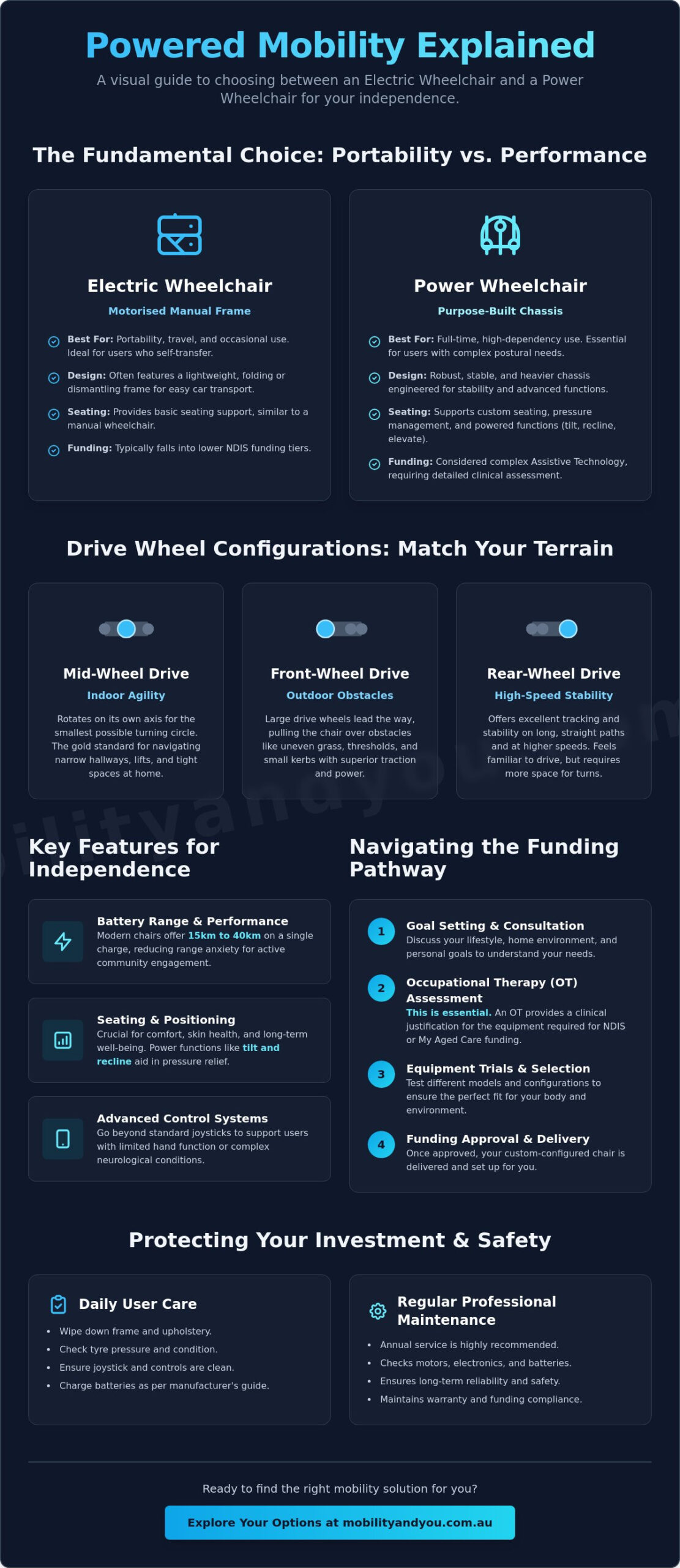
Choosing between an electric wheelchair power wheelchair often comes down to your daily environment and clinical needs. If you need a chair that fits in a standard car boot for trips to the shops, an electric model might be your best fit. However, if you spend the majority of your day in your chair and require specific positioning to maintain skin integrity, a power wheelchair provides the necessary stability. Modern advancements in 2026 have also improved battery range, with many models now offering between 15km and 40km of travel on a single charge, reducing range anxiety for active users.
We believe that the right equipment should adapt to you, not the other way around. By identifying whether you need a portable aid or a comprehensive mobility system, we can begin the process of tailoring a solution that supports your dignity and independence.
Exploring the Different Types of Powered Mobility
We believe that the environment where you spend most of your time should dictate the technology you use. Whether you’re navigating a tight apartment or exploring local parks, the physical configuration of your electric wheelchair power wheelchair makes a significant difference in your daily ease. In 2026, we’ve seen a shift toward more specialized drive systems that cater to specific terrains, ensuring that your equipment supports your lifestyle rather than limiting it. Understanding these configurations helps you and your Occupational Therapist narrow down the options during the assessment process.
Drive Configurations: Mid, Front, and Rear
The placement of the drive wheels changes how the chair handles and turns. We generally categorize these into three main types:
- Mid-wheel drive: These chairs rotate on their own axis. This creates the smallest possible turning circle, making them the gold standard for indoor living and navigating narrow hallways or lifts.
- Front-wheel drive: If you frequently encounter uneven grass or need to climb small kerbs, front-wheel drive offers superior traction. The large drive wheels lead the way, pulling the chair over obstacles with more power.
- Rear-wheel drive: These provide excellent stability at higher speeds and handle well on long, straight paths. They feel familiar to anyone who drives a car, though they require a larger area to turn around compared to mid-wheel models.
We’ve also seen the rise of hybrid models that attempt to bridge the gap between folding convenience and the structural stability of a power chair. However, it’s important to distinguish between standard models and Complex Rehab Technology (CRT). CRT systems are not off-the-shelf items. They’re custom-configured solutions designed for users who require specific postural support or advanced electronic controls to maintain their health and independence.
Portable and Folding Solutions
For those who travel often or have limited storage space, folding wheelchairs provide a sense of freedom that fixed-frame chairs cannot always match. Modern designs in 2026 lean heavily on lithium batteries. These are significantly lighter than traditional lead-acid batteries, often reducing the overall weight of the device to a point where a carer can more easily lift it into a vehicle. Most lithium batteries used in these portable models are also compliant with airline regulations, though you should always verify this before travel.
It’s vital to assess if a folding model offers enough postural support for your needs. While they’re excellent for short trips to the shops or holidays, they may lack the deep contouring and pressure management found in rigid power chairs. If you’re unsure which configuration fits your home or vehicle, we invite you to reach out to our team for a personalized discussion about your specific requirements.
Key Features to Consider for Your Independence
The right features are those that disappear into the background of your life, allowing you to focus on your goals rather than your equipment. When comparing an electric wheelchair power wheelchair, the technical specifications must serve your specific physical requirements. We’ve seen how the correct choice in seating or control systems can transform a user’s daily experience from one of frustration to one of total agency. Every component, from the joystick to the battery, should be selected based on how it supports your dignity and comfort throughout the day.
Seating, Comfort, and Pressure Care
For many in our community, a chair is a full-time environment rather than a part-time aid. A standard foam cushion often fails to provide the necessary protection for skin integrity over long periods. We recommend exploring advanced pressure-relieving materials like gel or air cell systems that redistribute weight more effectively. Power functions such as tilt-in-space and recline aren’t just luxury additions. They’re vital clinical tools for weight shifting, which helps manage circulation and prevents the development of pressure injuries. If you spend more than four hours a day in your chair, these functions become a foundation for your long-term health.
Battery Technology and Range
Range anxiety is a common concern for active users. In 2026, the choice usually sits between modern Lithium-ion and traditional AGM batteries. Lithium-ion offers a significant weight reduction and faster charging times, though AGM remains a reliable and cost-effective option for many. It’s important to remember that the advertised range, which typically spans from 15km to 40km, is an estimate based on ideal conditions. Real-world performance depends on several factors:
- The steepness of the terrain in your local neighbourhood.
- The total weight of the user and any attached accessories.
- How frequently you use power seating functions like tilt or elevation.
In the Australian climate, safe storage is essential. Extreme heat can degrade battery life prematurely, so we always suggest charging your chair in a cool, dry area. Regular equipment servicing ensures your batteries and motors remain efficient, giving you the confidence to explore further.
Control systems have also become more intuitive. While a standard joystick works for many, we can provide solutions including head arrays or chin controls for those with limited hand function. Attendant controls can also be integrated, allowing a family member or carer to navigate the chair safely in crowded or difficult spaces. Finally, consider how you’ll transport your chair. We can help you identify which models are compatible with portable ramps or vehicle hoists to ensure your electric wheelchair power wheelchair fits seamlessly into your existing travel routines.
Navigating the Funding and Assessment Process in Australia
We understand that the administrative side of mobility can feel like a maze. Whether you’re looking at an electric wheelchair power wheelchair, the funding pathway is designed to ensure you receive equipment that is both safe and effective for your specific needs. In Australia, this process primarily flows through the NDIS or My Aged Care. We’re here to help simplify those steps so you can focus on your independence. It’s a journey we take together, ensuring every piece of paperwork leads to a practical solution for your daily life.
The NDIS Pathway for Power Chairs
As of March 2026, the NDIS classifies assistive technology into three clear cost tiers. Most powered mobility solutions fall into the Mid-Cost ($1,500 to $15,000) or High-Cost (over $15,000) categories. For mid-cost items, you’ll need written advice from a professional, while high-cost items require a comprehensive report from an Occupational Therapist. It’s essential to include specific mobility goals in your NDIS plan early. With a new planning process rolling out from mid-2026, focusing on capacity building and personal agency is more important than ever. We work closely with registered providers to ensure your equipment meets all regulatory standards while fulfilling your clinical requirements.
Occupational Therapy Assessments
Your Occupational Therapist (OT) is your strongest advocate. During a functional capacity assessment, they don’t just look at your physical movements; they measure your home environment to ensure doorway and turning clearances are sufficient. This is particularly vital when choosing between an electric wheelchair power wheelchair, as the drive configuration directly affects how much space you need to maneuver. The OT’s role is to document how a specific chair meets the “Reasonable and Necessary” criteria. This means proving the equipment is a value for money solution that represents a standard of care necessary for your safety and autonomy.
For those over 65, the Commonwealth Home Care Packages (HCP) through My Aged Care provide a similar pathway for support. Regardless of your funding source, trialing equipment is a step you should never skip. A physical test allows you to feel the responsiveness of the joystick and the comfort of the seating in person. We believe that seeing the equipment in your own environment is the best way to ensure a perfect fit. If you’re ready to take the next step, you can contact our team to arrange a personalized equipment trial today.
Ensuring Longevity: Service, Repairs, and Daily Care
Your electric wheelchair power wheelchair represents a significant investment in your autonomy and quality of life. To protect that investment, a proactive approach to maintenance is essential—much like the way owners of high-performance European vehicles trust specialists like Eurotech Automotive for precision care. We’ve seen how a few minutes of daily attention can prevent costly repairs and, more importantly, ensure you’re never left without your primary means of movement. By establishing a simple routine, you can maintain the high performance and safety standards your equipment was designed to provide.
User-Led Maintenance Tips
Cleaning is the simplest form of care you can provide. Use a soft, damp cloth to wipe down the frame and seating, but be extremely careful around the joystick and control module. Moisture is the enemy of sophisticated electronics. Tyre health is equally vital. Whether you have pneumatic or solid tyres, checking the tread and pressure weekly reduces motor strain and extends your battery range. If your chair uses lead-acid batteries, we recommend charging them every night, regardless of how much you’ve used the chair that day. This prevents the deep discharge that can permanently damage battery capacity over time.
Professional Repairs and Support
While daily checks are helpful, annual wheelchair service in Brisbane and across Australia by a professional technician is non-negotiable for long-term safety. A technician can identify wear in the gearboxes or motor brushes that might not be visible to the eye. If you notice your chair drifting to one side or hear unusual grinding noises, it’s time for an expert look. Sometimes, the issue is a simple fix. For instance, if your chair won’t move, check that the “freewheel” levers haven’t been accidentally bumped into the disengaged position. These levers allow the chair to be pushed manually but must be locked for the motors to engage.
We know that being without your chair during a repair can be distressing. In these instances, wheelchair hire offers a temporary bridge to maintain your routine and independence. Many NDIS plans or insurance policies include provisions for emergency equipment hire, so it’s always worth checking your specific coverage before an issue arises. By partnering with a local service provider, you gain the peace of mind that comes with knowing support is nearby. We take pride in being a trusted partner for our regional community, ensuring your electric wheelchair power wheelchair serves you faithfully for years to come.
Empowering Your Journey to Greater Independence
Selecting the right mobility solution is a deeply personal step toward reclaiming your agency and staying connected with the community you love. We’ve explored how the distinction between an electric wheelchair power wheelchair often comes down to balancing your need for portability with the necessity of specialized clinical support. By prioritizing a professional assessment and understanding your unique environment, you can move forward with the confidence that your equipment will fit your life perfectly. Your independence is a long-term commitment; consistent care through regular maintenance ensures your device remains a safe and reliable partner for years to come.
Since 2016, our team has provided compassionate advice and expert technical servicing to help individuals find their perfect match. As an NDIS Registered Provider, we take pride in simplifying the funding process and offering the hands-on support you deserve. We invite you to browse our full range of specialised mobility solutions or visit us for a personalized consultation. You don’t have to navigate these choices alone. We’re here to help you embrace the freedom and quality of life that the right powered mobility solution provides.
Frequently Asked Questions
What is the main difference between an electric wheelchair and a power wheelchair?
The primary difference lies in the structural design and intended use of the device. An electric wheelchair is typically a motorised version of a manual frame designed for portability and folding. In contrast, a power wheelchair features a purpose-built chassis engineered for full-time use and complex seating needs. Choosing an electric wheelchair power wheelchair solution depends on whether you need a travel-friendly aid or a robust system for all-day postural support.
Can I take my electric wheelchair on a plane in Australia?
Yes, you can take your mobility aid on a plane, but you must check the battery type first. Most airlines accept dry-cell or lithium-ion batteries if they meet specific safety regulations. It’s essential to notify your carrier at least 48 hours before your flight and provide the battery’s Watt-hour rating. This ensures a smooth boarding process and protects the integrity of your equipment during transit.
How do I get NDIS funding for a power wheelchair?
To access NDIS funding, you’ll need a functional capacity assessment from an Occupational Therapist. They’ll document why the equipment is reasonable and necessary for your specific goals. For mid-cost items between $1,500 and $15,000, professional written advice is required. High-cost items over $15,000 necessitate a formal report and quote. We recommend starting this conversation early during your plan review to ensure your mobility needs are prioritised.
How long does a power wheelchair battery typically last?
Most batteries provide a daily range of 15km to 40km on a single charge. The overall lifespan of the battery pack usually lasts between 12 and 24 months depending on your daily usage and charging routine. To maximise longevity, we suggest charging your chair every night and avoiding extreme temperatures. Regular professional checks can help identify when your battery capacity is beginning to decline before it impacts your independence.
What is the best drive configuration for indoor use?
Mid-wheel drive is the superior choice for indoor navigation because it offers the tightest turning circle. Since the drive wheels are positioned directly under your centre of gravity, the chair can rotate on its own axis. This makes it much easier to move through narrow doorways, kitchens, and lifts. If your home has tight corners or limited floor space, this configuration provides the most agile and intuitive handling experience.
Do I need a licence to drive an electric wheelchair on the pavement?
You don’t need a licence or registration to operate a motorised wheelchair on Australian footpaths if the device is limited to 10 km/h. Under current regulations, users are classified as pedestrians and must follow the same road rules as people walking. While a licence isn’t required, we always encourage new users to practice in a safe environment to become comfortable with the joystick responsiveness and braking distances before heading into busy public areas.
How often should I service my power wheelchair?
We recommend a professional service at least once every 12 months to ensure your chair remains safe and reliable. During these sessions, technicians inspect the motor brushes, electronic connections, and tyre tread for signs of wear. Annual maintenance prevents small issues from becoming major breakdowns that could leave you stranded. Between professional visits, you should perform weekly checks of your tyre pressure and battery connections to maintain peak performance.
Is it better to hire or buy a wheelchair for short-term recovery?
Hiring is often the most practical choice for short-term recovery or temporary mobility challenges. It allows you to access premium equipment without the significant upfront cost of a permanent purchase. Hire also includes the peace of mind that maintenance is handled by the provider. If your needs are likely to change or improve over a few months, renting ensures you have the right support exactly when you need it most.