Choosing bathroom aids for older adults starts with a practical question: which part of the routine needs support? When shopping with Mobility and You, the right equipment depends on the task, the transfer involved and the available bathroom space. Looking beyond product names helps you compare options against everyday needs.
It’s understandable to feel unsure whether a shower chair, bathing aid or toileting support will suit someone’s needs, fit the bathroom or assist with transfers. The aim is to make specific routines more manageable while respecting comfort, dignity and independence.
This guide explains how to match bathroom aids to different tasks, what to measure before choosing equipment and how basic aids differ from specialised transfer options. It also compares ShowerBuddy transfer systems and mobile shower chairs using their stated features and intended setups.
Key Takeaways
- Start with the bathroom task that feels difficult or tiring, then identify the support needed for sitting, standing or transferring.
- Compare shower seating, bath access systems, toilet aids and non-slip products according to the person’s routine and bathroom layout.
- Check the transfer involved, the user’s needs and the available space rather than relying on a product name alone.
- When comparing ShowerBuddy systems, match the model’s stated setup and features to the bathroom configuration.
- ShowerBuddy products have tool-free assembly and corrosion-resistant frame materials. Check each model’s specifications for its individual features.
Bathroom Aids for Older Adults: Start With the Everyday Task
Needing support in the bathroom is a personal matter, not a measure of someone’s ability or identity. The right equipment can make a particular routine more manageable while respecting the person’s preferences and privacy.
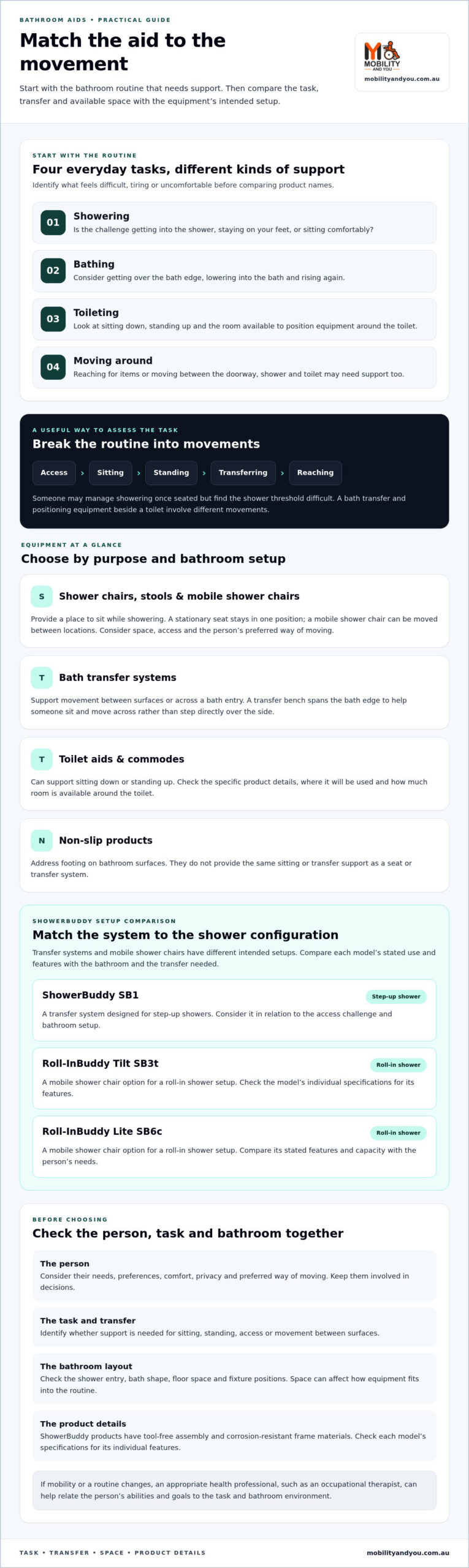
Bathroom aids are equipment designed to support specific activities, such as showering, bathing, toileting or moving around the room. Start by identifying which movement feels difficult, tiring or uncomfortable, then consider the person and the bathroom together. Equipment should suit the task it is intended to support.
Different tasks can call for different kinds of support:
- Showering: Consider whether getting into the shower, staying on your feet or sitting comfortably is the main challenge.
- Bathing: Think about how the person gets over the bath edge, lowers themselves and rises again.
- Toileting: The movement may involve sitting down, standing up or positioning equipment around the toilet.
- Moving around: Reaching for items or moving between the doorway, shower and toilet may be difficult even when the task itself is manageable.
These needs are different, so one aid may not suit every activity. A shower’s entry, the bath shape, floor space and the position of fixtures can all affect how equipment fits into the routine.
Which bathroom routines may need extra support?
Break the challenge into movements: access, sitting, standing, transferring or reaching. Someone may manage showering once seated but find stepping over the shower threshold difficult. Bathing can involve a different transfer, while toileting may require enough room to position equipment beside the toilet.
Needs can change over time. If a routine becomes harder or a person’s mobility changes, discuss the situation with an appropriate health professional, such as an occupational therapist. An assessment can help relate the person’s abilities and goals to the task and bathroom environment.
How do bathroom aids support independence?
An aid can offer a practical way to manage a particular movement. A seat provides somewhere to sit during showering, while a transfer bench can support movement across a bath edge. A Transfer bench is designed to help a person move into or out of a bath without stepping directly over its side.
Keep the person involved in decisions. Ask which part of the routine they would like to manage differently, what feels comfortable and how much privacy they prefer. The aim is to support choice and participation, not to assume what help someone needs. Suitability depends on the individual, the task and the bathroom setup.
Types of Bathroom Aids: Match Equipment to Showering, Bathing and Toileting
Bathroom aids are easier to compare when grouped by the activity they support. A shower seat, a system for moving into a bath and an aid beside the toilet address different needs. Start with the routine and bathroom setup instead of browsing by product name alone.
Shower chairs, stools and mobile shower chairs
A shower chair or stool provides a place to sit while showering. A stationary seat stays in one position, while a mobile shower chair can be moved between locations. Neither option suits every person or shower. Consider the available space, access and the user’s preferred way of moving. For focused guidance on choosing seating, explore the complete shower chair guide.
For a roll-in shower setup, the Roll-InBuddy Tilt SB3t and Roll-InBuddy Lite SB6c are mobile shower chair options. Compare their stated features and capacities rather than assuming all shower chairs work in the same way.
Bath transfer systems
Bath transfer systems support movement between a tub and shower area. This is different from simply sitting during a shower. A transfer bench, for example, spans the bath edge so a person can sit and move across rather than stepping directly over the side. The bathroom configuration and transfer required help determine whether this kind of equipment is suitable.
ShowerBuddy SB1 is a transfer system for step-up showers. It is designed for a different setup from a stationary shower seat. Identifying the access challenge first helps narrow the options.
Toilet aids and commodes
Toilet aids support tasks such as sitting down or standing up. A commode is a separate category of equipment with a toileting function, though some shower transfer systems include a commode system. Check the specific product details and consider where the aid will be used, how much room is available around the toilet and which movement needs support.
Non-slip products
Non-slip products address footing on bathroom surfaces. They do not provide the same support as a seat or transfer system, so they are not a substitute for equipment that assists with sitting or moving between surfaces. Consider which area needs attention and how a product would fit into the person’s routine and bathroom layout.
Once you’ve identified the task, compare options by their intended use and setup. Mobility and You supplies bathroom aids and daily living equipment for a range of routines.
ShowerBuddy Transfer Systems Compared: Which Bathroom Setup Do They Suit?
Shower transfer systems and mobile shower chairs suit different bathroom configurations. A transfer system is designed around moving between surfaces or across an entry, while a mobile shower chair is intended for use in a roll-in shower. Compare the intended setup with the bathroom and the person’s transfer needs.
This comparison summarises each model’s stated setup and key features. Use it to build a shortlist, then check the full specifications for the model you are considering.
| Model | Intended setup | Stated feature |
|---|---|---|
| ShowerBuddy SB1 | Step-up shower | Shower transfer system; 250 kg capacity |
| TubBuddy SB2 | Tub-to-shower transfer | Bath transfer system; 250 kg capacity |
| TubBuddy Tilt SB2T | Tub-to-shower transfer | Tilt function from 0 to 30°; 250 kg capacity |
| Roll-InBuddy Tilt SB3t | Roll-in shower | Mobile shower chair with tilt; lifetime frame warranty; 250 kg capacity |
| Roll-InBuddy Lite SB6c | Roll-in shower | Lightweight mobile shower chair; lifetime frame warranty; 136 kg capacity |
Step-up showers and tub-to-shower transfers
For a step-up shower, ShowerBuddy SB1 is a shower transfer system. TubBuddy SB2 is designed for tub-to-shower transfers, while TubBuddy Tilt SB2T adds a tilt function with a stated range from 0 to 30°. All three have a stated capacity of 250 kg. These distinctions help you compare models according to the entry and movement involved.
Before choosing, consider how the person approaches the shower or tub, the height and position of the entry and the room available for positioning the equipment. Match the model’s intended setup to the actual bathroom. An individual assessment can help determine suitability.
Roll-in showers and tilt options
For roll-in showers, Roll-InBuddy Tilt SB3t is a mobile shower chair with a tilt function, while Roll-InBuddy Lite SB6c is a lightweight mobile shower chair. The SB3t has a stated capacity of 250 kg, and the SB6c has a stated capacity of 136 kg. Both models have a lifetime frame warranty. These details apply to these models, not to every ShowerBuddy product.
ShowerBuddy products have tool-free assembly. Their frames use Grade 6061 T6 aluminium, with Grade 304 stainless-steel parts and hardware. The materials are described as corrosion-resistant. Check each model’s specifications alongside these range-level details when comparing equipment.
When comparing bathroom aids for elderly Brisbane searches, consider the person’s transfer, the room layout and the shower or bath configuration together. A model comparison is a starting point, not a substitute for checking whether the specific setup suits the user and bathroom.
How to Choose Bathroom Aids: Check Personal Needs, Fit and Product Details
A careful choice starts with the movement someone wants support with, then checks whether the equipment suits their needs and bathroom. Choose bathroom aids by matching the task, the person and the space. This approach can turn a broad search for bathroom aids for elderly Brisbane into a more practical shortlist.
What to assess about the person and bathroom
Involve the person who will use the aid. Their preferences, mobility, balance and usual transfer method matter, as does whether someone assists with the routine. An occupational therapist or another appropriate health professional can help assess how these needs relate to the bathroom and equipment being considered.
Before comparing products, describe the task that feels difficult or tiring. Use this checklist to build a clear picture:
- Identify the task. Is the difficulty getting into the shower, bathing, using the toilet, or sitting down and standing up?
- Consider the movement. Does the person need to sit, stand, transfer between surfaces or reach for items? Note how they currently move and what assistance they use.
- Describe the bathroom. Record whether it has a step-up shower, roll-in shower or bathtub. Note the entry, fixtures and available floor area.
- Measure the route and space. Check the route to the bathroom, doorway clearance and room around the shower, bath or toilet. Consider whether the equipment can be positioned where the task takes place.
- Compare product details. Check the published dimensions, capacity, adjustability and stated features against the person’s needs and the measured space.
Measurements make a shortlist more useful, but they do not replace an assessment of how the person will approach, transfer onto and use the equipment. Include the user and an appropriate health professional in decisions, particularly when transfers or assistance are part of the routine.
Which product details deserve close attention?
Read specifications model by model. Capacity should suit the intended user, while dimensions and adjustability affect fit and positioning. If a product’s details specify a safety belt, consider it as part of that model’s design. Do not assume every aid includes one. Compare published features rather than relying on category names or appearance.
ShowerBuddy products use Grade 6061 T6 aluminium frames and Grade 304 stainless-steel parts and hardware. These materials are described as corrosion-resistant. Warranty details are model-specific: the Roll-InBuddy Tilt SB3t and Roll-InBuddy Lite SB6c have lifetime frame warranties. Do not apply that warranty detail to the full range.
Once you’ve noted the task, measurements and relevant specifications, you can compare bathroom and daily living aids with a clearer idea of what to look for. Beyond specialised mobility aids, exploring practical wellness and home essentials at motionnest.store can also help support day-to-day comfort and functionality throughout the house.
Bathroom Aids from Mobility and You: Explore Equipment and Support
Mobility and You supplies bathroom aids and daily living equipment to support practical routines at home. The ShowerBuddy range includes transfer systems for different shower and bath configurations, plus mobile shower chairs for roll-in showers. Compare each model’s intended setup with the person’s needs and bathroom layout.
What the confirmed ShowerBuddy range includes
These models address different access arrangements. Their intended setups and model-specific details provide a useful starting point for comparison:
- ShowerBuddy SB1: A shower transfer system for step-up showers, with a 250 kg capacity. It rolls over most standard toilets, has a height-adjustable frame and includes a commode system.
- TubBuddy SB2: A bath transfer system for tub-to-shower transfers, with a 250 kg capacity and side stabilisers on the bath base.
- TubBuddy Tilt SB2T: A bath transfer system with a tilt function from 0 to 30°, an adjustable neck rest and a calf-strap safety belt. Its stated capacity is 250 kg.
- Roll-InBuddy Tilt SB3t: A mobile shower chair for roll-in showers, with a tilt function, a 250 kg capacity and a lifetime frame warranty.
- Roll-InBuddy Lite SB6c: A lightweight mobile shower chair for roll-in showers, with a 136 kg capacity and a lifetime frame warranty.
ShowerBuddy products have tool-free assembly. Their frames use Grade 6061 T6 aluminium, with Grade 304 stainless-steel parts and hardware, and are described as corrosion-resistant. These range-level details sit alongside features specific to individual models, so keep the distinction clear when comparing equipment.
A model’s intended setup does not mean it will suit every bathroom or person. Access routes, space to position the equipment and the transfer involved all matter. If an occupational therapist is helping assess equipment needs, model-specific information can support a more informed discussion.
What happens after choosing an aid?
Mobility and You sells mobility and daily living equipment and offers servicing, repairs and spare parts for mobility and disability aids. The company services and repairs products including wheelchairs, scooters, lift chairs, beds, hoists and walking aids. This support can be useful when considering equipment for ongoing use.
For a closer look at bathroom and daily living equipment, explore the available products and compare them with the person’s routine, preferences and bathroom setup. A thoughtful choice can support everyday independence while respecting comfort and dignity.
Explore bathroom aids for everyday independence.
Take the Next Step Towards a More Comfortable Routine
Choosing support does not mean changing everything at once. Start with one bathroom routine the person would like to manage more comfortably, then use it as a practical focus when exploring equipment. Needs and preferences can evolve, so it is reasonable to revisit options as circumstances change.
If you’re looking for bathroom aids for elderly Brisbane, keep the person’s comfort and sense of control at the centre of the decision. The right support is personal, and a considered choice can make everyday routines more manageable while respecting dignity.
Mobility and You offers bathroom aids and daily living equipment to help people compare options for their routines. Explore bathroom aids that support everyday independence.
With a clear idea of what matters most, you can make choices that support comfort, privacy and independence.
Frequently Asked Questions
Are bathroom aids only for older adults?
No. Bathroom aids can support people of different ages who find a bathroom task difficult because of mobility changes, disability, injury or other support needs. Start by identifying the routine the person wants to manage more comfortably, rather than making age the deciding factor. Involve them in comparing options and discussing preferences so the equipment reflects their priorities and supports dignity, comfort and independence.
How do I measure a bathroom before choosing an aid?
Measure the space around the shower, bath and access routes, noting thresholds, doorways and obstacles that could affect positioning. Compare those measurements with the selected equipment’s published dimensions, allowing for how it needs to be placed and used. Consider the person’s transfer in and out of the area, too. Measurements inform a decision, while an individual assessment can interpret them alongside the person’s support needs.
Can ShowerBuddy products be assembled without tools?
Yes. Tool-free assembly is a stated feature across ShowerBuddy products. This describes assembly, not whether a particular model suits a specific bathroom or person. Models differ, so follow the instructions provided with the selected product and refer to its specifications. If the person’s transfer needs or bathroom configuration are complex, consider those factors separately when assessing suitability.
What is the difference between a shower chair and a shower transfer system?
A shower chair or stool provides a seated option during showering. A transfer system is designed to assist movement into a particular shower or bath arrangement. For example, a mobile shower chair intended for a roll-in shower is not automatically interchangeable with a system designed for a step-up shower or tub transfer. Identify the access movement that needs support, then compare equipment designed for that setup.
Do bathroom aids prevent falls?
No bathroom aid can guarantee that falls will not happen. Equipment may support a specific activity, such as sitting during showering or managing a transfer, but its suitability and setup matter. Consider the person’s mobility and bathroom environment together, and seek an appropriate assessment if needs are complex or changing. Involve the person in decisions, and treat equipment as one part of supporting their routine, not as a complete safety plan.
Does the NDIS fund bathroom aids?
NDIS funding depends on the participant’s circumstances, plan and the funding rules that apply at the time, so do not assume a particular bathroom aid will be funded automatically. Review current NDIS guidance and discuss the equipment need with the participant’s support team or plan contact. Be ready to explain the daily task the aid relates to, how the bathroom setup affects its use and the person’s support requirements.