Imagine standing at your front gate, looking at the park across the street, and feeling a pang of hesitation because the walk feels just a little too far today. We understand that the fear of a sudden stumble or the fatigue of a quick trip to the shops can make your world feel smaller than it should be. It’s common to feel confused by the technical differences between frames and rollators, especially when you simply want to feel steady and secure.
You deserve to move through your community with dignity and ease, knowing a comfortable seat is always available when you need a rest. In this guide, we’ll help you discover how to select and master the perfect wheelie walker to restore your confidence and daily independence. We’ve designed this resource to simplify your journey, covering everything from the latest ISO 11199-2:2021 safety standards to understanding how the 2026 Medicare deductible affects your equipment choices. We’ll show you how modern, lightweight designs and smart technology can turn a simple stroll into a renewed opportunity for connection and freedom.
Key Takeaways
- Learn how a built-in seat provides the security of an immediate resting place during your daily outings.
- Discover why selecting the right wheel size and braking system is essential for your safety on various terrains.
- Find out how to choose a wheelie walker that matches your weight capacity and fits through standard doorways.
- Master the “wrist-crease rule” to set your handle height perfectly, protecting your posture and preventing shoulder strain.
- Understand the importance of professional equipment servicing to keep your mobility aid performing safely and reliably.
What is a Wheelie Walker? Understanding Your Mobility Options
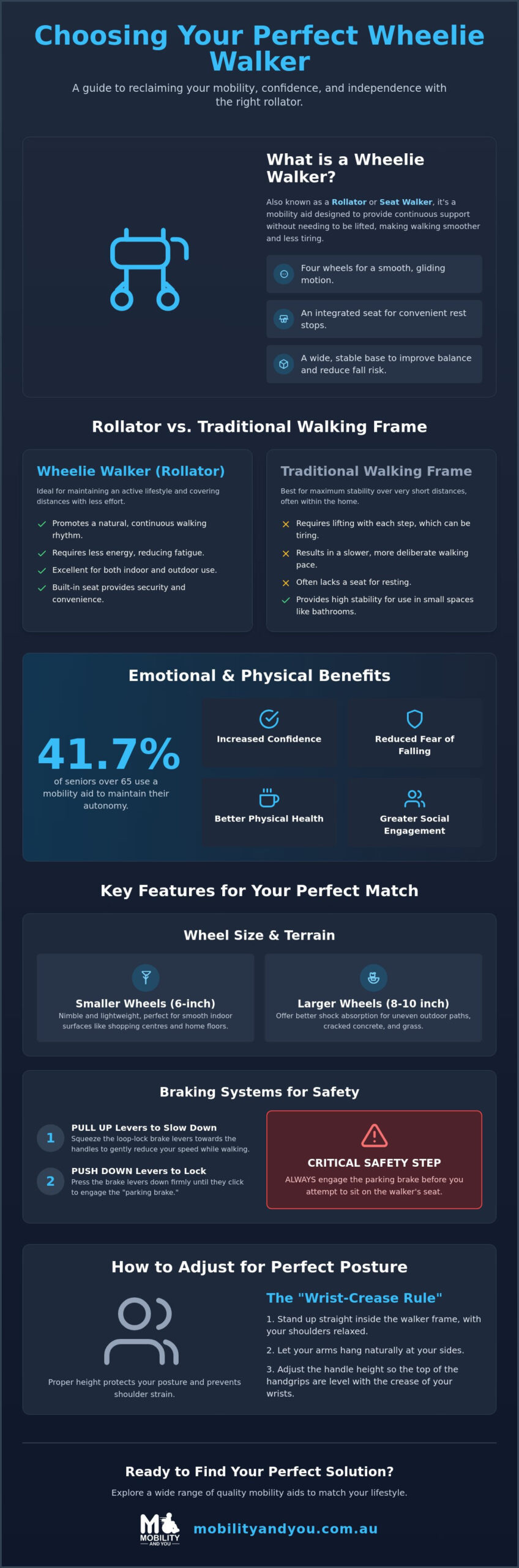
A wheelie walker is a specialized mobility aid designed with wheels on all legs, typically four, and a integrated seat for resting. In our local community, you might hear these devices referred to as rollators, seat walkers, or mobility walkers. While they all serve the same ultimate goal of movement, their primary purpose is to provide a stable, weight-bearing base that moves with you. Unlike a standard cane, which only offers a single point of contact, these walkers create a wide support zone that significantly improves balance and reduces the risk of stumbling.
We often find that clients prefer a wheelie walker over other aids because it offers a unique combination of support and convenience. It isn’t just about getting from point A to point B; it’s about having the confidence to stop and rest whenever you need to. This built-in seat is a game-changer for those who experience fatigue or shortness of breath during short trips to the shops or the park.
Wheelie Walkers vs. Traditional Walking Frames
Understanding the difference between a rollator and a traditional Walker (mobility) is essential for choosing the right fit for your lifestyle. A standard walking frame usually has no wheels or only two wheels at the front, requiring you to lift or slide the device with every step. This can be quite tiring and often results in a slower, more deliberate gait.
Rollators allow for a much more natural walking rhythm because the wheels stay in constant contact with the ground. While a frame might be the better choice for high-stability needs inside a small bathroom, a wheelie walker excels when you’re covering distances. It requires less energy to operate, which helps you stay on your feet longer without feeling exhausted.
The Emotional and Physical Benefits of Staying Active
The benefits of using a mobility aid are as much emotional as they are physical. Statistics show that approximately 41.7% of seniors over 65 use some type of mobility aid to maintain their autonomy. When you have a reliable partner for your walk, the anxiety of falling while alone begins to dissipate. This sense of security encourages you to engage in social activities and outdoor hobbies that might have felt too risky before.
Physically, consistent movement is vital for maintaining muscle tone and joint health. By providing just enough support to make walking comfortable, these devices help you stay active, which is the best way to preserve your long-term strength. We believe that a walker shouldn’t be seen as a limitation, but rather as a tool that opens up your world and protects your dignity. This holistic approach to well-being also involves addressing sensory needs; for example, Amazing Hearing Centre provides specialized audiology support to ensure your ability to communicate remains as strong as your physical mobility.
Essential Features to Look for in a Quality Rollator
Choosing the right mobility aid isn’t just about picking a colour or a brand; it’s about matching the equipment’s mechanical features to your specific daily environment. We believe that a high-quality wheelie walker should feel like an extension of your own body, responding smoothly to every turn. To achieve this, we focus on several primary pillars: wheel dynamics, braking reliability, frame weight, and how easily the device folds for transport.
Wheel Size and Terrain Capability
The size of the wheels on your walker determines where you can go and how much effort it takes to get there. Smaller 6-inch wheels are nimble and lightweight, making them perfect for indoor use or gliding across smooth shopping centre floors. However, if your daily routine involves outdoor walks, you’ll likely benefit from larger 8-inch wheels or even 10-inch models. Larger wheels provide better shock absorption on uneven Australian footpaths, helping you manage cracked concrete or grass with significantly less jarring to your hands and shoulders. When you’re browsing our range of walkers, consider where you spend most of your time to ensure your wheels can handle the journey.
Braking Systems and Locking Mechanisms
Safety is our absolute priority, and the braking system is the most critical component for your peace of mind. Industry-standard “loop-lock” brakes are designed to be intuitive and easy to use, even for those living with arthritis or limited hand strength. You should be able to pull the levers upward to slow down while walking and push them downward to engage the “parking brake.” This locking feature is vital; you must always engage the parking brake before you attempt to sit on the walker’s seat. Regular maintenance is also key, as brake tension can loosen over time. We recommend following Mayo Clinic’s guide to walkers to ensure you’re using these safety features correctly and keeping your equipment in top shape.
Weight and portability are the final pieces of the puzzle. While a sturdier frame provides a sense of security, it also needs to be light enough for you or a carer to lift into a car boot. Modern designs often feature an “X-fold” mechanism, which allows the wheelie walker to collapse side-to-side rather than front-to-back. This creates a much slimmer profile for storage and transport, ensuring your mobility aid is a help rather than a hindrance when you’re on the move. Balancing these features ensures your walker supports your lifestyle without adding unnecessary physical strain.
Selecting the Right Model for Your Body and Lifestyle
Finding the right wheelie walker is a deeply personal journey. We’ve seen how a mismatched fit can lead to physical discomfort or a loss of confidence. It’s not just about the features; it’s about how the device integrates with your physical frame and the specific environments where you live and move. Whether you’re navigating a cozy apartment or exploring local parklands, the right model acts as a reliable partner in your daily autonomy.
One of the first technical specifications we check is the Safe Working Load (SWL). This rating is a critical safety requirement, not just a suggestion. If you exceed the SWL, you compromise the integrity of the frame and the effectiveness of the braking system. While standard models often support up to 130kg, we provide heavy-duty and bariatric options for those who require extra reinforcement. Choosing a model with a higher weight capacity often comes with the added benefit of a wider, more cushioned seat, which makes those essential rest periods much more comfortable.
Dimensions matter just as much as weight capacity. We encourage you to measure the narrowest points in your home, particularly bathroom and bedroom doorways. Many standard Australian doorways are approximately 820mm wide, but older homes can have much tighter clearances. Checking the overall width of your walker ensures you won’t feel “stuck” in your own home. For those with specific physical challenges, such as limited wrist strength or severe arthritis, specialized gutter-arm walkers allow you to rest your weight on your forearms, taking the pressure off your hands and shoulders.
Weight Capacity and Bariatric Options
When selecting between standard and Heavy Duty (HD) rollators, consider your long-term needs. An HD model is designed with a reinforced chassis to prevent “frame flex,” ensuring the walker remains steady even under significant weight. This stability is vital for your safety when transitioning from a standing to a seated position. We always prioritize your dignity by offering models that provide the necessary support without feeling bulky or difficult to manoeuver.
Indoor vs. Outdoor Mobility Needs
Your primary environment dictates the best wheel configuration. Compact 3-wheelers are exceptionally agile, making them a popular choice for navigating tight indoor spaces or busy cafes. However, they lack the built-in seat and the high-level stability of their 4-wheel counterparts. For more on versatile options, see our guide on choosing the best 4 wheeler mobility walker. If you’re an adventurous user, you might even consider outdoor rollators with pneumatic tyres, which glide over gravel and uneven paths far more smoothly than standard solid wheels.
How to Safely Use and Adjust Your Wheelie Walker
Acquiring your new wheelie walker is a significant step toward reclaiming your freedom, but its effectiveness depends entirely on a proper setup tailored to your unique height and posture. Even the highest quality equipment can cause discomfort or increase fall risks if it isn’t adjusted correctly. We’ve seen how a few simple tweaks to handle height can transform a tiring walk into a steady, confident stroll. Our goal is to ensure you feel supported by your equipment, rather than feeling like you’re fighting against it.
One of the most common mistakes we observe is walking with the device too far in front of the body. When you push the walker ahead of you, your centre of gravity shifts forward, which can lead to a stooped posture and reduced stability. Instead, you should aim to walk “inside” the frame. Your feet should stay roughly in line with the rear wheels. This position ensures that the weight-bearing support remains directly beneath you, allowing the walker to act as a true anchor for your balance.
Setting the Correct Handle Height
To find your ideal handle height, stand as tall as you comfortably can with your shoes on and your arms relaxed at your sides. Have a friend or carer adjust the handles so they align with your wrists. The wrist-crease rule is the gold standard for ergonomic walker setup, ensuring your weight is distributed through your arms without straining your neck or shoulders. When you place your hands on the grips, there should be a slight bend in your elbows, ideally between 20 and 30 degrees. This specific angle provides the best leverage for using the brakes and supporting your weight during a stumble. If you’re unsure about your current setup, we invite you to contact our team for personalized guidance on achieving the perfect fit.
Safe Sitting and Standing Techniques
The built-in seat is a wonderful feature for managing fatigue, but it must be used with caution. Before you attempt to sit, you must turn around so the backs of your legs are touching the edge of the seat. At this precise moment, engage the parking brakes by pushing the levers down until they click. Never attempt to sit without the brakes locked, as the wheelie walker could roll away from you. Use the armrests or the frame for support as you lower yourself slowly. It’s also vital to remember that a standard rollator is not a wheelchair; you should never allow someone to push you while you’re seated, as the small wheels and frame aren’t designed for that type of force and could tip over.
Finding Your Perfect Solution with Mobility and You
We believe that choosing a mobility aid shouldn’t feel like a simple transaction; it’s a partnership rooted in your long-term well-being and dignity. Our team is here to help you explore our Shop to find the exact model that aligns with your specific lifestyle goals. We understand that the administrative side of healthcare can be overwhelming, so we offer dedicated support for those navigating NDIS and My Aged Care funding streams. Having a trusted local partner who understands these regulatory frameworks ensures you receive the maximum benefit from your plan while securing the high-quality equipment you deserve.
Maintaining your independence also means ensuring your equipment remains in peak condition for years to come. Regular servicing and repairs are essential for the ongoing safety of your wheelie walker. We provide comprehensive checks on braking systems, wheel alignment, and frame integrity to give you absolute peace of mind during every outing. Our commitment to your movement doesn’t end when you leave our showroom; we’re here for the life of your equipment to ensure it continues to perform reliably and safely.
Buy vs. Hire: Which Option Suits You?
Choosing between purchasing and hiring depends entirely on your specific physical requirements and recovery timeline. If you’re managing a short-term injury or recovering from a recent surgery, our equipment hire options provide a flexible, cost-effective solution without the commitment of a full purchase. Conversely, if you’re looking for a permanent companion to enhance your daily autonomy and social engagement, buying a wheelie walker is often the most sustainable choice for long-term independence. We’ll help you weigh these options based on your clinical needs and personal preferences.
Expert Support for Occupational Therapists and Families
We take great pride in our collaborative approach with Occupational Therapists to ensure every solution meets specific clinical goals and safety standards. We invite families and healthcare professionals to visit our showroom, where you can try various models in a supportive, low-pressure environment before making a decision. For those with temporary lower-limb injuries who may not yet be ready for a walker, you might find our knee scooter hire guide helpful for understanding alternative recovery paths. Our local expertise ensures that whether you’re a professional practitioner or a family member, you have a knowledgeable ally dedicated to your community’s health landscape.
Reclaiming Your Freedom of Movement
Reclaiming your independence is a journey we’re honoured to share with you. Throughout this guide, we’ve focused on how the right features and proper adjustments can turn a simple tool into a life-changing asset. From understanding wheel dynamics to perfecting your posture with the wrist-crease rule, every detail serves the goal of keeping you safe and steady on your feet. Selecting the perfect wheelie walker is the first step toward a more vibrant, active lifestyle where you don’t have to worry about fatigue or the fear of falling during your daily outings. For those who want to extend that same sense of security into their home, exploring a lift chair and adjustable bed package Brisbane residents trust can help build a complete 24-hour support system that protects your mobility from sunrise to sunset.
As specialists in mobility aids since 2016 and a proud NDIS Registered Provider, we bring years of technical expertise and compassionate care to your doorstep. Our expert servicing and repair team ensures your equipment remains a reliable partner in all your adventures, providing the peace of mind you need to stay active and engaged with your community. Browse our range of high-quality wheelie walkers today and discover the freedom that comes with professional, personalized support. We’re here to help you move with confidence, dignity, and a renewed sense of possibility.
Frequently Asked Questions
Is a wheelie walker the same as a rollator?
Yes, a wheelie walker and a rollator are essentially the same mobility aid. While “rollator” is the technical industry term, many Australians use “wheelie walker” or “seat walker” to describe the same device. These aids feature wheels on all legs and a built-in seat, distinguishing them from standard walking frames that require a lift and place movement to advance.
Can I use a wheelie walker on grass or uneven ground?
You can use most rollators on grass or uneven ground if they are equipped with larger wheels. While 6 inch wheels are perfect for smooth indoor floors, we recommend 8 inch or 10 inch wheels for navigating parklands or cracked footpaths. Larger wheels provide better shock absorption and prevent the device from getting stuck in soft turf or small ruts.
How do I know if my wheelie walker is the right height?
Your walker is at the correct height when the handles align with the crease of your wrists while you stand tall with your arms relaxed. This setup ensures your elbows have a slight bend of 20 to 30 degrees when you grip the handles. This specific alignment prevents shoulder strain and allows you to apply the brakes quickly and effectively during your daily walks.
Does the NDIS cover the cost of a wheelie walker?
The NDIS typically covers the cost of a wheelie walker if it is deemed a “reasonable and necessary” support to help you achieve your mobility goals. You will usually need to have funding allocated under the Assistive Technology category of your plan. We recommend consulting with your Occupational Therapist to ensure the specific model you choose meets the NDIS requirements for your individual needs.
How much weight can a standard wheelie walker hold?
A standard wheelie walker generally has a Safe Working Load (SWL) of up to 130kg. However, weight capacities vary significantly between different models and manufacturers. For those who require additional support, heavy duty or bariatric versions are available that can safely accommodate 200kg or more. Always check the specific SWL sticker on the frame before use to ensure your safety.
Can someone push me while I am sitting on my walker?
No, you should never allow someone to push you while you are sitting on a standard rollator. These devices are designed for stability while walking or sitting stationary; they aren’t built to function like a wheelchair. Pushing someone on a walker can cause the frame to tip or the small wheels to catch on uneven surfaces, leading to a serious fall.
How do I fold my wheelie walker for transport in a car?
Most modern walkers fold by either pulling a strap on the seat or releasing a catch on the frame. Models with an “X-fold” mechanism collapse side to side, which creates a very slim profile that fits easily into a car boot or behind a front seat. We suggest practicing the folding motion at home to ensure you can manage it comfortably when you are out and about.
What is the difference between a 3-wheel and 4-wheel walker?
The primary difference is that a 4-wheel walker includes a built-in seat and offers superior lateral stability. A 3-wheel model is often lighter and has a tighter turning circle, making it ideal for navigating very narrow indoor spaces. However, 3-wheelers don’t provide a place to rest, so they are generally better for users who don’t experience significant fatigue during their movement.