A hospital bed shouldn’t turn your bedroom into a cold, sterile ward; it should be the foundation of your daily independence. For many Australians, the search for hospital beds for sale starts with a mix of technical confusion and the fear that their home will lose its personal comfort. We understand that you aren’t just buying medical furniture. You’re investing in safety, dignity, and the ability to stay in the home you love while making daily care easier for your family.
alsatian دار
It’s natural to feel anxious about the costs or the complex jargon surrounding NDIS requirements. Our team believes that clinical excellence and home-style aesthetics can exist in the same piece of equipment. This 2026 guide will help you select a bed that balances medical features like electronic profiling with a design that fits your lifestyle. We’ll walk you through the essential safety standards maintained by the NDIS Quality and Safeguards Commission and show you how a locally owned Australian provider makes the long-term support journey much simpler for your family.
alsatianدار
Key Takeaways
- Learn why TGA-approved frames are essential for safety and how these specialized beds differ from standard adjustable furniture to support your long-term independence.
- Master the “Big Five” clinical functions to look for when browsing hospital beds for sale to ensure your choice supports easier breathing, safer transfers, and daily comfort.
- Discover how modern homestyle designs can blend medical necessity with your bedroom’s existing decor, removing the clinical feel without compromising on care.
- Understand the critical role of specialized pressure-relieving mattresses in preventing skin breakdown and why the right surface is just as vital as the bed frame itself.
- Navigate the complexities of NDIS and My Aged Care funding with our guide on how to work with a Registered Provider to secure the essential equipment you need.
alsatian دار
Understanding Hospital Beds for Sale: More Than Just an Adjustable Frame
alsatian دار
Moving from a clinical environment back to the comfort of home is a significant milestone in any recovery journey. It’s a transition that requires more than just a familiar room; it requires a foundation of safety and support. When families search for hospital beds for sale, they often discover that these specialized pieces of equipment are far more complex than a standard bedroom set. Our team at Mobility and You views the bed as the most critical tool in a home-care setting, acting as the primary site for rest, treatment, and daily interaction.
alsatian دار
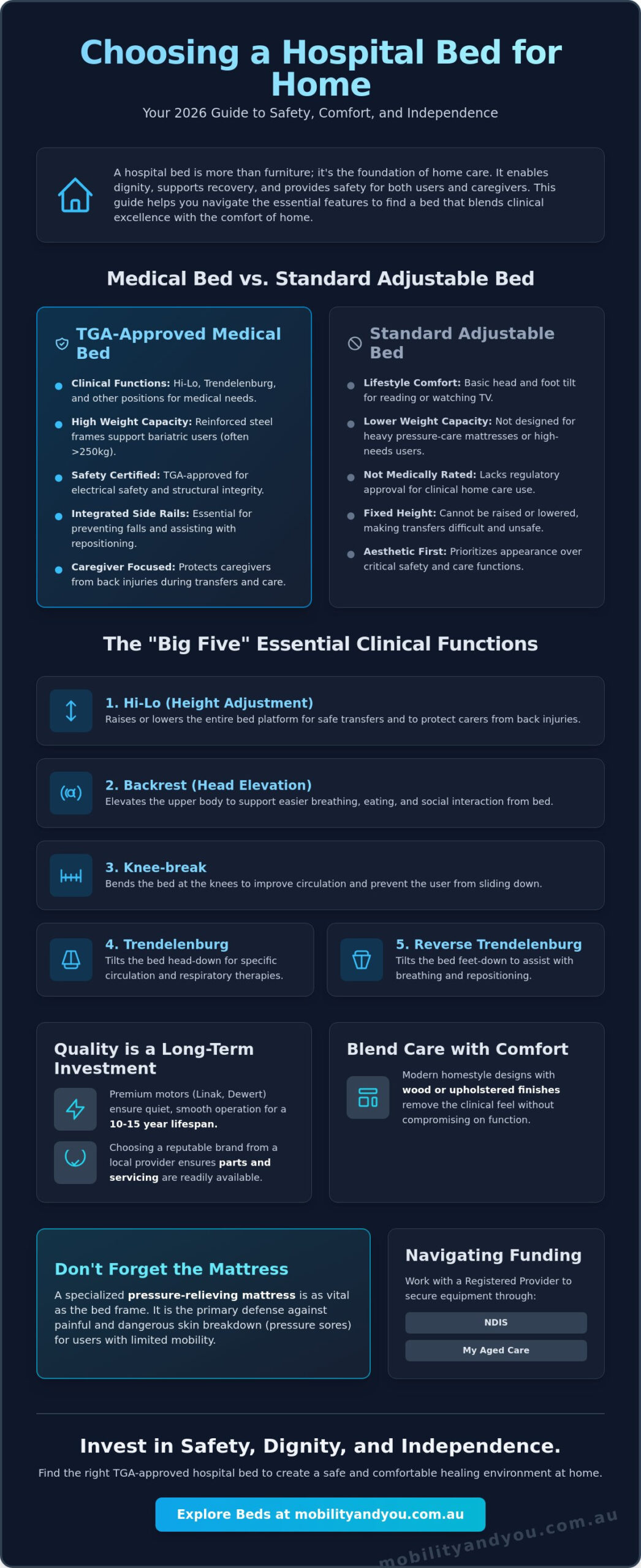
In Australia, the Therapeutic Goods Administration (TGA) regulates medical devices to ensure they meet strict safety and performance benchmarks. Choosing a TGA-approved bed means the frame, motors, and electronics have undergone rigorous testing for electrical safety and structural integrity. This is vital because a home-care bed often operates 24 hours a day, supporting users with limited mobility who are at high risk of falls or pressure injuries. We prioritize equipment that meets these standards to ensure our clients maintain their independence without compromising their safety.
alsatian دار
Medical Bed vs. Standard Adjustable Bed
alsatian دار
While a standard adjustable bed found in a lifestyle furniture store might tilt the head or feet for reading, it lacks the clinical engineering required for patient care. Medical beds are built with reinforced steel frames and high weight capacities, with bariatric options often supporting users over 250kg. These frames are designed to accommodate heavy pressure-relieving mattresses and integrated side rails that prevent accidental falls. For a broader perspective on these differences, this Hospital bed overview highlights the fundamental components that separate clinical equipment from consumer furniture.
alsatian دار
The Hi-Lo function serves as the critical differentiator for home care safety, allowing the entire bed platform to raise or lower to facilitate safe transfers and protect carers from back injuries. Beyond height, medical beds often include Trendelenburg and reverse Trendelenburg positions, which are essential for managing circulation issues or respiratory distress. Many of our clients access these advanced features through their NDIS funding, ensuring they receive the specific clinical support their condition demands.
alsatian دار
Why Investing in Quality Matters for Long-Term Care
alsatian دار
Investing in a high-quality medical bed is an investment in long-term reliability. Premium frames utilize world-class actuator systems from brands like Linak or Dewert, which are known for quiet, smooth operation over a 10 to 15 year lifespan. Cheaper, non-medical alternatives often fail under the stress of constant positioning, leaving vulnerable users without a way to adjust their posture or exit the bed safely.
alsatian دار
Because these are essential medical aids, we emphasize the importance of choosing equipment that allows for easy servicing and repairs. A bed failure isn’t just an inconvenience; it’s a risk to the user’s health and the carer’s ability to provide support. By choosing a reputable brand from a trusted local partner, you ensure that parts are readily available and that your home-care environment remains a place of healing and dignity rather than a source of stress.
alsatian دار
Essential Functions to Look for When Buying a Medical Bed
alsatian دار
When you’re browsing hospital beds for sale, the technical jargon can feel overwhelming. We focus on the “Big Five” functions because they transform a simple piece of furniture into a clinical tool. These movements include the Hi-Lo (height adjustment), Backrest, Knee-break, Trendelenburg, and Reverse Trendelenburg. Each one serves a specific purpose, from helping a loved one breathe easier to making it safer for you to assist with daily dressing and hygiene tasks.
alsatian دار
A user-friendly handset is vital for maintaining independence. For those with limited dexterity or conditions like arthritis, large buttons and clear icons make a world of difference. Many modern beds also feature a “Zero-G” or Zero Gravity position. This mimics the posture astronauts take during liftoff, distributing weight evenly to alleviate pressure on the lower back and improve circulation. It’s a game-changer for chronic pain management. If you’re exploring how motorised positioning can transform your sleep and daily routine, our ultimate guide to electric adjustable beds covers how these systems support chronic conditions and improve independence at home. Safety is equally paramount, and we recommend reviewing this FDA guide to bed safety to understand how side rails and positioning functions work together to protect the user.
alsatian دار
The Hi-Lo Function: Protecting the Caregiver
Chronic back injuries affect approximately 1 in 6 Australians, often due to improper lifting or bending. Raising the bed to waist height, usually between 60cm and 80cm, prevents the constant stooping that leads to caregiver burnout. If the user is at a high risk of falling, we often recommend a “Floorline” bed. These models lower to just centimeters above the floor, significantly reducing the impact of an accidental roll. Because these movements rely on heavy-duty actuators, regular equipment servicing is essential to keep the motors running smoothly and safely for years to come.
alsatian دار
Positioning for Health: Backrest and Knee-break
The Backrest and Knee-break functions work together to create the “Fowler’s Position.” By elevating the torso to a 45 or 60-degree angle, you open up the chest cavity. This makes breathing easier for those with respiratory conditions and aids digestion after meals. Without the knee-break, a user often slides toward the foot of the bed, which creates skin shear and discomfort. Elevating the knees also helps manage oedema by encouraging blood flow back to the heart, reducing swelling in the lower limbs. If you’re unsure which specific functions fit your diagnosis, our team is here to help you find the right hospital beds for sale that meet your clinical requirements and personal comfort needs.
alsatian دار
Choosing the Right Aesthetic: Clinical vs. Homestyle Designs
alsatian دار
One of the biggest hurdles families face when looking at hospital beds for sale is the fear that a bedroom will transform into a sterile ward. We understand this concern deeply. Your home is a sanctuary, and it shouldn’t feel like a clinic just because your physical needs have changed. Modern engineering allows us to bridge the gap between medical necessity and personal comfort. Today, choosing a bed doesn’t mean sacrificing your decor. High-quality homestyle beds hide powerful electric motors within elegant timber or upholstered frames. This “normalized” environment plays a vital role in mental health. Research into home-based care suggests that familiar, non-clinical surroundings can reduce patient anxiety and improve sleep quality for those managing long-term mobility issues. By maintaining a domestic look, we help our clients feel like themselves rather than just “patients.”
alsatian دار
The Rise of the Homestyle Medical Bed
We’ve seen a significant shift toward designs that look like high-end furniture. These beds feature integrated headboards and fabric surrounds that completely mask the lifting mechanisms. They offer the same independence and mobility as clinical models but blend seamlessly into a modern Australian home. Key features often include:
- Integrated headboards and footboards in various timber finishes like oak or walnut.
- Full fabric surrounds that can be matched to your existing bedroom suite.
- Full compliance with TGA standards and NDIS requirements for safety and durability.
- Wider frame options, including King Single and Double sizes, which allow couples to stay together.
These designs ensure that even with the inclusion of trendelenburg positions or hi-lo functionality, the bed remains a piece of furniture you’re proud to have in your room. For couples where one partner needs clinical support, an electric adjustable bed in a homestyle design can offer the ideal balance of medical function and bedroom aesthetics.
alsatian دار
When a Clinical Frame is the Better Choice
While aesthetics matter, some situations demand a traditional clinical frame. These designs are essential in high-fluid environments where easy-to-clean surfaces are a priority for infection control. Their open-base construction is specifically designed to provide the necessary clearance for patient lifters and floor hoists. This is a critical safety factor for caregivers who need to move a loved one safely without risking back injuries. If you’re searching for hospital beds for sale but only need this level of support for a few weeks, our hire options provide a cost-effective way to access professional-grade equipment for short-term recovery. For many Australian families, these frames offer the most practical solution during acute recovery phases where functionality must come first. They feature powder-coated steel that stands up to rigorous cleaning and often include removable head and foot boards for quick access during care routines.
alsatian دار
The Importance of Pressure Care and Mattress Selection
alsatian دار
When you’re browsing hospital beds for sale, it’s easy to focus solely on the electronic functions of the frame. However, our team always reminds families that the bed frame is only half of the solution. The mattress is what actually provides the clinical care. For someone spending 15 to 20 hours a day in bed, the risk of decubitus ulcers, or pressure sores, is a serious medical concern. These painful injuries occur when constant pressure cuts off blood supply to the skin. Standard retail mattresses aren’t designed for this. They’re often too rigid, causing a “shear” effect where the skin is pulled in one direction while the bone moves in another as the bed adjusts. This friction leads to skin tears and long-term complications.
alsatian دار
We offer several specialized medical mattresses to address these risks. High-density foam options provide a stable base for those with higher mobility. Visco-elastic, or memory foam, allows for better immersion, redistributing weight across a larger surface area. For those at the highest risk, air-alternating systems are the gold standard. These mattresses use a pump to inflate and deflate air cells in a timed cycle, ensuring no single part of the body bears weight for too long.
alsatian دار
Matching the Mattress to the User’s Risk Level
Choosing the right surface depends on a clinical risk assessment. We generally categorize needs into three levels. Low-risk users benefit from high-quality foam. Medium-risk users often require visco-elastic or hybrid mattresses that combine foam with air cells. High-risk users, especially those who cannot reposition themselves, need an active air-alternating mattress. These systems automatically redistribute pressure every 10 to 15 minutes. We always recommend consulting with an Occupational Therapist (OT) to get a formal pressure care prescription before you finalize your purchase.
alsatian دار
Sizing and Compatibility Considerations
A medical mattress must be flexible enough to “bend” with the bed’s profiling actions. If the mattress is too stiff, it will lift off the frame, creating a gap that poses a fall risk or reduces the effectiveness of the positioning. In the Australian market, the King Single is the most popular choice for home care. It provides an extra 15 centimeters of width compared to a standard single, which offers more room for the user to turn and easier access for caregivers. Before finalising your frame and mattress combination, it’s worth reviewing the precise single bed dimensions Australia guide to confirm your bedroom layout can accommodate the equipment and any required mobility aids. You can view our compatible mattress and frame bundles at our shop to ensure a perfect fit.
alsatian دار
Our team is here to help you find the right balance of comfort and clinical protection. Contact us today for expert advice on selecting the perfect pressure care solution for your home.
alsatian دار
Funding and Support: Navigating the NDIS and My Aged Care
alsatian دار
We believe that financial support should be a bridge, not a barrier. Whether you’re self-managed, plan-managed, or NDIA-managed, we work closely with your support network—which can include providers like Mighty Mentors WA—to ensure the procurement process is seamless. This professional oversight helps guarantee that the equipment you receive meets the rigorous safety standards required for home clinical care in 2026.
alsatian دار
Getting a Hospital Bed through the NDIS
The process begins with an Occupational Therapist (OT) assessment. Your OT evaluates your physical needs, such as pressure care requirements and transfer abilities, to justify the bed as a “reasonable and necessary” support. Once the assessment is complete, we provide a formal quote for your NDIS plan manager or the NDIA. Hospital beds typically fall under the “Capital – Assistive Technology” budget. This category is reserved for higher-cost items that provide long-term benefits. It’s different from “Core” funding, which usually covers everyday consumables or low-cost aids under A$1,500. You can find more details on our NDIS information page regarding how to navigate these specific categories and documentation requirements.
alsatian دار
Before you commit to a purchase, we always recommend a professional trial. Every home environment is unique. A bed that looks perfect in a brochure might be too large for a specific bedroom layout or incompatible with a particular floor hoist. Understanding the exact single bed dimensions Australia standards can help you plan your room layout in advance and avoid costly compatibility issues. We facilitate these trials to ensure the equipment truly enhances your independence and mobility without creating new obstacles in your home.
alsatian دار
Why Choose Mobility and You for Your Home Care Needs?
Empowering Your Home Care Journey with the Right Support
alsatian دار
Selecting the ideal medical bed is a significant step toward maintaining dignity and safety in your own home. You now understand that the best hospital beds for sale offer a blend of clinical precision, such as advanced pressure care, and homestyle aesthetics that fit your personal space. Navigating the NDIS or My Aged Care systems can feel overwhelming, but you don’t have to do it alone. Since 2013, our family-owned and operated Australian business has guided families through these complex funding pathways. We’re a Registered NDIS Provider with a dedicated team ready to manage the technical details for you. Our relationship continues long after your bed is delivered through our full servicing and repair support. This ensures your investment remains in peak condition for years to come. We’re proud to be your trusted local partner in health and mobility.
alsatian دار
View our range of high-quality hospital beds for sale
alsatian دار
We look forward to helping you find the perfect solution that brings comfort and independence back into your daily life.
alsatian دار
Frequently Asked Questions
alsatian دار
Is a hospital bed for sale tax-deductible in Australia?
Yes, you can potentially claim a hospital bed as a tax deduction if it’s prescribed by a doctor as a medical necessity. Under Australian Taxation Office guidelines, these items may fall under the Medical Expenses Tax Offset or be treated as a deductible capital expense for certain NDIS participants. It’s essential to consult with a qualified accountant, such as the team at Business Wise, to confirm your eligibility based on your specific health requirements and financial situation. Our team provides detailed tax invoices to assist with your records and claims.
alsatian دار
Can I use a normal mattress on a hospital bed frame?
You shouldn’t use a standard inner-spring mattress on an adjustable hospital bed because it isn’t designed to bend. Standard mattresses can’t handle the 4-section profiling movements of the frame, which leads to motor strain and permanent damage to the mattress coils. We recommend specialized pressure-care mattresses made from high-density foam or air cells. These are engineered to flex with the bed while providing 24-hour skin protection and support for the user.
alsatian دار
What is the difference between a 3-function and 5-function hospital bed?
A 3-function bed controls the height of the head, the knee break, and the overall height of the bed platform. A 5-function bed adds two critical movements: Trendelenburg and Reverse Trendelenburg, which allow the entire bed to tilt forward or backward. These extra functions are vital for users with specific circulation issues or respiratory conditions that require postural drainage. Choosing between them depends on whether you need advanced positioning to manage complex health needs at home.
alsatian دار
How much space do I need in a room for a hospital bed?
Do hospital beds come with side rails, and are they safe?
Most hospital beds offer optional side rails, but they must be used according to TGA safety standards to prevent entrapment. We provide various options including 3/4 length rails and split-rail systems that offer security without making the user feel trapped. A clinical assessment is always recommended before installing rails to ensure they’re the safest choice for the individual’s mobility level. Our team can demonstrate how to operate these safely during a showroom visit or home installation.
alsatian دار
How long does a medical bed typically last in a home environment?
A high-quality medical bed typically lasts between 10 and 15 years when it’s serviced regularly. The steel frames are built for long-term durability, while the electronic motors from brands like Linak are tested for thousands of cycles. To maximize the lifespan of your equipment, we suggest an annual maintenance check to lubricate moving parts and test the electrical components. This proactive care ensures the bed remains a reliable tool for maintaining independence and mobility.
alsatian دار
Can I hire a hospital bed before deciding to buy one?
Yes, hiring is a practical way to test different features before you commit to a purchase. We offer flexible rental periods that allow you to see how the equipment fits into your home and meets your daily care needs. If you find the model is a perfect fit, we often provide a hire-to-buy option where a portion of your rental fees is applied to the final price of the hospital beds for sale in our current inventory.
alsatian دار
What happens if the bed motors stop working?
If a motor stops working, you should first check the power plug and the lockout switch on the handset. Most of our beds feature a manual override or a battery backup system that allows you to lower the bed safely if the power fails or a motor malfunctions. As a locally owned and operated business, we provide prompt technical support and carry spare parts for the 5-year warranty period. Our technicians can usually resolve motor issues quickly to minimize any disruption to your routine.