Imagine waking up at 7:00 AM without the sharp tug of lower back pain or the frustrating struggle to swing your legs over the mattress edge. For many Australians, an electric adjustable bed is the vital tool that turns this vision into a daily reality. We understand that a restorative night’s rest feels impossible when you’re managing joint swelling or trying to understand NDIS funding options. It’s draining to feel like your bedroom has become a place of physical effort rather than a sanctuary for recovery.
Our team is here to show you how modern sleep systems provide essential clinical support for chronic conditions while maintaining the warm, stylish look of premium home furniture. You’ll learn how custom positioning reduces physical strain and makes transfers safer for the 1 in 6 Australians living with back problems. We’ll also break down the practical steps to choosing the right model and accessing the support you need to maintain your independence at home for the next decade.
Key Takeaways
- Learn how modern designs have evolved from clinical hospital equipment into stylish, motorized solutions that redefine comfort in your own bedroom.
- Discover the therapeutic advantages of tailored positioning for managing chronic pain, reducing oedema, and improving overall circulation.
- Master the technical details of motor configurations and Hi-Lo functionality to select the perfect electric adjustable bed for your lifestyle.
- Navigate the complexities of Australian bed sizes and mattress types, including advice on how to access NDIS funding for your purchase.
- Understand the importance of a personalized trial and professional local support to ensure your new setup provides lasting independence.
What is an Electric Adjustable Bed? Redefining Home Comfort
An adjustable bed is a multi-hinged motorized sleep surface designed to elevate the head, feet, or both independently. While these systems were once confined to the 1,300 plus public and private hospitals across Australia, they’ve transitioned into stylish home-care solutions that prioritize both aesthetics and function. This shift means you don’t have to sacrifice the look of your bedroom to access the therapeutic benefits of medical-grade equipment.
The core of an electric adjustable bed consists of a heavy-duty steel or timber base, whisper-quiet electric motors, and a hand-held remote or smartphone app. It’s a mistake to assume a standard mattress will suffice on these frames. Most traditional innerspring mattresses lack the flexibility to withstand frequent contouring. Specialized mattresses, typically made from high-density memory foam or latex, are required to bend up to 60 degrees without losing structural integrity or compromising support.
The Evolution of Adjustable Sleep Technology
Sleep technology has moved far beyond the clunky manual cranks found in early 20th-century clinics. Modern designs now feature dual-zone motors that allow partners to adjust their side of the bed without disturbing the person next to them. As an NDIS registered provider, our team sees how integrated features like under-bed lighting and USB charging ports transform a piece of medical equipment into a lifestyle hub. These smart additions help users maintain their independence by keeping essential devices and pathways visible and reachable during the night.
Adjustable Beds vs. Standard Bed Bases
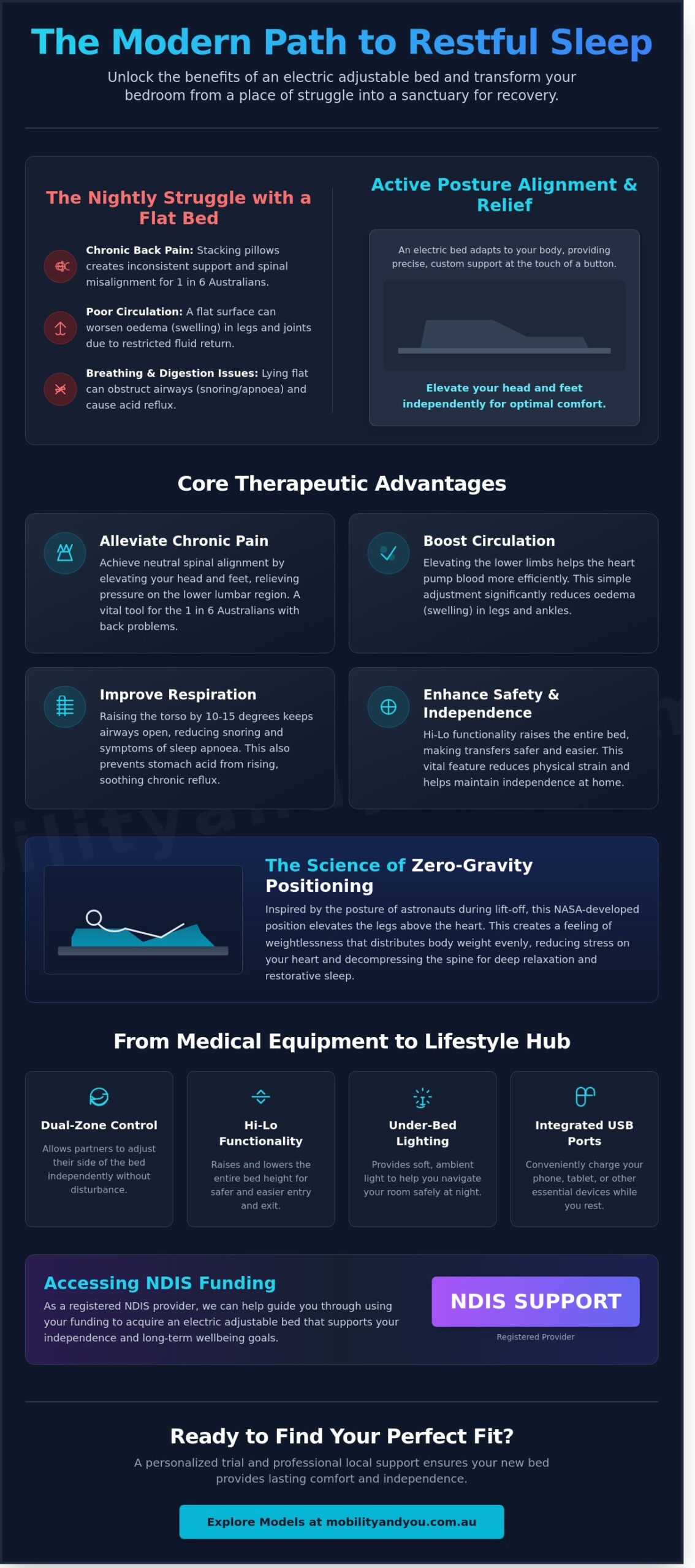
Standard bed bases offer static support, which often forces the body into unnatural positions. Many Australians attempt to find relief by stacking three or four pillows behind their neck, yet this creates inconsistent support and often leads to spinal misalignment. An electric adjustable bed provides active posture alignment. This is vital for pressure care management. It allows for the precise distribution of body weight to prevent skin breakdown and improve circulation. Choosing the right base ensures your sleep environment adapts to your physical needs rather than forcing your body to adapt to a flat, unyielding surface.
At Mobility and You, we understand that choosing the right equipment is a significant decision for your health and your home. We’re a family-owned business committed to helping you find a practical, high-quality solution that restores your freedom. Whether you’re managing a chronic condition or simply seeking a better night’s rest, we invite you to explore how these systems can support your long-term wellbeing.
Therapeutic Health Benefits: How Adjustable Positions Improve Wellness
Investing in an electric adjustable bed isn’t just about luxury; it’s a clinical decision that directly impacts your daily vitality. We’ve seen how the right sleep posture transforms recovery for our local clients. Research into Therapeutic Health Benefits shows that sleep position is a primary factor in managing chronic conditions. For the 1 in 6 Australians living with back problems, finding a neutral spinal alignment reduces the mechanical stress on vertebrae. By elevating the head or feet, we can alleviate pressure on the lower lumbar, providing relief that a flat mattress simply can’t offer.
Circulation also improves when you use adjustable features. Elevating the lower limbs helps the heart pump blood more efficiently and reduces oedema, which is common in those with restricted mobility. If you struggle with snoring or obstructive sleep apnoea, raising the torso by just 10 to 15 degrees keeps airways open. This simple adjustment also prevents stomach acid from rising, offering a non-invasive solution for chronic reflux. We focus on these practical outcomes to ensure our community members maintain their dignity and physical freedom at home.
The Science of Zero Gravity Positioning
This NASA-inspired setting mimics the posture astronauts assume during lift-off to distribute force across the body. Zero Gravity is a position where the legs are elevated above the heart level to neutralise gravity. By reaching this state, you reduce the workload on your heart and minimise the compression of your spinal discs. It’s an effective way to achieve a feeling of weightlessness that relaxes the muscles and encourages deeper, restorative sleep cycles. Our team recommends this position for anyone looking to decompress after a long day of physical activity.
Relief for Specific Medical Conditions
For the 3.6 million Australians living with arthritis, finding a “pain-free” angle is essential for rest. Adjusting your electric adjustable bed allows you to shift weight away from inflamed joints, reducing morning stiffness. We often assist clients during post-surgery recovery, where controlled elevation is critical to prevent blood clots and manage swelling. If you’re navigating these challenges, you can explore our range to find a setup that suits your specific rehabilitation needs. Maintaining an upright position is also a clinical recommendation for those with chronic respiratory issues, as it allows for better lung expansion and easier breathing throughout the night.
Key Features and Technology: Navigating Your Options
Selecting an electric adjustable bed requires a look at the engineering under the frame. We find that understanding the internal mechanics helps our clients make choices that truly enhance their independence. The motor configuration is the heart of the system. Single-motor units usually adjust only the head or the feet, while dual-motor systems allow independent movement for both ends of the mattress. For those requiring precise support, quad-motor technology adds adjustments for the lumbar region and head tilt, providing targeted relief for chronic spinal issues.
Our team often recommends massage functions for more than just luxury. These vibration settings stimulate blood flow and help relax tight muscles before sleep. Safety remains our priority in every product we stock. High-quality frames include 24-volt battery backups and emergency lowering systems. These ensure you aren’t stuck in an elevated position during a power outage. Pinch-point protection is another critical feature, preventing injuries to fingers or pets during frame movement.
Hi-Lo Beds: Essential for High-Care Needs
Vertical lift technology distinguishes a Hi-Lo bed from a standard lifestyle base. These beds move straight up and down, which is vital for safe transfers from a wheelchair or walker. For caregivers, raising the bed to waist height reduces the risk of back strain during daily care tasks. If you’re recovering from surgery or a temporary injury, our equipment hire services provide access to these clinical-grade features without a long-term commitment. This adjustability is a proven factor in preventing falls for users with limited leg strength.
Split King and Dual Adjustability
Sharing a bed shouldn’t mean compromising on comfort. Split King configurations use two separate mattresses on two independent bases housed within a single frame. This setup solves the common dilemma for couples by allowing one person to sleep flat while the other remains elevated for respiratory support or acid reflux management. We offer a choice between wired remotes, which stay attached and are easy to find, or wireless systems that offer a cleaner look. These individual controls ensure both partners receive the specific health support they need without disturbing each other’s rest. It’s about maintaining your lifestyle while addressing your unique physical requirements.
Planning Your Purchase: Sizes, Mattresses, and NDIS Funding
Selecting an electric adjustable bed requires a balance of technical specifications and personal comfort. Our team wants to make sure your choice supports your long-term health and fits perfectly within your home. In Australia, the most common sizes for individual sleepers are the Long Single and the King Single. A Long Single measures 92cm by 203cm, which is exactly half the size of a standard King. This makes it the go-to choice for couples who want separate control while sleeping side-by-side. If you need more room to move, a King Single provides an extra 15cm of width, measuring 107cm by 203cm. This extra space is often vital for those who need to change positions frequently during the night.
NDIS and Funding for Adjustable Beds
Accessing support through government schemes requires specific steps. To secure funding through the NDIS or My Aged Care, the equipment must meet “reasonable and necessary” standards. This means showing that the bed reduces your reliance on carers or manages a specific medical risk, such as chronic respiratory issues or restricted mobility. Our team works closely with Occupational Therapists (OTs) who provide the required clinical evidence for your plan. The OT will assess your home environment and physical needs to prescribe the right model. Review our NDIS provider information to see how we assist with these funding pathways and administrative requirements.
Choosing the Right Mattress for Adjustability
Flexibility is the most critical factor for an electric adjustable bed mattress. Traditional inner-spring mattresses often lack the “give” needed to contour with the base as it moves. Memory foam and latex are excellent choices because they bend easily without losing structural integrity. For those who worry about heat, gel-infused foam is a practical solution. These materials are designed to dissipate body heat more effectively than standard foam, often keeping the surface temperature more consistent throughout the night. Hybrid options are available, but they must feature specialized pocket springs that allow for frequent articulation. You can explore more bedding specifications in our resources section.
We also need to consider weight capacity to ensure your safety and the bed’s longevity. While many standard frames support up to 180kg, bariatric needs require specialized engineering. Bariatric adjustable beds often feature dual motors and reinforced frames to safely support users up to 300kg or more. Choosing a bed with a capacity that exceeds your weight by a safe margin helps prevent motor fatigue and ensures smooth, quiet operation for years to come. We’ll help you look at the technical data to ensure the frame and mattress combination is fit for purpose.
Finding Your Perfect Fit with Mobility and You
Choosing an electric adjustable bed is a significant decision that impacts your comfort for years to come. We believe that reading about features isn’t enough. You need to feel how the mattress supports your spine and how the motors respond to your touch. A personalized trial is essential because every body has different pressure points and mobility limitations. Our team encourages you to spend time testing different configurations to ensure the equipment truly enhances your independence. We don’t just want you to buy a bed; we want you to find a solution that restores your quality of sleep.
Our commitment to your well-being extends far beyond the initial selection. We manage the entire process, including professional delivery and full assembly in your home. Our technicians don’t just leave a box at your door. We set everything up and provide comprehensive user training for you and your carers. This ensures everyone is comfortable operating the various height and tilt functions safely. We’ve found that this hands-on instruction reduces anxiety and helps users get the most out of their new technology from the very first night.
Families often find the NDIS equipment landscape difficult to manage. As an NDIS registered provider, we act as a bridge between your clinical needs and the administrative requirements of the scheme. We assist with the detailed documentation and equipment trials necessary for capital support applications. Our staff has supported hundreds of local participants in securing the right aids, ensuring all gear meets strict Australian safety standards. We take the stress out of the paperwork so you can focus on your health.
Professional Servicing and Long-Term Support
Keeping your equipment in peak condition requires more than just careful use. Regular mechanical checks are vital to ensure the actuators and control systems remain reliable. Because we’re a locally owned and operated business, we provide ongoing support that national retailers often can’t match. If you ever need servicing and repairs, our technicians are nearby to help. We also offer equipment hire options for complementary aids like lift chairs, providing flexible solutions for your evolving home care needs.
Experience the Difference in Person
Nothing replaces the experience of a showroom visit. It’s the only way to compare different motor speeds and mattress firmness levels side by side. Some individuals require a faster lift for easier transfers, while others need the slow, gentle movement of a premium electric adjustable bed to manage vertigo or chronic pain. Our compassionate team is here to help match specific technology to your physical needs without any high-pressure sales tactics. We treat every client with the dignity they deserve. Explore our range of electric adjustable beds today and take the first step toward a better night’s rest.
Take the Next Step Toward Better Sleep and Independence
Choosing an electric adjustable bed is a significant move toward reclaiming your comfort and autonomy. These systems offer vital health benefits by improving circulation and providing targeted pressure care for those managing long-term health conditions. Since 2016, our family-owned and operated team has focused on delivering these practical solutions to the Australian community with a personal touch. We understand that navigating mobility needs can feel overwhelming, so we provide clear guidance as a registered NDIS provider to ensure you access the support you’re entitled to.
Explore our range of Electric Adjustable Beds
Frequently Asked Questions
Does NDIS cover the cost of an electric adjustable bed?
Yes, the NDIS can cover the cost of an electric adjustable bed if it’s deemed a reasonable and necessary support for your specific needs. As an NDIS registered provider, we’ve helped many participants access funding under the Assistive Technology or Capital Support categories. You’ll generally need a recommendation from an Occupational Therapist who identifies how the bed supports your independence and mobility goals. We’ll work with your support team to ensure the equipment meets every health requirement.
Can I use my existing mattress on an adjustable bed base?
You can only use your existing mattress if it’s specifically designed to bend and flex without damaging its internal structure. Traditional innerspring mattresses often lack the flexibility required for an electric adjustable bed and may suffer from spring failure or permanent bowing. We recommend using high-quality foam, latex, or specialized pocket spring mattresses. These materials are engineered to contour to the base’s movements, ensuring you maintain proper pressure care and support throughout the night.
What is the best sleeping position for lower back pain?
The Zero Gravity position is widely considered the most effective setting for relieving lower back pain. By elevating your head and knees slightly above your heart, you create a 120 degree angle that neutralizes the spine and reduces pressure on the lumbar region. This position mimics the natural curvature of your back, which helps relax surrounding muscles. Our clients often find that even a small 15 degree incline provides significant relief from chronic spinal tension and discomfort.
How long do the motors in an electric bed typically last?
High-quality electric bed motors are designed to last between 10 and 15 years with regular domestic use. Most reputable manufacturers provide warranties ranging from 5 to 10 years on the electrical components to ensure your peace of mind. To maximize the lifespan of your motors, it’s important to respect the weight capacity limits, which usually range from 150kg to 250kg depending on the model. Our team prioritizes stocking brands with proven durability in Australian conditions.
Are adjustable beds noisy to operate at night?
Modern adjustable beds are engineered to operate quietly, typically producing noise levels below 50 decibels. This is roughly equivalent to the sound of a quiet refrigerator or a soft whisper. You won’t have to worry about waking a partner or household members when you adjust your position at 2:00 AM. The smooth, gradual movement of the actuators ensures that transitions are seamless and discreet, maintaining a peaceful environment for everyone in the home.
What happens to the bed if there is a power outage?
Most modern electric beds include a battery backup system or an emergency lowering feature to ensure you aren’t stuck in an elevated position during a power failure. These systems usually require two 9V batteries, which provide enough temporary power to return the bed to a flat, horizontal state. It’s a vital safety feature that maintains your independence even when the local grid goes down. We’ll always show you how to access these emergency controls during the initial setup.
Is a King Single or a Long Single better for an adjustable bed?
A Long Single is often the better choice if you plan to pair it with another base to create a Split King, as it measures 92cm by 203cm. If you’re using the bed individually and prefer more room to turn, a King Single offers an extra 15cm of width at 107cm wide. Both sizes share the same 203cm length, which is essential for taller adults. Choosing the right dimensions ensures your comfort while fitting perfectly within your bedroom’s footprint.
Do adjustable beds help with snoring and sleep apnoea?
Elevating the head of your electric adjustable bed by just 7 to 10 degrees can significantly reduce snoring and the symptoms of obstructive sleep apnoea. This slight incline uses gravity to keep your airways open and prevents the soft tissues in the throat from collapsing. Research suggests that sleeping at an angle can improve oxygen flow and reduce the frequency of breathing interruptions. It’s a simple, non-invasive way to improve sleep quality for both you and your partner.