Imagine you’re halfway through a morning trip to your local park when your scooter suddenly loses power, leaving you stranded far from home. It’s a stressful situation that many of the 175,000 Australians who rely on mobility devices fear every time they head out. We understand that your independence is tied directly to the reliability of your mobility scooter batteries, and the confusion over AGM versus Gel chemistries can often feel overwhelming. You deserve to feel confident that your equipment will get you where you need to go without the worry of an unexpected breakdown or the high cost of frequent, avoidable replacements.
Our team at Mobility and You is here to support you with practical, expert advice to ensure you get the most out of your investment. We’ll show you exactly how to extend your battery life by up to 25 percent through proper charging cycles and storage habits. We’ll also help you identify the specific signs that it’s time for a replacement so you can maintain your freedom safely. From understanding NDIS funding options for maintenance to choosing the right power source for your specific model, this guide provides the clear, professional path to a more reliable daily journey.
Key Takeaways
- Understand why specific deep-cycle technology is essential for your safety and how it differs from standard automotive power.
- Master the “8-hour rule” and other simple charging techniques to maximize the lifespan and performance of your mobility scooter batteries.
- Compare AGM, Gel, and Lithium chemistries to find the ideal balance of weight and power for your lifestyle and specific scooter model.
- Learn to recognise the subtle warning signs of battery decline to protect your scooter’s motor and avoid an unexpected loss of independence.
- Discover how our team supports your journey through professional fitting, responsible disposal, and navigating NDIS funding for your equipment.
Understanding Mobility Scooter Batteries: Types and Technology
The battery serves as the heart of your equipment, providing the essential energy needed to maintain your daily rhythm and social connections. We understand that for our clients in Brisbane and across South East Queensland, a reliable power source is about more than just movement; it’s about the dignity of choice and the peace of mind that comes with knowing you won’t be left stranded. As specialists like UK Mobility Batteries highlight, unlike standard automotive batteries designed to provide a high-cranking burst of power to start an engine, mobility scooter batteries utilize deep-cycle technology. This allows them to provide a steady, consistent flow of electricity over several hours, ensuring the sensitive electronic controllers remain stable and safe during operation.
Choosing the right power profile is a technical decision that our team approaches with clinical precision. Because a mobility scooter is often used indoors and stored in living areas, the safety of the battery chemistry is paramount. We prioritize sealed designs that eliminate the risk of acid leaks or toxic fumes. To better understand how these components support your lifestyle, you can explore Your Ultimate Guide to Mobility Scooters in Brisbane for a broader look at local mobility solutions.
SLA (Sealed Lead Acid) and AGM Batteries
Absorbed Glass Mat (AGM) technology is the most common choice for standard daily use. In these units, the electrolyte is held in highly porous glass fiber mats, which makes them completely spill-proof and maintenance-free. They’re an exceptionally cost-effective solution for users who stick to paved footpaths and flat shopping centers. While they’re heavier than newer alternatives, their reliability in temperate Australian climates makes them a staple for many households. If you’re using a portable or boot-scooter, we’ll often look at the total weight of these batteries to ensure the lifting requirements remain manageable for you or your carer.
Gel Batteries for Heavy-Duty Use
For clients who enjoy exploring local parks or require all-terrain performance, Gel batteries offer a robust step up in durability. These batteries use a thickened, silica-based gel electrolyte that is incredibly resistant to deep discharge damage. They typically survive more charge-discharge cycles than standard AGM options, often lasting 20 percent longer in high-demand environments. We recommend Gel technology for larger, bariatric, or outdoor scooters because they handle the vibration and incline stress of uneven Australian terrain without losing capacity prematurely.
The Rise of Lithium Mobility Batteries
Lithium-ion technology has transformed the industry, particularly for those using folding invalid scooters. The primary benefit is the weight-to-power ratio; a lithium battery can weigh up to 70 percent less than a lead-acid equivalent while providing the same range. They charge significantly faster, often reaching full capacity in half the time of traditional units. While the initial investment in A$ is higher, the long-term value is clear. A high-quality lithium battery can handle between 1,000 and 2,000 cycles, whereas lead-acid types may need replacement after 300 to 500 cycles, making lithium a smarter financial choice over a three-year period.
The Ultimate Charging Guide: How to Extend Battery Life
We understand that your mobility scooter is more than just a piece of equipment; it’s your connection to the community and your ticket to independence. To keep your mobility scooter batteries performing at their peak, we recommend following the “8-hour rule.” This means charging your scooter for at least 8 hours after every day of use, even if you only went for a short trip to the local shops. Unlike older battery types, the lead-acid or gel cells in your scooter thrive when they’re kept at a high voltage level.
It’s a common mistake to wait until the battery gauge is in the red before plugging it in. In reality, consistently running your battery to empty can reduce its total lifespan by up to 45%. We suggest “topping up” the charge every evening. This habit keeps the battery chemistry stable and ensures you’re never left stranded during an afternoon outing. Our local Australian climate also plays a significant role in battery health. In many regions, summer temperatures frequently climb above 35°C. High heat accelerates internal chemical reactions, which can lead to premature degradation. We always advise charging your scooter in the coolest, shaded part of your home to protect the internal cells from heat stress.
Step-by-Step Charging Protocol
Establishing a consistent routine helps prevent accidental damage and ensures a reliable charge every time. Our team suggests this simple process to keep your mobility aids in top condition:
- Turn the scooter power off and remove the key to stop any power draw.
- Ensure the charger plug is firmly seated in the charging port before you turn on the wall switch.
- Charge in a well-ventilated, dry area away from direct sunlight or damp conditions.
- Leave the charger connected until the indicator light confirms a “full” status, as interrupting the cycle can lead to reduced capacity.
- Always use the manufacturer-approved charger, as third-party units often have incorrect voltage outputs that can cause cell damage.
Common Charging Mistakes to Avoid
One of the most dangerous errors is using a standard car battery charger. These units deliver power at a high amperage that can warp the plates inside mobility scooter batteries, rendering them useless in a single session. You should also be mindful of “phantom loads,” which are small electrical draws from display panels or accessories that continue to drain power while the scooter is idle. If a battery is left in a flat state for more than 14 days, the internal chemistry can crystallise, a process that usually prevents the battery from ever holding a charge again. When your batteries eventually reach the end of their functional life, following EPA battery disposal guidelines ensures that lead and other heavy metals are recycled responsibly.
If you’re noticing that your scooter doesn’t have the range it once did, it might be time for a professional diagnostic. We provide professional mobility equipment servicing to test your battery health and ensure your electrical systems are safe. You can always contact our team for expert advice on maintaining your mobility and freedom.
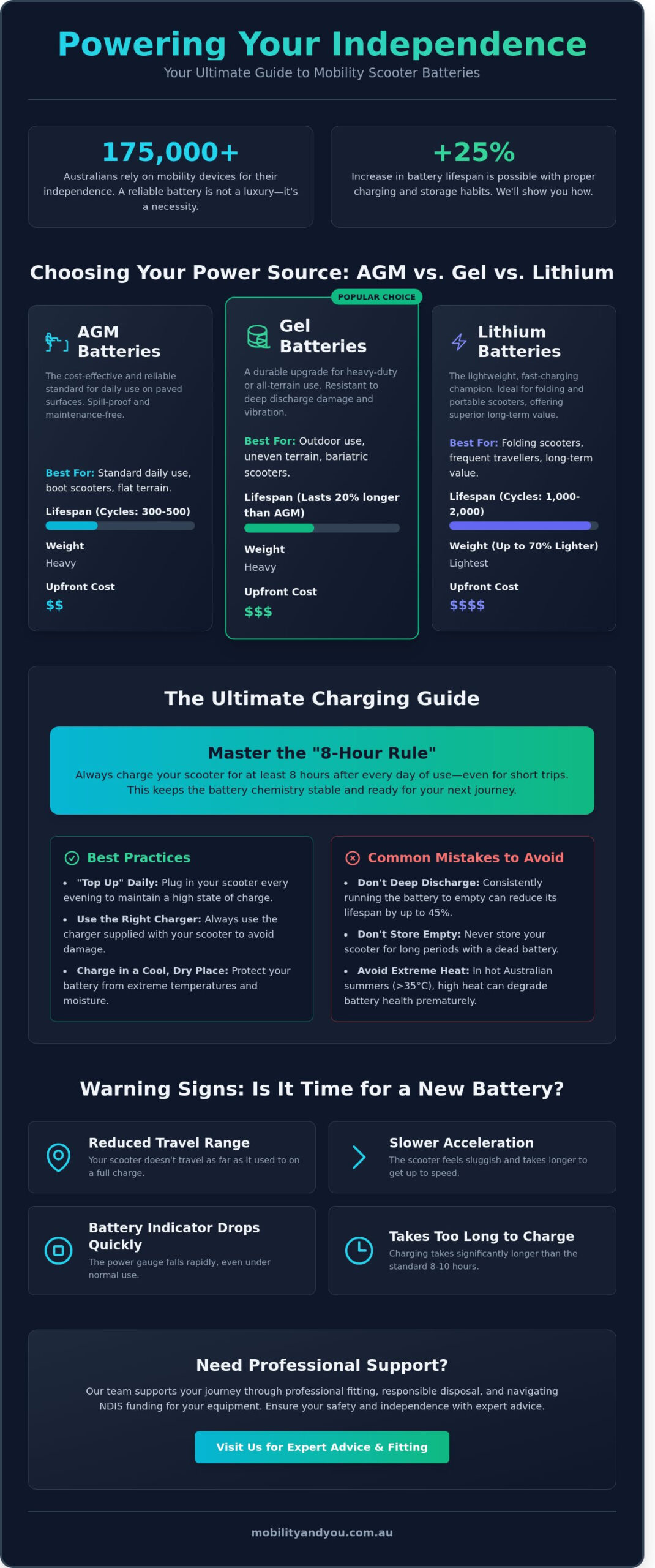
Choosing Your Next Battery: AGM vs. Gel vs. Lithium
Selecting the right power source for your mobility scooter is a vital step in maintaining your independence. At Mobility and You, we understand that every client has unique requirements, whether you’re navigating local shopping centres or exploring hilly coastal paths. Selecting the ideal mobility scooter batteries involves balancing your daily travel habits with the specific technical requirements of your equipment. We want to ensure you feel confident and supported in making a choice that enhances your quality of life.
Performance Comparison Framework
- AGM (Absorbent Glass Mat): These are often the standard choice for budget-conscious users. They perform reliably for light daily needs and are completely spill-proof, making them safe for general use and transport.
- Gel: If you use your scooter frequently or live in an area with steep inclines, Gel batteries offer superior deep-cycle performance. They typically handle 20 percent more discharge cycles than standard AGM models, providing better longevity for heavy users.
- Lithium: These are the gold standard for active travelers. Lithium batteries can be up to 70 percent lighter than lead-acid alternatives. This is a significant factor if you or a carer frequently load a portable scooter into a car boot.
Understanding Battery Specifications (Ah and Voltage)
Amp-hours (Ah) essentially represent the size of your “fuel tank.” A 12Ah battery might suit a small, portable boot scooter, whereas a 75Ah battery is designed for heavy-duty, long-distance models. Our team recommends calculating your longest typical trip and adding a 25 percent safety margin to determine your required Ah. This ensures you never feel stranded or anxious about your remaining charge.
Most Australian mobility scooters operate on a 24V system. This is almost always achieved by connecting two 12V batteries in series. It’s essential to replace both batteries at the same time. If you mix an old battery with a new one, the older unit will pull down the performance of the new one, leading to premature failure and wasted investment. We always suggest checking your scooter’s manual to verify compatibility with the motor and controller before upgrading to a different chemistry, especially when moving to lithium.
Weight limits are another critical consideration for your mobility scooter batteries. The total weight of the battery pack affects the scooter’s centre of gravity and its maximum carrying capacity. If you’re an NDIS participant looking for a solution that balances power with ease of handling, we’re here to help you navigate those technical specifications. You can browse our range of mobility equipment to see which battery configurations best suit our various scooter models. If you’re also considering a new device altogether, our complete guide to mobility scooters for sale in Brisbane covers how to match the right model to your lifestyle, funding options, and long-term maintenance needs. As a locally owned family business, we take pride in helping you find the exact fit for your lifestyle and physical needs.
When to Replace Your Mobility Scooter Batteries
We understand that your scooter is more than just a piece of equipment; it’s your bridge to the community and your daily independence. Because mobility scooter batteries are consumable components, they eventually reach a point where they can no longer support your lifestyle. In Australia, most Gel or AGM batteries provide peak performance for 12 to 24 months, though this varies based on your terrain and how often you’re out and about. Using a battery past its prime does more than just shorten your trips. It forces the motor to work harder to compensate for low voltage, which can lead to overheating and costly damage to the scooter’s internal controller.
Safety is our primary concern for every client we serve. If you notice the battery casing looks “bloated” or has a rounded, swollen appearance, it’s a sign of internal gassing or overheating. This is a serious safety risk that requires immediate attention. Similarly, any white, powdery residue around the terminals indicates acid leakage or heavy corrosion. These issues can damage the wiring loom of your scooter and, in rare cases, pose a fire risk. You can explore our mobility resources to learn more about identifying equipment wear and tear before it becomes a hazard.
Five Signs Your Battery is Failing
- Decreased Range: You find yourself needing to charge the unit after a trip to the local shops that used to only use a fraction of the power.
- Struggling on Inclines: The scooter feels sluggish or “laboured” when climbing standard 1:14 Australian access ramps.
- Unstable Battery Gauge: The needle or digital bar drops significantly into the red zone when you pull the throttle, even if it showed “full” while stationary.
- Slow Acceleration: There is a noticeable delay or a “soft” feeling when you try to move from a complete stop.
- Extended Charging: The charger stays on the “bulk” or “charging” phase for more than 10 hours without switching to the green “float” light.
Testing Your Battery Performance
You can perform a simple “load test” at home by observing your battery meter while driving on a flat, paved surface. If the meter drops by more than two bars during steady acceleration, the cells are likely losing their ability to hold a charge. However, it’s easy to confuse a faulty charger with a failing battery. If your charger indicates a full charge within 30 minutes of use, it often means the mobility scooter batteries have developed high internal resistance and can no longer accept a deep charge. Our team recommends a professional diagnostic capacity test every 12 months. This technical check measures the exact amp-hour output to ensure you won’t be left stranded away from home.
Don’t let a fading battery limit your freedom or damage your scooter’s motor. Book a professional battery health check with our friendly technicians to ensure your equipment is ready for your next outing.
Professional Support and NDIS Funding for Batteries
Choosing the right mobility scooter batteries is only half the battle. Professional installation ensures that every connection is secure and free from corrosion, which prevents unexpected power drops. Our specialist team verifies that your existing charger’s output voltage and chemistry settings align perfectly with your new power cells. This precision protects your investment and prevents premature cell failure. We also manage the responsible disposal of old lead-acid or gel units through accredited Australian recycling programs. This keeps hazardous materials out of our local landfills and ensures heavy metals are reclaimed safely. Most major manufacturers require authorised technicians to perform these replacements to keep your product warranty valid. Contact our team for expert advice on scheduling your next battery diagnostic or fitting.
Accessing Batteries Through the NDIS
The NDIS generally classifies battery replacements under the Assistive Technology budget. If your scooter is essential for your daily goals, the cost of maintenance usually falls under the Capital Support or Core Support categories. We’re an NDIS registered provider and we understand the specific documentation required by the Agency. Our team provides detailed, formal quotes that include the battery specifications and professional fitting fees. You can submit these documents directly to your plan manager or through the MyPlace portal to secure funding. We’ll help you track when your next replacement is due so you’re never left without a reliable way to get around your community.
Our Commitment to Your Independence
We only stock high-quality, reliable brands because we know a battery failure is more than a technical glitch. It’s a loss of freedom. As a family-owned business, we prioritise long-term reliability over quick sales. We’ve seen that regular maintenance checks can extend the life of mobility scooter batteries by up to 25 percent, which provides significant savings over the life of your equipment. Our technicians take the time to explain your battery’s health after every service. We want you to feel confident every time you leave your home. You can read more about our family-owned approach and our dedication to supporting the dignity of every client we serve. We’re here to ensure your mobility remains consistent, safe, and stress-free.
Keep Your Independence Moving Forward
Maintaining your freedom starts with understanding the technology that powers your daily life. Whether you’ve opted for the durability of Gel cells or the lightweight efficiency of Lithium, consistent charging habits are the key to longevity. Industry data suggests that well-maintained mobility scooter batteries typically provide reliable service for 12 to 18 months before a replacement is required. As an NDIS Registered Provider, we understand the importance of having a dependable ride for every community outing. Our specialist servicing and repair team brings technical expertise to every health check, ensuring your equipment meets rigorous safety standards.
We’re proud to be a locally owned family business that supplies leading high-performance battery brands to our Australian community. Our team focuses on reducing the stress of technical maintenance so you can focus on the activities you love. If you’ve noticed a decrease in your travel range or your charger is showing unusual signals, it’s time to speak with our experts. Book a battery health check or find your replacement today and enjoy the peace of mind that comes with professional support. We’re ready to help you stay mobile and connected to your world.
Frequently Asked Questions
How long should mobility scooter batteries last?
Most mobility scooter batteries last between 12 and 18 months if you use your scooter daily. For those who only use their device once or twice a week, the lifespan can extend to 3 years. We recommend checking your battery health during an annual service to ensure you maintain your independence and safety while out in the community.
Can I upgrade my scooter from AGM to Lithium batteries?
You can often upgrade to lithium, but it requires a specialized lithium-compatible charger and a check of your scooter’s controller. Lithium batteries provide up to 2,000 charging cycles compared to the 300 to 500 cycles found in standard AGM models. Our team at Mobility and You can assess your specific model to see if this conversion is a safe and practical solution for your lifestyle needs.
Should I leave my mobility scooter on charge all the time?
You should leave your scooter on charge whenever it’s not in use, as modern smart chargers automatically stop once the battery reaches 100 percent capacity. This practice prevents the voltage from dropping to a level that causes permanent internal damage. Our experts suggest plugging in your charger every night to ensure your mobility scooter batteries are always ready for your next outing.
What happens if I don’t use my scooter for a long period?
Batteries will naturally self-discharge at a rate of 3 to 5 percent per month if left disconnected. If the charge level falls below 10.5 volts per battery, lead sulfate crystals form on the plates, which permanently reduces the capacity. To protect your investment, we recommend charging the batteries for 8 to 12 hours at least once every 30 days during periods of inactivity.
Is it okay to replace just one battery instead of the pair?
You must always replace mobility scooter batteries in pairs to ensure they have matching resistance levels and charge capacities. Installing a new battery alongside an old one causes the older unit to pull power from the new one, which can reduce the lifespan of your new purchase by 50 percent within a few months. This balanced approach ensures your scooter remains reliable for your daily travel.
Does the NDIS pay for mobility scooter battery replacements?
The NDIS typically covers the cost of battery replacements if the scooter is listed as an approved item in your plan under the Assistive Technology budget. Specifically, funding for repairs and maintenance is usually found in the Core or Capital supports sections. As an NDIS registered provider, we can help you navigate the process of using your funding to keep your equipment in top condition.
How much does it cost to replace mobility scooter batteries in Australia?
Replacement costs in Australia depend on the battery size, with 12Ah batteries for portable scooters sitting at a different price point than 75Ah batteries for large, all-terrain models. Prices also vary between standard AGM and premium Gel or Lithium options. We provide detailed quotes based on your specific scooter model to ensure you receive the correct technical specifications for your mobility needs. If you’re also evaluating whether it’s time to invest in a new device, our 2026 buyer’s guide to mobility scooters for sale in Brisbane can help you compare models, understand NDIS funding pathways, and make a confident, informed decision.
How do I dispose of my old mobility scooter batteries safely?
You should take your old lead-acid or lithium batteries to a designated recycling center or a local specialist like Mobility and You for safe disposal. Since 98 percent of a lead-acid battery is recyclable, proper disposal prevents toxic chemicals from entering Australian landfills. Many local councils also offer free drop-off points through the B-cycle scheme to support environmental health and community safety.